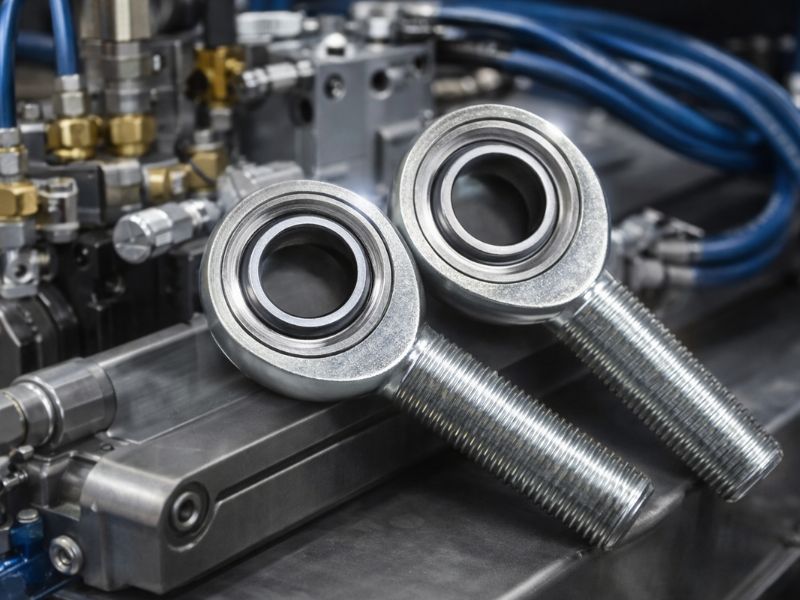
The decision to switch from conventional greased rod ends to self-lubricating alternatives in hydraulic systems addresses specific operational realities that grease-lubricated components cannot adequately solve. Self-lubricating rod ends suit joints where access, contamination, or duty cycle makes regular greasing impractical.
This article examines when self-lubricating rod ends deliver measurable value, where they fail, and what actual operating conditions should drive your selection process.
Understanding Self-Lubricating Rod End Technology
A self-lubricating rod end incorporates a PTFE (polytetrafluoroethylene) or PTFE composite liner set between the ball and the housing. The liner runs dry against the ball, wears as the joint moves, and does not regenerate; it has a finite service life determined by material thickness and operating conditions.
The construction differs fundamentally from greased bearings. Self-lubricating designs need no grease fitting, and they run with less play than a metal-to-metal joint. A PTFE liner replaces the metal race surface, so the joint has its own limits on load, temperature and contamination. For the short definition, see maintenance-free rod end.
Wear Limits and Replacement Criteria
Replace the joint when radial play reaches about 0.1 mm (0.004 in) or the liner shows visible wear. Service life depends on load, speed, contamination exposure, and misalignment.
When Maintenance-Free Rod Ends Actually Make Sense
Remote or Difficult-Access Locations
Hydraulic cylinders on booms, long spray arms or subsea actuators are hard to reach for relubrication, and a maintenance-free joint removes that visit.
In these applications, maintenance-free rod ends eliminate scheduled lubrication. As a rule of thumb, the case for maintenance-free is strong when reaching the joint costs several times the part price. Where the joint is easy to reach and regreasing fits the maintenance schedule, a greased joint stays the simpler choice.
Contaminated Operating Environments
Most hydraulic rod ends are replaced because of corrosion or play. In dusty sites such as grain handling, mining and cement, grease makes this worse, because excess grease collects dust and abrasive particles.
PTFE-lined bearings run with less play than greased equivalents, but a tight fit alone does not keep dust out of the sliding surface.
Protection Requirements: A dust boot or sealed version helps keep dust out of the sliding surface. Sealing does not make the joint immune to every environment, so abrasive slurry and high-pressure washing need a separate check.
In salt spray, 316L resists chloride pitting better than 304, and a PTFE-lined joint has no grease fitting to maintain.
High-Frequency Cycling Applications
Where a joint cycles continuously, a regreasing schedule costs labor at every joint, and a PTFE-lined joint removes that schedule.
Packaging machinery and automated motion controls are typical uses for the PTFE-lined JMX/JFX series.
When a maintenance-free joint is worth considering
- Duty cycle is continuous, with little downtime for servicing
- Maintenance access requires equipment shutdown or special procedures
- Environment includes abrasive dust, chemical exposure, or saltwater
Meeting these conditions is when a maintenance-free joint is worth considering.
Performance Characteristics That Matter
Load Capacity Limitations
Load capacity depends on the liner construction and the housing material. Profab does not publish one static rating per series, so send the load with the quote request.
Choose the series from the real load, not from the thread size alone.
Heavy shock loading is the case for a metal-to-metal joint. Profab's CM/CF series is commonly specified for agricultural arms and press linkages under shock loading, and its metal-to-metal joint handles high static loads and frequent impact loads.
Temperature Operating Range
Temperature limits depend on the liner and on the bonding agent that holds it. The bonding agent degrades before the PTFE does, typically above 150°C, so hot cycles near that level shorten liner life. Send the working temperature with the inquiry.
Ask for the liner type and its temperature limit before ordering, because liner constructions differ.
Near exhaust manifolds or furnaces, include the heat transferred from adjacent components when you work out the working temperature.
Oscillation Speed Constraints
Sliding friction generates heat, and repeated motion influences wear. Record the oscillation angle, frequency, stroke and speed before you choose a liner.
Ask the liner maker for the PV limit of the liner you plan to use. Load, speed, oscillation angle, temperature and contamination all influence bearing life.
Material Selection for Hydraulic Applications
Stainless Steel Construction Benefits
Corrosion resistance represents the primary driver for stainless steel rod end selection. Grade 304 stainless provides adequate corrosion protection for indoor industrial environments and mild outdoor exposure. Marine applications, chemical processing, or saltwater exposure require 316 or 316L stainless steel. When sourcing components for demanding applications, working with an experienced maintenance-free rod ends supplier helps match the grade and series to the application.
Stainless costs more than carbon steel, so the grade should match the exposure. The wrong grade is a common reason rod ends fail early in corrosive environments.
17-4PH is the precipitation-hardened option. After H900 heat treatment its tensile strength reaches about 1,310 MPa, which suits high-cycle and high-load linkages.
PTFE Liner Variations
Liner construction varies. Some liners use a bronze wire structure impregnated with PTFE, and others use a PTFE braided fabric.
Ask for the liner type, its temperature limit and its load limit with the quote request.
Spherical Bearing Integration
Hydraulic cylinder rod end joints must accommodate misalignment from mounting flex, thermal expansion, and structural deflection. Angular travel depends on the series and size. Profab's JMX/JFX table lists 6.5 to 17 degrees, and standard stainless rod ends allow about 10 to 15 degrees.
Ball Surface Requirements: For PTFE transfer film formation to function properly, the mating ball surface must achieve Ra 0.2 μm (8 μin) or better. Rougher surfaces prevent uniform film development and accelerate liner wear. The ball material must be hardened to minimum 58 HRC to resist embedment of abrasive particles that would damage the PTFE liner.
The spherical geometry combined with PTFE lining creates a self-lubricating articulating joint. Mobile equipment needs this capability because cylinder mounting points move relative to each other during operation.
Where Self-Lubricating Rod Ends Fail
Undersizing and Point Loading
Size the joint from the actual load, not from the thread size alone.
Misalignment beyond the design angle shortens joint life, because a joint held at its limit binds and carries side load. Check the alignment during installation.
Edge Loading from Excessive Misalignment
If the housing touches the bracket, the joint has run out of travel. A high-misalignment spacer adds travel where the housing would otherwise touch the bracket.
Applications with large deflections or mounting flex must account for the maximum misalignment in the worst case, not the nominal case.
Design Verification: Calculate maximum angular displacement including thermal expansion, structural deflection, and dynamic loading. Ensure the selected rod end’s angular capacity exceeds this maximum by a safety factor of 1.5-2.0.
Improper Installation Torque
Apply torque at the wrench flats, not at the bearing housing, and do not over-tighten, because excessive tightening can distort the body or change the internal bearing fit.
Stainless threads can gall, so ask for a suitable thread fit, finish and lubricant when you order.
Grease Contamination
Do not add grease to a self-lubricating rod end by habit. For PTFE fabric and sintered bronze liners the maker does not recommend lubricant, and extra grease can attract contaminants or interfere with the intended friction pair. Some fibre-reinforced liners are the exception, so follow the maker's guidance.
Mark maintenance-free joints in the service documents so crews do not grease them.
Industry-Specific Applications
Industrial Hydraulic Systems
General factory floor applications present diverse requirements. For a heavily loaded pivot that can be greased on a schedule, the SATK/SITK series with a grease fitting is the choice. Outdoor, washdown and dirty duty points to the PTFE-lined JMX/JFX series.
The decision criterion should focus on actual operating conditions rather than assumed benefits. A proper specification includes environment description, duty cycle, load profile, and maintenance access constraints.
Agricultural Machinery
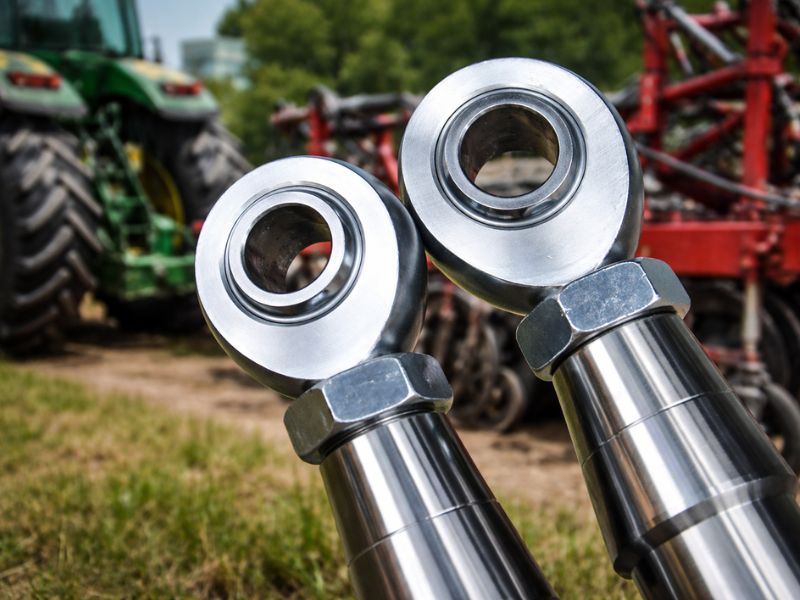
Implement linkages, spray boom pivots, and tillage equipment subject rod ends to high contamination loads combined with outdoor exposure. Maintenance-free rod ends reduce service requirements during busy planting and harvest periods when downtime costs peak.
Where field shock loads are heavy, Profab's metal-to-metal CM/CF series is commonly specified for agricultural arms under shock loading.
Material Handling Systems
Conveyor mechanisms, automated guided vehicles, and sortation equipment cycle continuously through defined motions. The repetitive nature creates ideal conditions for maintenance-free designs. Scheduled lubrication across the many joints of a machine adds up to significant labor.
On food and packaging lines, excess grease can contaminate nearby products, so a PTFE-lined joint with no grease point is easier to keep clean.
Marine Applications
Saltwater exposure accelerates corrosion of threaded fasteners, bearing surfaces, and mounting hardware. 316 stainless steel construction combined with PTFE liners addresses both corrosion and lubrication requirements.
Marine actuator rod ends take continuous salt spray and vibration in steering and trim systems, where a seized joint is a safety issue.
Making the Right Selection Decision
The choice between maintenance-free and conventional rod ends should follow from analysis of actual operating conditions. Consider these decision factors:
Access and Labor Cost: If reaching the joint means stopping the machine or repositioning equipment, a maintenance-free joint is worth considering.
Operating Environment: Contamination from dust, moisture, or corrosive elements favors PTFE-lined bearings. Clean indoor equipment with easy access can use a greased or metal-to-metal joint.
Load Profile: High shock loads favor a metal-to-metal joint such as the CM/CF series.
Duty Cycle: Continuous operation or high-frequency cycling makes scheduled lubrication impractical. Intermittent operation with accessible mounting permits conventional designs.
Service Life Requirements: The liner wears, so plan a replacement interval by cycle count or operating hours rather than waiting for visible failure.
The decision matrix should weight these factors according to the specific application rather than applying generic assumptions about superiority.
Conclusion
Maintenance-free rod ends solve specific problems in hydraulic systems. They do not represent universal improvements over greased bearings. The technology excels in contaminated environments, remote locations, and high-duty-cycle applications where scheduled lubrication proves impractical.
Proper application requires understanding both the capabilities and limitations. For side load, grade, and series choice on cylinder ends, see hydraulic cylinder rod ends. Load capacity, temperature range, and oscillation speed all impose constraints that must be respected in the design process. Material selection, proper installation, and appropriate environmental protection ensure the components deliver their designed service life.
Profab Machine specializes in precision-engineered stainless steel components for demanding hydraulic applications. With two decades of experience in custom fabrication and materials selection, Profab supports OEMs and maintenance operations in identifying appropriate solutions for specific operating conditions and performance requirements.