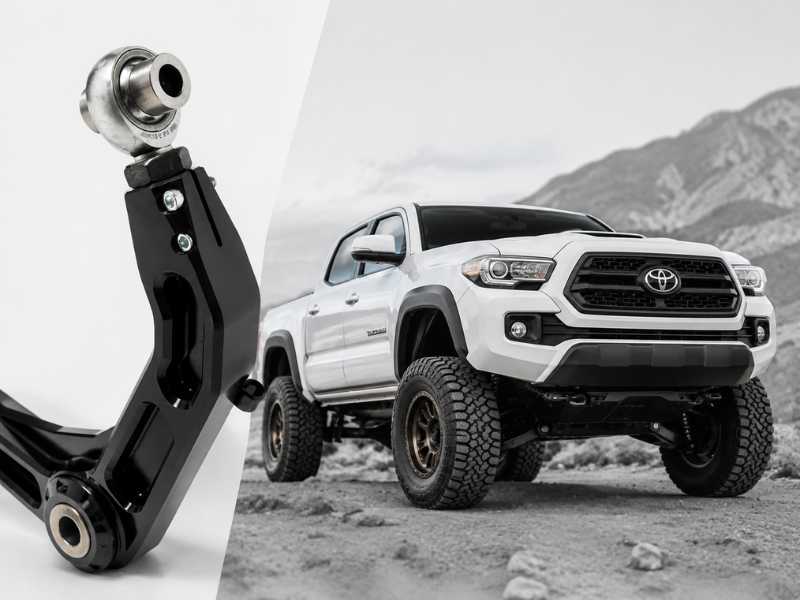
The lift goes in, the truck looks great, then you drive it on the highway and spend the whole trip fighting the wheel. Alignment shop confirms the geometry is out of spec, and they can't fix it with what's there. You need upper control arms.
This happens to every lifted Tacoma that keeps the stock UCAs. Toyota engineered the suspension geometry around a specific ride height. Add 3 inches and every angle in the front suspension shifts. Some shifts are small enough to ignore. Caster loss and camber change are not.
What Lift Does to Your Front Suspension Geometry
The Tacoma runs an independent front suspension. The upper and lower control arms, ball joints, and knuckle work as a geometric system. Toyota set the angles at the factory so that at stock ride height, the wheel sits plumb, the caster angle keeps the truck tracking straight, and the suspension can cycle through its range without binding.
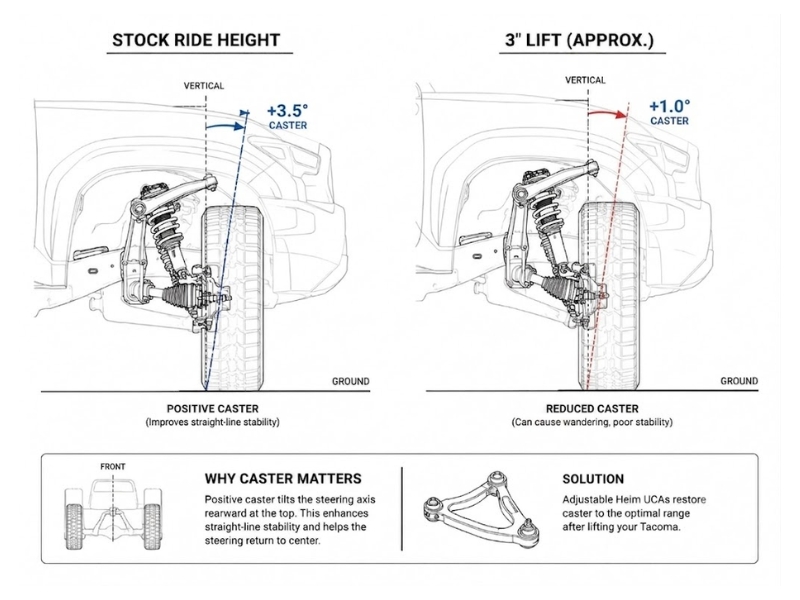
When you add a 3-inch lift, the suspension is forced down into a constant droop state, which strips away your positive caster. When an alignment tech tries to max out the factory lower cam bolts to recover that caster, it forces the lower arm into positions that push camber out of spec. You run out of adjustment range. Left uncorrected, positive camber means the outside edge of the tire carries more load than the inside and wears faster, while less caster means the truck doesn't return to center after a turn, wants to wander at highway speed, and generally feels vague.
As AccuTune Off-Road's Tacoma alignment guide explains, lifting the truck alters control arm angles in a predictable way: caster drops and positive camber increases. The factory lower control arm cam bolts can compensate for minor changes, but a 2.5-inch or 3-inch lift pushes the geometry further out than those cams can reach.
Why Rubber Bushing UCAs Only Get You Part of the Way
Most aftermarket UCAs fix this by building in a corrected geometry. The arm is longer or repositioned to add 2 to 4 degrees of positive caster and pull the top of the wheel back inward. That solves the problem for a specific lift height. Bolt on a fixed-geometry UCA designed for 3 inches of lift, run 3 inches of lift, and the geometry lands close to where it needs to be.
The issue is that no two lifted Tacomas are actually the same. One truck has a 2.5-inch lift and 33s. Another has 3 inches, 35s, and a steel bumper with a winch. A third has an overland build with a full roof rack. Ride heights vary, tire sizes vary, wheel offsets vary, and accessory weight all feed into what alignment numbers actually work. A fixed-geometry UCA optimized for one of these setups isn't optimal for the others.
There's also a second problem with rubber bushing frame mounts on UCAs. Rubber bushings tolerate a certain amount of twist and deflection before they push back. As you lift the truck further and the UCA operates at steeper angles, the bushing starts to carry a preload just from the arm position, even before any steering or suspension input. That preload limits how freely the arm pivots, adds noise, and accelerates bushing wear. It also means the actual alignment you measured at rest changes as the bushing deflects under load.
What a Heim Joint Does Differently
A heim joint at the frame mount swaps the rubber bushing for a metal ball-and-socket. The ball pivots freely in any direction, no deflection, no preload, no stored energy pulling the arm back to center. The alignment you set stays set under load, because nothing in the joint is compressing or recovering.
That's why heim joint UCAs are standard for anything running more travel or heavier loads than the factory setup handles. The tradeoff is real: metal-on-metal transmits more vibration than rubber, and the joint needs periodic inspection, especially where grit and water are part of the regular operating environment.
Why Adjustable Matters More Than Fixed
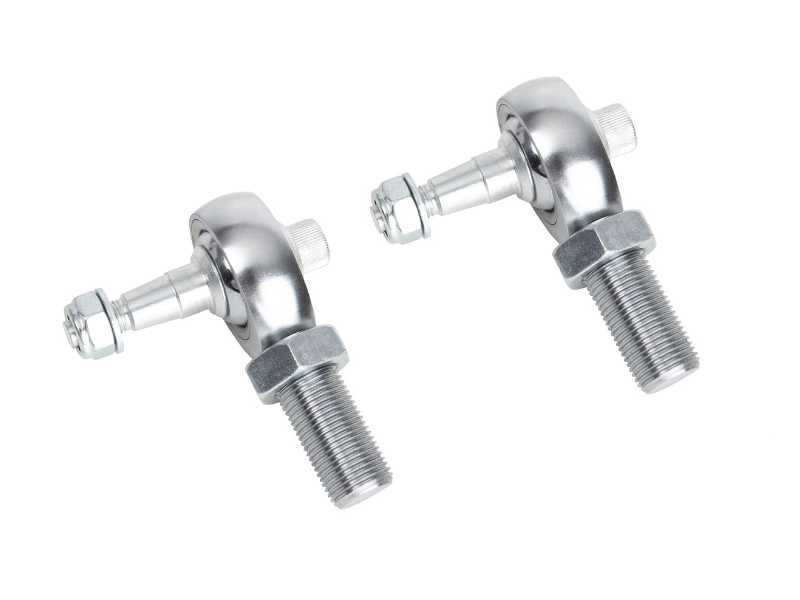
The adjustability of a true heim-based UCA comes from the threaded rod ends at the frame pivots. By adjusting the inner and outer positions of the front and rear heims independently, fabricators and alignment techs can change the arm's angle. Shortening the rear heim relative to the front moves the upper ball joint rearward, adding the positive caster needed for highway stability. Extending both heims equally primarily pushes the ball joint outward, changing camber.
Fixed-geometry aftermarket UCAs build in a set amount of correction—usually around 2 to 4 degrees. While this works for a standard setup, it fails when an overland truck carries a heavy front steel bumper, a winch, or altered ride heights. The actual geometry requirements change based on the specific load.
An adjustable stainless heim UCA means your alignment tech can dial the actual geometry to match your specific ride height, tire size, and load rather than getting as close as the fixed geometry allows and calling it done. For trucks that run different configurations seasonally, or get progressively built over time, the adjustability means the UCA doesn't become obsolete every time something else on the truck changes.
The Case for Stainless Heims in Off-Road Use
Standard heim joints in aftermarket UCAs are often chrome-moly steel. That's fine for track and race use where the car is cleaned, inspected, and rebuilt between events. Off-road Tacomas run through mud, creek crossings, and standing water, sometimes for days at a time without a proper cleanup. Carbon steel heims in that environment corrode at the contact surface between the ball and the housing, tightening the joint and eventually seizing.
A seized heim joint on a UCA frame mount means the arm is no longer pivoting freely. Instead of the suspension cycling smoothly, the joint is binding and releasing, which transmits as harshness through the chassis and puts lateral stress on the ball joint at the knuckle. You won't notice it immediately, but you will notice accelerated ball joint wear and a suspension that feels less controlled over rough terrain than it did when the heims were new.
Stainless heims resist this corrosion pattern. The contact surface stays clean and the joint stays free-moving through the range of conditions an off-road truck actually sees. For a daily driver that occasionally sees dirt, the difference isn't critical. For a truck that runs wet trails regularly, it's the difference between a joint that stays working and one that slowly degrades between builds.
What to Actually Look for When Buying
The adjustability range matters more than the maximum correction number. A UCA that claims 4 degrees of caster correction at one fixed position isn't actually adjustable. Look for arms where you can select and fine-tune the correction, not just choose between a few preset slots.
Check the heim size relative to the arm. Undersized heims on a heavy-duty arm are the failure point. For Tacoma applications, 3/4-inch heims are the functional baseline for anything doing real off-road use. Smaller heims exist but limit load capacity at the frame mount, which is exactly where the forces are highest.
Verify the heim material and sealing. A stainless heim with no seal is better than a carbon steel heim, but a stainless heim with a wiper seal that keeps grit out of the contact surface is better still. Some manufacturers use uniballs instead of standard heims at the knuckle end. These offer more angular range but require more frequent inspection. Either way, the service interval for any metal-on-metal joint in wet off-road conditions is shorter than most people expect.
Conclusion
A lifted Tacoma needs more than a fixed-geometry UCA to stay correctly aligned. Adjustable heim joints let an alignment tech dial caster and camber to the truck's actual ride height, tire size, and load, and stainless construction keeps that adjustment free-moving through the wet, gritty conditions a fixed-geometry rubber-bushed arm can't handle as well.
Profab Machine supplies stainless steel heim joints in metric and UNF thread sizes, in 304 and 316L, for fabricators building custom UCAs and suspension linkages. For non-standard bore or thread combinations, custom specifications are available.