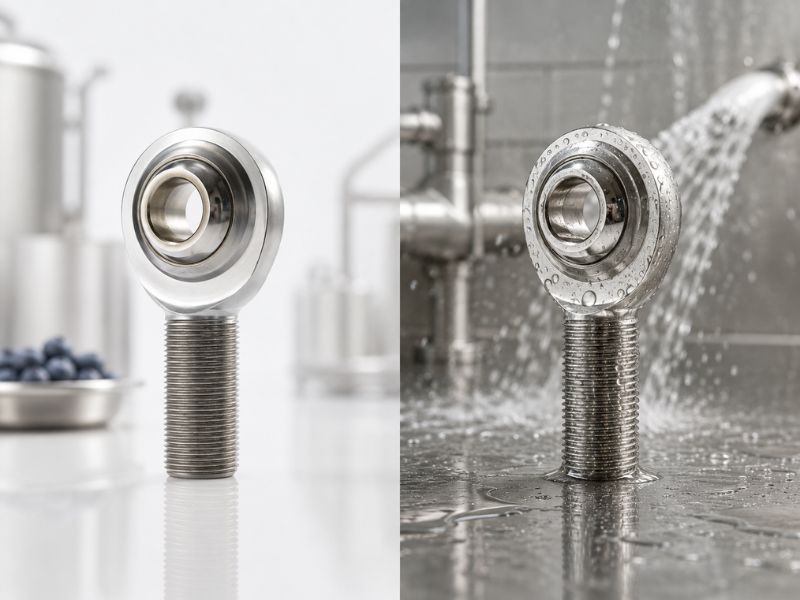
Walk through a distributor catalog and you'll find rod ends described as food grade, FDA-compliant, washdown rated, sanitary design, and hygienic series. These terms are not synonyms; they don't all describe the same thing, and using the wrong one when specifying components for a food processing facility creates either compliance gaps or unnecessary overspecification.
The confusion exists because "food grade" and "washdown rated" each describe a different attribute of the same component. A rod end can be one without the other. Understanding what each term actually covers is the starting point for selecting correctly.
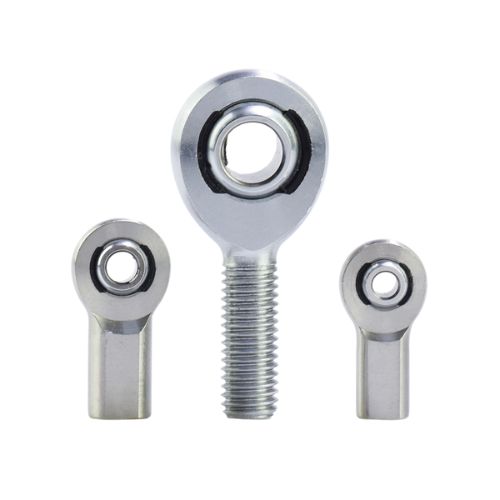
What "Food Grade" Actually Covers
"Food grade" in the context of mechanical components almost always refers to the lubricant, not the metal, the seal, or the bearing geometry.
NSF International's H1 lubricant registration is the standard that defines food-grade lubricant for incidental food contact. An H1-registered lubricant is formulated from base stocks and additives that are acceptable for use in applications where incidental contact between the lubricant and food may occur. The H1 designation covers the lubricant only.
As Vanguard Products' breakdown of NSF 51 vs. FDA explains, FDA compliance describes whether the base material formulation is permitted. It answers "can this material legally be used near food?" NSF certification tests performance in real-world conditions and confirms sanitation requirements are met. These are two different standards covering different attributes of a component.
A rod end shipped with H1-registered grease carries a food-grade lubricant. Whether the housing material, the seal material, the surface finish, and the geometry meet food safety requirements is a separate question that the H1 lubricant designation doesn't answer.
What "Washdown Rated" Actually Covers
"Washdown rated" most often refers to an IP rating: specifically the IP65, IP67, IP68, or IP69K designation from IEC 60529.
IP69K is the most stringent washdown rating and the one that matters for food processing. It requires the component to withstand high-pressure, high-temperature water spray (typically 80°C at 80–100 bar, at close range from multiple angles). A component that passes IP69K testing will not allow water ingress during the type of washdown spray used in food and beverage facilities.
An IP65 rating, by contrast, only covers protection against water jets at low pressure. Many rod ends described as "washdown rated" in general industrial catalogs carry IP65 or IP66 ratings, which are not sufficient for the high-pressure CIP washdown cycles common in poultry, dairy, and ready-to-eat food production.
The IP rating describes the seal's ability to keep water out. It says nothing about whether the housing material is corrosion-resistant, whether the lubricant is food-grade, or whether the surface geometry avoids harborage points where bacteria accumulate.
The Zone Framework: Which Spec You Need Depends on Where the Rod End Lives
Food processing facilities typically divide their production areas into zones based on food contact risk. The zone classification determines what component specifications are actually required.
Zone 1 (Direct Product Contact): Components in this high-risk area must meet strict hygienic design standards to ensure food safety:
- Food-Safe Materials: All surfaces must use FDA 21 CFR or NSF/ANSI 51 compliant materials.
- H1 Lubrication: Requires NSF H1-registered lubricants or self-lubricating PTFE liners.
- Washdown Sealing: IP69K-rated seals (such as FKM or EPDM) to withstand high-pressure CIP cleaning.
- Surface Finish: Smooth housing surfaces with a roughness of Ra ≤ 0.8 µm (32 µin).
- Hygienic Geometry: Zero exposed threads, crevices, or recesses where bacteria and residue can accumulate.
Zone 2 (splash zone, incidental contact risk): Components here are exposed to washdown spray and splashing but don't directly contact product. H1 lubricant is still required where any lubricant could migrate toward the product zone. IP69K sealing is appropriate. 316L stainless construction is the standard for housing and shank material. Surface finish requirements are less stringent than Zone 1.
Zone 3 (non-contact, enclosed areas): Standard industrial rod ends with 316L housings and food-grade lubricant may be adequate. The primary concern here is corrosion resistance from the facility's humidity and occasional chemical exposure, not direct food safety compliance. IP65 or IP67 may be sufficient depending on actual washdown exposure.
Most rod ends in food processing plants are Zone 2 or Zone 3 applications. Zone 1 rod end applications are uncommon because components directly above open product streams are typically specified away or enclosed by design. Understanding which zone applies determines whether you need full hygienic design compliance or a more practical industrial corrosion-resistant specification.
How Rod Ends Fail in Food Environments
The failure sequence is specific enough to be worth understanding before specifying replacements.
A standard industrial rod end in a food processing environment fails first at the seal. Washdown spray at high pressure finds the gap between the wiper seal lip and the inner ring face. Once the seal is compromised, two things happen simultaneously: the lubricant is washed out, and food-contaminated water enters the bearing cavity. The rod end continues to function mechanically for some time while harboring contamination internally.
This is the failure mode that creates the compliance problem. The rod end doesn't seize immediately. It continues operating while becoming a contamination harbor, and the problem isn't discovered until a swab test or a strip-down inspection finds it.
As Solve Industrial Motion's food processing reliability guide documents, H1-rated lubricants are the minimum for any bearing in or near the product contact zone, and re-lubrication access points in product zones create contamination pathways in both directions. A grease zerk in Zone 2 is both a potential lubricant contamination source and an ingress point for contamination entering the bearing during the re-greasing process.
For rod ends in Zone 2, the preferred configuration is sealed-for-life with PTFE liner or solid lubricant, with no grease fitting, no re-lubrication access point in the product area. The entire contamination pathway is eliminated rather than managed.
The Four Attributes That Actually Matter
When a food processing engineer asks for a "food grade rod end," they usually need a component that meets all four of these attributes simultaneously. Each attribute comes from a different specification:
1. Corrosion-resistant material: 316L stainless for housing and shank. Not 304, which lacks the molybdenum content to resist chloride-containing sanitizers. Housing surface should be passivated after machining. No carbon steel internal components.
2. Food-safe lubricant: NSF H1 registered grease, or PTFE solid liner with no external lubricant required. If the rod end uses a grease fitting, the grease must be H1 registered and the re-lubrication procedure must be documented in the facility's FSMA preventive controls plan.
3. Adequate sealing for the washdown environment: IP69K for Zone 1 and Zone 2. Seal materials must comply with FDA 21 CFR or NSF/ANSI Standard 51 for food contact risk areas. EPDM is the standard specification for CIP caustic chemistry. FKM (Viton) suits oil and fuel exposure better than repeated hot NaOH cycles, and NBR is not appropriate for either.
4. Hygienic geometry: No exposed threads in product zones, no crevices that trap product residue, smooth external surfaces that allow water to drain rather than pool. This attribute is about design geometry, not material or certification, and it's the one most often missing from "food grade" catalog listings.
A rod end that has 316L housing and H1 lubricant but has exposed thread shanks and standard industrial lip seals meets two of the four attributes. It's not a food-grade specification for Zone 1 or Zone 2 use, regardless of how it's described in the catalog.
Specifying for Your Application
For food processing rod ends, work through the four attributes in sequence rather than searching for a single label that covers all of them.
Start with zone classification for each installation point. Zone determines which of the four attributes are mandatory versus recommended. Then specify material grade (316L for any wet or chemical exposure), lubricant (H1 or PTFE self-lubricating), sealing (IP69K for Zones 1 and 2, lower for Zone 3), and geometry (review the external profile for threads, gaps, and drain paths).
If the supplier's catalog description says "food grade" or "washdown rated," ask which attributes the designation actually covers and request the underlying certifications: lubricant NSF H1 registration number, IP test report, material certification for 316L, and seal compound FDA 21 CFR compliance documentation. A complete specification has all four, not just a general label.
Conclusion
Food grade describes the lubricant. Washdown rated describes the seal. Neither term by itself confirms the material, geometry, or zone-appropriate specification a food processing installation actually needs, so match the component to the zone, not the label.
Profab Machine manufactures stainless steel rod ends in 316L with passivation, PTFE-lined and sealed configurations available for food processing and pharmaceutical applications.