
The purchase price argument for carbon steel pulleys is straightforward: they cost less. The total cost argument is less obvious, and it runs the other way in several industries. A carbon steel pulley in a food processing washdown zone corrodes at the groove surface, which roughens the groove, which abrades the belt or rope running over it, which shortens the belt or rope’s service life, and when the belt fails, the line goes down. The stainless pulley costs more on the invoice and less over the maintenance cycle.
That’s the argument in one paragraph. The rest of this article makes it specific.
The Failure Sequence Carbon Steel Pulleys Follow in Wet Environments
Carbon steel pulley failures in wet environments follow a predictable sequence that most maintenance teams have seen but few connect back to the pulley as the root cause.
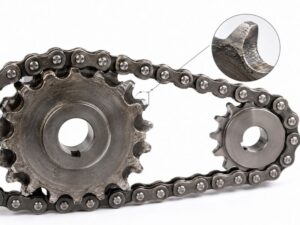
The groove surface oxidises first. Surface rust on a cast iron or carbon steel pulley groove appears within weeks of exposure to persistent moisture, salt air, or cleaning chemicals. The rust layer is soft and abrasive: harder than the belt fabric or rope fibre that contacts it, but much softer than the steel beneath. The rust layer doesn’t just sit there. Belt tension cycles repeatedly press the belt against the groove surface and pull it away. Each cycle wipes a thin layer of rust against the belt contact face. The belt wears from the groove surface rather than from normal fatigue.
The second stage: the rust removes itself and pits the groove. What was a smooth turned or ground groove surface becomes progressively rougher as the oxide layer forms, gets wiped off, reforms, and gets wiped off again. Pitting follows. A pitted groove has irregular contact with the belt or rope: load concentration at the pit edges rather than distribution across the groove profile. That concentration produces hot spots, accelerated local wear, and eventually cracking at the belt edge or rope strand fatigue at the contact point.
The third stage: the belt or rope fails at an interval far shorter than its rated life, the cause is logged as "belt failure" or "rope wear," and a new belt or rope is ordered. The pulley is not replaced. The new belt runs on the pitted groove and fails faster than the first one did.
This sequence is not unique to any particular industry. It appears in any installation where a carbon steel pulley sees persistent moisture, and the symptoms look like belt or rope quality problems rather than pulley condition problems until someone measures the groove surface.
Where Stainless Steel Interrupts That Sequence
A 304 or 316L stainless steel pulley maintains the chromium oxide passive layer that gives stainless its corrosion resistance across repeated cycles of wet and dry conditions, temperature swings, and chemical exposure.
The groove surface on a stainless pulley does not rust. The groove profile machined or turned into the pulley at manufacture is the same groove profile the belt contacts one month later and one year later. Belt and rope service intervals extend to their rated fatigue life rather than being cut short by groove surface abrasion.
This isn’t a theoretical advantage. It’s the reason food processing, pharmaceutical, and marine equipment specifies stainless pulleys as a baseline rather than a premium option, because in those environments, carbon steel pulleys don’t last long enough to be economically viable on a full replacement-cycle basis.
The Groove Surface Finish Advantage
When a pulley is new, the groove surface finish is set by the machining or casting process. For food processing applications, 316L stainless pulleys can be turned to a fine, low-roughness finish and electropolished after machining, producing a micro-smooth groove surface that contacts the belt without abrasion even at sustained high belt tension.
A carbon steel pulley can be machined to the same initial finish, but it won’t hold that finish in a washdown environment. The passive layer on stainless means the stainless pulley holds its initial groove finish for the service life of the installation, not just the first service interval.
For rope sheaves, this matters for a different reason. A rough groove surface on a rope sheave concentrates contact stress at the wire strands touching the high spots, accelerating wire fatigue at exactly the points of highest bending stress. A smooth stainless groove distributes contact load across the full rope contact arc and significantly extends rope service intervals.
Hygiene and Cleanability in Food and Pharmaceutical Applications
In food processing and pharmaceutical production, the pulley isn’t just a mechanical component. It’s a surface that may be in or near the product zone and must withstand daily cleaning cycles without generating contamination.
Carbon steel pulleys in food environments create two problems. First, rust particles contaminate the product zone. A corroding groove surface sheds iron oxide particles that a high-pressure washdown stream can carry into open product conveyors or processing areas. Second, a corroded groove surface develops surface microgeometry (pits, crevices, and rough features) that traps food residue and provides attachment points for bacterial biofilm. The rough surface is harder to clean than a smooth one and may not reach the surface hygiene required after a standard CIP cycle.
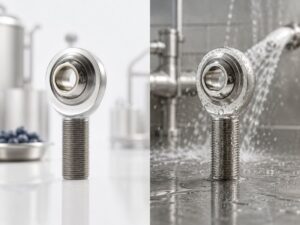
A 316L stainless steel pulley with an electropolished groove surface has no rust particles to shed and provides a smooth, chemically resistant surface that cleans fully with standard washdown chemistry. For chloride-bearing cleaning agents, which are common in food and dairy processing, 316L is the correct specification because the molybdenum content raises the pitting resistance threshold that 304 cannot clear.
⚠️ Note: For food processing pulleys in direct washdown zones, specifying 316L stainless without also confirming the groove surface finish leaves a gap. A 316L pulley with a rough turned groove still traps food residue in the groove root. Specify the grade and the finish together: a smooth, electropolished or passivated 316L groove. That combination, not the grade alone, delivers the hygiene performance the environment requires.
Marine and Outdoor Installations: Why Coatings Don’t Solve the Problem
The alternative to stainless pulleys in marine environments is coated carbon steel: galvanised, powder-coated, or epoxy-painted. Coatings work until they don’t, and the groove is where they fail first.
The groove of a pulley is the highest-wear surface on the component. Belt tension, rope pressure, and constant relative motion between the belt or rope and the groove surface abrade coating faster there than anywhere else on the pulley body. A powder-coated pulley with a worn groove is a bare carbon steel groove in contact with salt air or seawater, which is exactly the condition the coating was supposed to prevent. The body of the pulley may still look presentable while the groove is actively corroding.
Galvanising has the same vulnerability. The zinc sacrificial layer at the groove wears away under belt or rope contact, and the underlying carbon steel is then exposed. The galvanised body lasts longer than the groove, but the groove is what matters for drive performance and belt life.
A 316L stainless pulley has no coating to wear through. The corrosion resistance is intrinsic to the material at every surface, including the groove root and flanks under full belt or rope tension. For marine applications with particularly aggressive chloride exposure, such as offshore platforms or vessels operating in tropical salt water, Duplex 2205 provides a meaningful step up from 316L in pitting resistance at the groove surface where crevice geometry concentrates corrosive attack.
Reduced Maintenance Frequency and Predictable Service Life
One advantage of stainless steel pulleys that maintenance schedulers value is that service intervals become predictable. A carbon steel pulley in a wet environment degrades at a rate that depends on temperature, chemical concentration, and humidity variations, all of which fluctuate. The pulley’s actual service life in a given installation is shorter than the nominal service life and variable enough that replacement timing is reactive rather than planned.
A 316L stainless pulley in the same environment degrades primarily through mechanical wear at the groove contact surface, which is load and cycle dependent and therefore predictable. Inspection at defined intervals confirms groove profile and surface condition. Replacement is scheduled rather than emergency.
That predictability has an operational cost benefit that doesn’t show up on the purchase price comparison: emergency pulley replacement typically involves line downtime, expedited parts procurement, and unplanned labour, all at premium cost relative to scheduled maintenance.
Where Carbon Steel Pulleys Still Make Sense
Stainless steel pulleys are not the right choice for every application, and specifying them where carbon steel works equally well is an unnecessary cost.
Dry, enclosed, non-corrosive environments (indoor manufacturing, enclosed mechanical drives, and HVAC systems away from humidity) don’t expose the groove surface to the conditions that cause carbon steel to corrode faster than its mechanical wear rate. In those environments, a properly maintained carbon steel pulley delivers its full rated service life at lower purchase cost, and the stainless premium buys no measurable performance difference.
High-load, high-shock applications where the primary failure mode is mechanical fatigue rather than corrosion also favour conventional materials. Cast iron has better damping properties than stainless steel, which reduces vibration transmission through the drive system, a relevant factor in high-speed belt drives where noise and vibration are design constraints.
The decision is not "stainless is better." It’s "stainless is necessary when the operating environment will corrode carbon steel faster than mechanical wear limits service life." In food processing, marine, pharmaceutical, and chemical environments, that condition is reliably met. In dry industrial applications, it often isn’t.
304 vs 316L for Stainless Steel Pulleys: Choosing the Right Grade
Not all stainless steel delivers the same corrosion performance at the groove surface. 304 and 316L are both stainless, but 316L’s 2–3% molybdenum content raises its resistance to chloride pitting specifically, and the groove of a pulley in a washdown environment sees exactly the chloride concentration and crevice geometry that most benefits from that molybdenum addition.
Specify 304 for outdoor applications without persistent salt spray or chemical contact: architectural installations, covered outdoor drives, and general industrial equipment in moderate humidity.
Specify 316L for food processing washdown zones, marine environments, coastal outdoor installations, and any application where the cleaning chemistry contains chlorinated sanitisers or the environment includes salt air or seawater contact.
For the most demanding offshore or chemical plant environments, Duplex 2205 provides roughly double the yield strength of 316L alongside substantially higher chloride pitting resistance, allowing smaller pulley sections for the same load capacity and longer service intervals in continuous seawater exposure.
For a full guide on selecting between pulley types and materials for your specific application, see our pulley selection guide.
Profab Machine manufactures stainless steel pulleys in 304 and 316L for food processing, marine, chemical, and outdoor industrial applications. V-groove, round groove, and flat face configurations are available with custom bore, keyway, and groove profile to drawing.