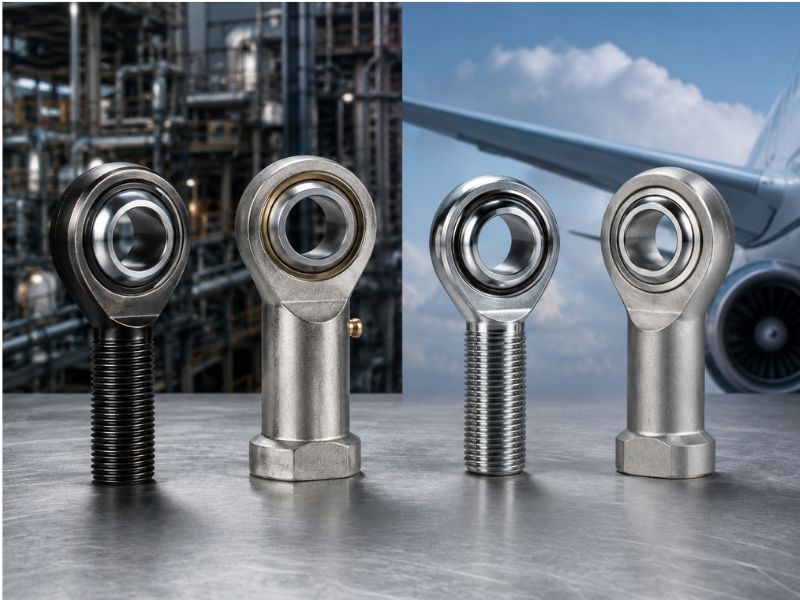
Industrial and aerospace rod ends perform the same basic function: a spherical bearing mounted in a threaded housing that transmits load while allowing angular misalignment. The operating principle is identical. The manufacturing standards, material specifications, liner systems, dimensional tolerances, and documentation requirements are not.
The choice between the two isn't primarily about budget. It's about which failure mode is acceptable in your application, what documentation your customer or regulator requires, and whether the operating environment pushes beyond what industrial-grade components are designed to handle.
| Dimension | Industrial Rod End | Aerospace Rod End |
|---|---|---|
| Primary standards | ISO 12240-4, DIN 648 | AS81935, AS81820, MS21240, NAS series |
| Radial clearance (new) | 0.05–0.15 mm typical | 0.025 mm or tighter (spec-controlled) |
| Housing material | Carbon steel, stainless (304/316L) | Alloy steel, 17-4PH, titanium |
| Ball/race material | Carbon steel, chrome steel, stainless | Corrosion-resistant steel (CRES), 440C, 17-4PH |
| Liner system | PTFE film, sintered bronze, or metal-to-metal | Woven PTFE/polyamide fabric composite (e.g. Fibriloid®) |
| Temperature range | –40°C to +150°C typical | –54°C to +163°C PTFE; up to +260°C for metal-to-metal |
| Static radial load (1" bore) | 20,000–35,000 lbf typical | 50,000+ lbf for AS81935 grade |
| Traceability documentation | Manufacturer cert on request | Full lot traceability, MTR, CMC required |
| Inspection | Dimensional and visual | Magnetic particle, dye penetrant per spec |
| Price relative to industrial | 1× | 5–20× |
The Tolerance Gap and Why It Matters
This is where most comparisons stop being useful. "Aerospace bearings are tighter tolerance" is accurate but doesn't tell you why that matters for your specific application.
The typical new radial clearance in an industrial rod end is 0.05 to 0.15 mm. An aerospace rod end to AS81935 holds radial clearance to 0.025 mm or tighter. That 0.05 to 0.10 mm difference sounds trivial until you consider what happens to it over time in a vibrating system.
Under cyclic loading, radial clearance in a rod end grows as the liner wears or the ball contact zone expands. In an industrial application with infrequent cycling and moderate loads, this growth rate is slow and the starting clearance matters less. In an aerospace control linkage cycling thousands of times per flight hour, a looser starting clearance means earlier geometric imprecision in the control system. The tolerance at installation sets the upper bound on system precision throughout service life.
More practically: in a high-frequency vibrating machine or a precision positioning system, a rod end with 0.1 mm of initial radial clearance can produce audible and measurable lash at load reversal. Firgelli Auto's rod end engineering reference documents this directly: run an undersized bolt through the bore or use a looser-tolerance joint and the system clatters under load reversal.
Liner Systems: Film vs Woven Fabric
The liner inside the rod end housing determines friction coefficient, wear rate, temperature capability, and load capacity. Industrial and aerospace grades use fundamentally different liner technologies.
Industrial PTFE liners are typically a sintered or film PTFE layer bonded or pressed against the housing bore. They operate dry with a friction coefficient of around 0.05–0.15 and handle the temperature and load range of standard industrial machinery. These liners are adequate for the application they're designed for. When they wear through, the joint is replaced.
Aerospace woven composite liners such as RBC's Fibriloid system use woven PTFE and polyamide (nylon) fiber bundles flooded with thermoset resin and bonded to the housing bore. The woven construction maintains structural integrity as the PTFE matrix wears, unlike a film liner which degrades more uniformly but with no reinforcement. The result is a liner that maintains a friction coefficient below 0.05 under oscillating motion, sustains higher compressive loads before the liner creeps or delaminates, and has significantly better fatigue resistance under high-cycle loading.
The load capacity difference is substantial. As RBC Bearings' Fibriloid engineering data documents, aerospace-grade self-lubricating rod ends in 1-inch bore sizes reach static radial load capacities above 50,000 lbf. Industrial rod ends in the same bore typically rate in the 20,000 to 35,000 lbf range.
One important constraint that applies to both types equally: self-lubricating PTFE-lined rod ends are designed for oscillating motion, not continuous rotation. PTFE generates frictional heat under sustained rotation that the liner cannot dissipate quickly enough. For applications requiring continuous shaft rotation, rolling element bearings are the correct architecture regardless of grade level.
Rod End Material Specifications
Housing and shank:
Industrial rod ends are typically carbon steel (for load capacity and cost), 304 or 316L stainless (for corrosion resistance), or alloy steel in heavy-duty series. The material choice is driven by environment and load.
Aerospace rod ends specify corrosion-resistant steel (CRES) alloys precisely. 17-4PH precipitation-hardened stainless is common for housings and shanks where the combination of strength, corrosion resistance, and machinability is required. In the H900 condition, 17-4PH reaches yield strength around 1,170 MPa with adequate corrosion resistance for most aerospace environments. Titanium housings appear in weight-critical applications.
Ball:
Industrial balls are typically 52100 chrome steel (HRC 58–64) or stainless steel in corrosion-resistant versions. The 52100 balls provide good wear resistance and load capacity.
Aerospace balls are specified to CRES grades with additional controls on surface finish, hardness uniformity, and sphericity. 440C stainless at HRC 58–60 is common in aerospace rod ends where both hardness and corrosion resistance are required. The surface finish specification on aerospace balls is tighter than industrial, reducing the initial run-in wear that a rougher surface would generate
Documentation and Traceability
This is the selection trigger that engineers rarely talk about but often determines the actual purchase decision.
An industrial rod end order from a standard distributor comes with a manufacturer's certificate of conformance and potentially a material test report. The documentation confirms the product meets catalog specifications. Lot-level traceability to raw material heat numbers is sometimes available and sometimes not, depending on the supplier.
An aerospace component to AS81935 or a military specification requires full lot traceability from raw material through finished part. The documentation package includes: material certifications with heat number traceability, dimensional inspection reports for critical features, magnetic particle or dye penetrant inspection results, certificates of conformance to the applicable specification, and often first article inspection reports for initial lot qualification.
If your customer, program, or regulatory framework requires this documentation, industrial rod ends cannot provide it regardless of their mechanical performance. The documentation is part of the specification. Many defense, aerospace, and critical infrastructure projects trigger aerospace-grade specification requirements specifically because of the traceability requirement rather than because the loads exceed what industrial components can handle mechanically.
When to Use Each
Specify industrial rod ends when:
The application is general industrial machinery, food processing equipment, agricultural equipment, marine hardware, or automotive applications. The operating environment falls within the temperature, load, and chemical exposure range of standard industrial components. Documentation requirements are standard commercial certs. Maintenance access allows for inspection and replacement on a defined schedule. The failure consequence is a maintenance event, not a safety-critical event.
Specify aerospace rod ends when:
The application is aircraft structure or control systems, defense equipment, or any system where the regulatory or customer specification calls for AS, MS, or NAS part number conformance. The load cycle count per year is high enough that tighter starting tolerances meaningfully extend geometric precision over service life. The documentation requirement includes lot-level material traceability. The liner system must sustain higher load density than industrial liner systems support. The failure consequence is a safety event rather than a maintenance event.
The gray zone:
High-performance industrial equipment, semiconductor manufacturing, precision robotics, and medical devices sometimes fall between these categories. The load and environment can be met by industrial-grade components, but the customer specification or quality system requires aerospace-style documentation. In these cases, the spec level follows the documentation requirement, and the cost difference is a program requirement rather than an over-engineering decision.
Stainless Steel Rod Ends Across Both
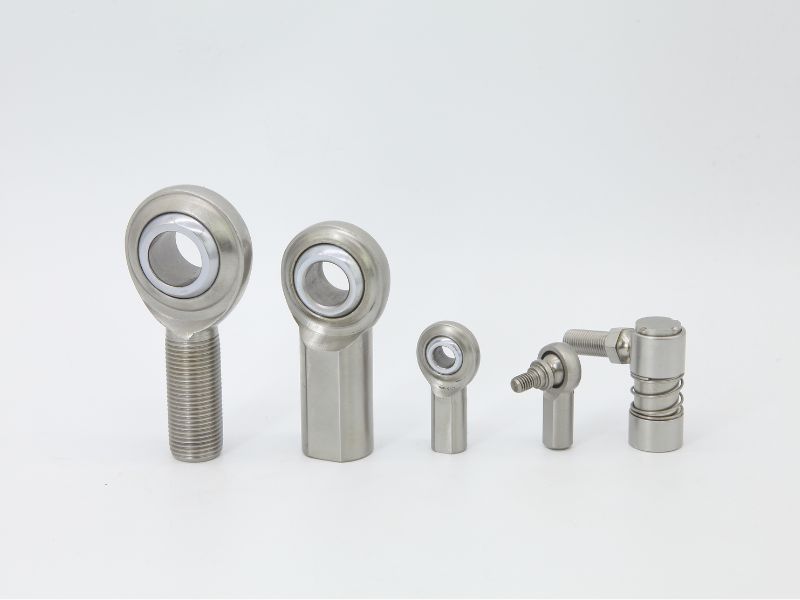
Stainless steel rod ends exist in both industrial and aerospace grades. The grade designation is not what makes a rod end stainless. The liner system, dimensional tolerance, and documentation are what distinguish an industrial stainless rod end from an aerospace one.
Stainless steel rod ends in 316L are the standard for food processing, marine, and chemical environments where corrosion resistance drives the material selection. These are industrial-grade parts. 17-4PH stainless rod ends in aerospace-grade configurations are a different product category serving a different set of requirements, even though both are stainless steel and can be made in similar physical sizes.
The correct selection question isn't "stainless or not stainless." It's "which load case, which environment, which documentation package, and which failure consequence." The answers to those questions determine both the material and the grade level.
Conclusion
The choice isn't stainless vs. not stainless. It's tolerance, liner system, and documentation package matched to the failure consequence your application can tolerate. Get those three right and the material and grade level follow.
Profab Machine manufactures stainless steel rod ends in 304, 316L, and 17-4PH for industrial, marine, food processing, and high-load applications. We support custom configurations to your specification.