

Heim Joint Steering: Why Bigger Tires Demand the Upgrade
- By Ray Wang /
- July 28, 2026
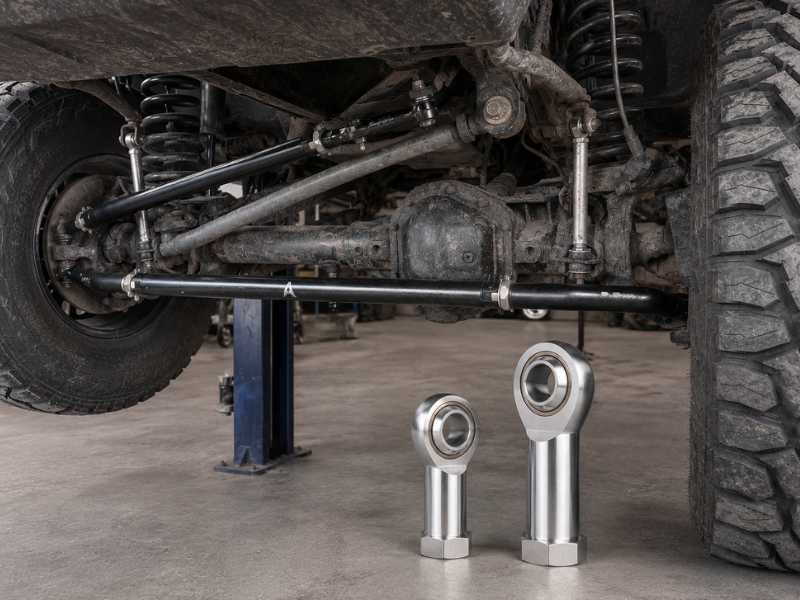
Table of Contents
The 37-inch mark comes up constantly in off-road communities as the threshold where steering upgrades stop being optional. It shows up in forum recommendations, parts kit descriptions, and alignment shop conversations. But the reason usually gets reduced to “bigger tires need stronger parts,” which is technically true and practically useless.
The actual reason is more specific, and understanding it tells you exactly what kind of upgrade you need and why heim joints solve the problem when beefier OEM-style tie rod ends don’t.
What Changes at 37 Inches
A 37-inch tire weighs roughly 20 to 30 percent more than a 33-inch tire. A 35-inch tire sits somewhere in between. That weight matters, but it’s not the main issue.
The main issue is scrub radius and what happens to it when you lift a vehicle and add wider, heavier tires.
Scrub radius is the distance between the point where your steering axis meets the ground and the center of the tire contact patch. Every vehicle has a scrub radius engineered in at the factory, designed to balance steering feel with stability. When you add a lift and wider tires with different backspacing than stock, the scrub radius changes. As documented repeatedly in JL Wrangler Forums, a side-effect of mounting large heavy tires is that they wear out factory steering and suspension parts prematurely. Some owners see drag link failure before 15,000 miles on 37s.
The mechanism is this: an increased scrub radius means that road surface irregularities, braking forces, and lateral loads create a larger moment arm acting on the steering linkage. Every bump transfers more energy into the tie rod and drag link. Every braking event creates more kickback. The forces that were manageable at 33 inches become damaging at 37 inches, not linearly but in proportion to how far the scrub radius has shifted.
Add to that the unsprung weight of a 37-inch tire, typically 65 to 80 pounds per corner for a mounted wheel and tire combination, versus 45 to 55 pounds for a 33-inch setup. That additional rotating and unsprung mass amplifies every steering input and every road impact transmitted to the front axle.
Why OEM Tie Rod Ends Fail at This Scale
Factory tie rod ends use a tapered ball stud that seats into a tapered hole in the steering knuckle. The taper creates a press-fit style connection that tightens under load. This works well for the load range the factory geometry was designed for. At 37 inches and above, two problems emerge.
First, factory ball studs and their internal nylon/plastic bushings are sized for stock loads and stock tire mass. When heavy 37-inch tires increase leverage and scrub radius, lateral forces exceed the factory joint’s retention capability. The internal seats wear prematurely, causing radial play and sloppy steering response long before expected. As documented across Wrangler and truck forums, running 37s on factory drag links and tie rods routinely degrades OEM ball joints in under 15,000 miles. The factory components aren’t inherently defective—they’re simply being operated far outside their intended design envelope.
Second, the tapered connection only allows a fixed angular range at the joint. As suspension geometry changes during articulation, a tapered tie rod end that reaches its angular limit binds rather than pivots. On a stock-height vehicle with stock tires, this limit is never reached in normal driving. On a lifted vehicle with 37s and aggressive suspension travel, it’s reached regularly. Binding at the steering joint during suspension articulation is one of the contributing factors to bump steer.
What Heim Joints Do Differently
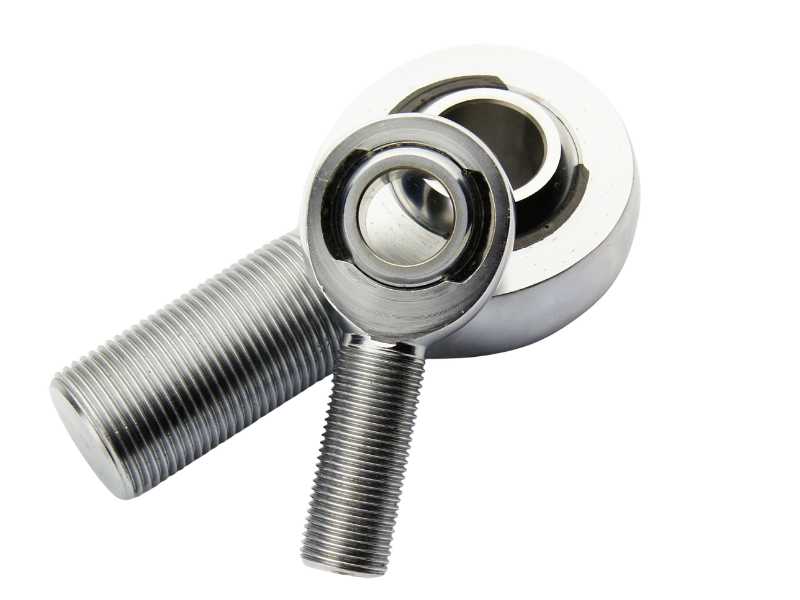
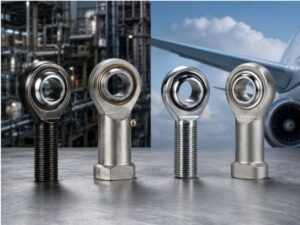
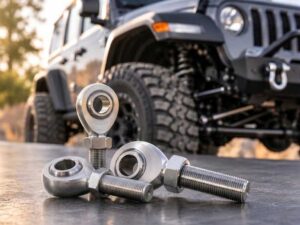
A heim joint replaces the tapered stud with a spherical ball-and-socket. The ball pivots freely in any direction within its angular range. The connection to the knuckle uses a straight through-bolt rather than a taper, which means:
The load path is through the bolt in shear, not through a friction-clamped taper. The bolt either holds or it doesn’t. There’s no intermediate state where the connection is technically present but effectively loose.
The angular range of a heim joint is typically 10 to 15 degrees in standard versions and up to 25 to 30 degrees in high misalignment versions. This range covers the articulation demands of a heavily lifted vehicle without binding. When a heim joint steering setup is correctly installed, it articulates through the full suspension travel range without the bind points that contribute to bump steer.
OEM steering knuckles use a tapered hole for tie rod ends while heim joints use a straight through-bolt. For 37 to 42-inch tires, 3/4-inch joints with a static load rating of roughly 28,000 lbs are mandatory, providing the rigidity needed to prevent death wobble caused by component flex.
The knuckle modification required is drilling out the tapered hole to accept a straight bolt. This is part of the conversion. A clean straight hole with a tight bolt fit transfers load through the bracket, not through thread engagement. The fit between the bolt and the hole must be as tight as reasonably achievable. Any slop in the hole allows the bolt to work-harden and eventually shear.
The Size Question: 3/4 Inch vs 7/8 Inch
Not all heim joints are adequate for all tire sizes. The size selection matters more than most builds account for.
For 35 to 37-inch tires, 3/4-inch heim joints are the functional baseline. At this size, the static load rating exceeds 28,000 pounds, which handles the combination of tire weight, scrub radius forces, and impact loads in normal off-road use.
For 37-inch tires and above, especially on heavier vehicles or builds running aggressive trails, 7/8-inch joints are the more defensible choice. The larger bearing surface distributes load across more contact area, and the larger bore accepts a heavier bolt in shear. As NC4x4 forum regulars note, the cost difference between 3/4-inch and 7/8-inch is small relative to the consequences of a steering failure on a trail. Spec up once rather than replace after a failure.
For 40-inch tires and above on full-size trucks or competitive crawlers, 1-inch heim joints are appropriate. At this tire size and vehicle weight, the forces on the steering linkage during aggressive articulation routinely exceed what smaller joints can handle reliably over a season of use.
Stainless vs Chromoly for Daily-Driven Rigs
Most steering heim joint kits are built around chromoly steel. For dedicated trail rigs that get cleaned and inspected after every run, chromoly is a reasonable choice. The strength-to-weight ratio is good and the parts are well-supported by the aftermarket.
For daily-driven vehicles that also see trails, the maintenance reality is different. A chromoly heim joint that lives in road salt from November through March, sees mud on weekends, and gets washed monthly rather than after every trip will corrode at the bearing interface between service intervals. The corrosion tightens the joint, reducing its angular range and eventually preventing free articulation. A joint that can’t pivot freely transmits stress into the surrounding structure instead.
Stainless heim joints maintain free articulation across the maintenance intervals that a daily driver actually sees. However, material selection is critical when scaling tire size. Standard 304 and 316L stainless offer excellent corrosion resistance, but their lower yield strength makes them best suited for sway bar links or lighter-duty applications—not primary steering linkages on big tire builds.
For steering setups running 37 to 39-inch tires, 17-4PH stainless steel is the proper engineering choice. It closes the strength gap with heat-treated chromoly while retaining superior corrosion resistance against road salt and mud. For extreme builds at 40 inches and above where ultimate peak load capacity is mandatory, heat-treated chromoly or oversized 17-4PH joints ensure the linkage won’t flex or deform under heavy lateral impacts.
The Bump Steer Connection
Bump steer is the change in toe angle that occurs as the suspension cycles through its travel range. When the tie rod and the control arm don’t arc through the same geometric path during suspension compression and droop, the wheel steers itself as the suspension moves. You feel this as the steering wheel pulling or kicking in response to bumps rather than road inputs.
Heim joint steering addresses bump steer in two ways. First, the greater angular range of the heim means the tie rod can follow the suspension arc without binding. Second, because the heim joint connection geometry is adjustable, with rod length set by threading the heim in or out of the tube before locking, the tie rod can be positioned at the exact height and angle needed to minimize bump steer for a given lift height and axle position.
A tapered OEM tie rod end doesn’t offer this adjustment. It sits where it sits, and if the geometry is off for your lift height, you compensate with a drop pitman arm, an adjustable track bar, or you accept the bump steer and move on. The heim joint conversion removes one of the constraints from the geometry problem.
What the Conversion Involves
Converting to heim joint steering requires more than swapping tie rod ends. The full process covers:
Drilling the knuckle. The tapered hole that accepts the OEM ball stud gets drilled to accept a straight bolt. This is the point of no return on a set of knuckles. Do it on a drill press or with proper fixturing. A hand drill introduces angle variation that creates the slop that defeats the purpose of the conversion.
Sizing the tube. The drag link and tie rod tubes need to be sized to match the heim joint thread and provide the right length range for your geometry. DOM steel tube in the 1.25 to 1.5-inch diameter range with appropriate wall thickness is standard for 37-plus builds.
Setting geometry. With heims, you can thread the joint in and out to set the exact length. Use this to set toe and to position the drag link parallel to the track bar to minimize bump steer. An adjustable track bar paired with a heim steering conversion lets you dial both geometry elements together.
Getting alignment. As one long-running thread on Jeep Enthusiast Forums notes, the main drawback to heim steering is finding an alignment shop that knows what they’re doing with it. Many builders end up setting toe themselves. A competent shop that understands custom front axle geometry is worth finding before you do the conversion, not after.
Profab Machine supplies stainless steel rod ends in daily-driven and off-road applications. For high-load builds at 40 inches and above, 17-4PH is available on request.
Food Grade vs. Washdown Rated Rod Ends
Are Heim Joints Worth It on a Daily Driven Jeep
Why Lifted Tacomas Need Adjustable Heim UCAs
Single Shear vs Double Shear Rod End Mounts
Send Inquiry Now
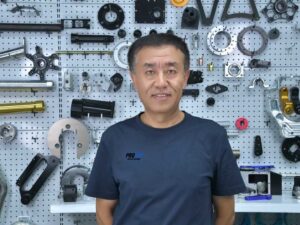
Ray Wang is an engineer at Profab Machine with more than 20 years of experience in stainless steel applications and automotive parts. Over the years, he has built deep expertise in precision machining, material behavior, and practical engineering solutions. His hands-on background and strong focus on quality help ensure every project meets demanding performance and reliability standards.