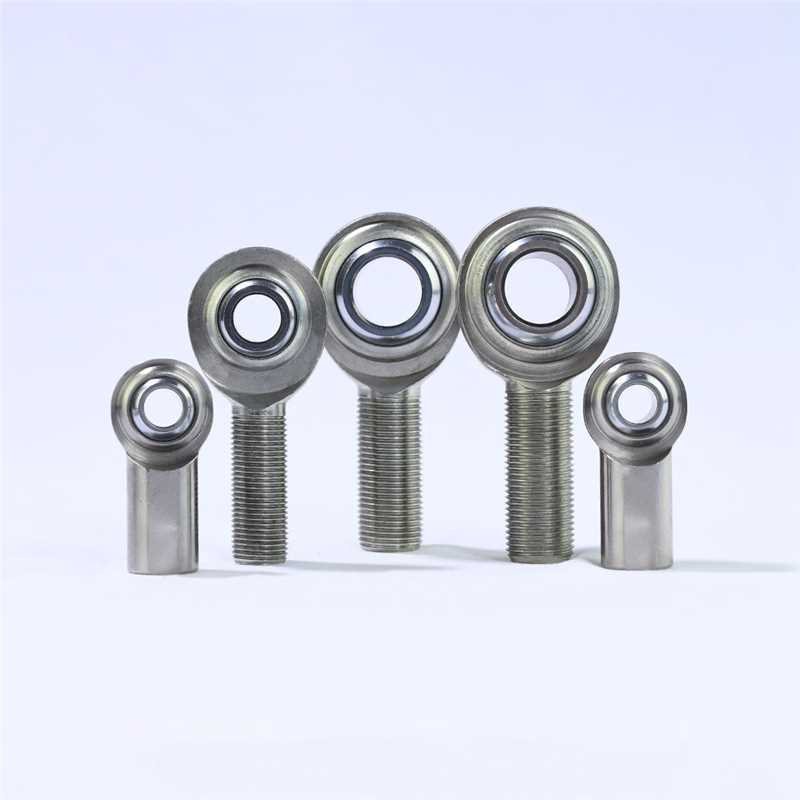
A rod end fails in one of five ways. The race wears and the joint gets play, the ball stiffens or seizes, the shank bends under misalignment, a crack grows from the thread root, or the thread engagement is too short. Each leaves a different sign, so the first job is to match what you feel and see to a cause before you order a replacement. The table below is the short version.
| What you see or feel | Likely failure | First check |
|---|---|---|
| Play across the pin axis, a click on load reversal | Race or liner worn | Hold the link and move the ball; measure the movement |
| Stiff or notchy at one position of travel | Misalignment, or contact at the housing edge | Turn the joint through its range with the link unloaded |
| Ball will not turn at all | Seizure from corrosion, dirt or a dry race | Remove the pin and turn the ball by hand |
| Housing or shank visibly bent | Misalignment beyond the joint's limit | Compare the angle at full travel with the spec sheet |
| Rod end loose on its thread, or unscrewing | Jam nut loose or short engagement | Check nut torque and how far the thread is in |
| No warning, then a break at the thread | Fatigue crack from the thread root | Inspect the whole thread, including under the nut |
Race Wear and Play That Starts Small
The race is where friction and wear happen, so wear shows up first as play. In a lined or bronze-race rod end the ball gets room to move, then clicks when the load reverses, then rocks and wears the race edges faster. A worn race cannot be adjusted back into tolerance. The rod end is replaced, and the cause of the wear is fixed first so the new one does not wear the same way.
Measure the play where the load acts. Fix the link, move the ball along the pin axis and across it, and note the movement. The usual causes are a load above what the joint was sized for, dirt that reaches the race, and a dry metal-to-metal race.
Seizure and Stiffness
Stiffness and seizure are two points on the same progression. Friction at the ball and race rises, the joint turns less freely, and in the end the ball stops moving. Corrosion, packed dirt and dried grease are the usual causes. Once the ball stops, the joint no longer works as a bearing and movement can be passed to the shank and the bracket as bending.
Stiffness at one position of travel and free movement elsewhere usually points at geometry, and stiffness all the way round at the race. Remove the pin and turn the ball by hand to tell the two apart. Stainless threads that lock up during assembly are a separate failure, galling, which has its own article.
Bending From Misalignment
A rod end tolerates only a limited tilt, and the spec sheet gives the figure. When the linkage asks for more, the housing or shank meets the bracket and the joint is stopped. The next movement bends the shank or the mount. A published motorsport guide states that a bent rod end cannot be unbent and should be replaced, with the cause of the bending corrected first.
Check the angle at full travel, not at rest, and look for a joint that was installed already cocked because the bracket holes or ears are out of line. Spacers on each side of the rod end widen the tilt before contact. Shock loads applied off the bore axis load the shank in bending too.
Thread Engagement and the Jam Nut
A rod end carries its load through the thread, so a short thread is a weak joint. A widely accepted aircraft rule of thumb has a rod end engage its mating part by 1 to 1.5 thread diameters at least, as described in a trade article on witness holes. A 1/4-28 thread therefore needs about 1/4 inch of engagement or more. The article itself says no definitive specification could be found, so for industrial linkages use the maker's figure where one is given.
On a female rod end, a small hole drilled in the threaded body shows whether the mating thread has reached it. The author prefers probing the hole with a piece of safety wire to looking, because paint, dirt or grease can hide it, although he calls a visual check acceptable. A jam nut then locks the adjusted position. If the nut has backed off, the rod end can turn on its thread, and the joint looks loose when the bearing is fine.
The Crack You Cannot See
A fatigue crack at a thread root can give little warning. A Canadian investigation report describes a helicopter tail rotor pitch link whose rod end broke next to the nut. The failure was high cycle fatigue under normal service loads. The fracture started at the thread root in the presence of corrosion pitting, and a deteriorated rod end bearing probably made it worse. The corrosion-preventive compound that the manual called for had not been applied to the threads.
The report holds three lessons for any threaded rod end, even though a tail rotor carries different loads from a conveyor linkage:
- A play check can pass while the joint is finished. Radial play was within the published limit, yet the races showed metal-to-metal contact that appeared to meet the replacement requirement.
- A crack can hide under the nut. The inspection covered only the exposed thread, so a crack covered by the link, the locking device or the nut could be missed. The report notes that the integrity of the rod end cannot be accurately judged unless the entire threaded area is inspected.
- Thread roots and corrosion go together. A thread root is a stress concentration, and a corrosion pit there starts the crack. Protecting the thread is part of keeping the rod end.
The case is from a Transportation Safety Board of Canada report. Stainless steel resists the corrosion part better than plated steel, which is a reason to choose it for wet duty. It is not immune at a thread root, and it does not remove the stress concentration there.
An Inspection Routine You Can Repeat
Run the same five checks each time a joint is serviced, so the readings are comparable between visits.
- Clean the joint and note how it looks: dirt in the race, rust at the thread, cracked paint.
- Measure play along and across the pin axis with the link held.
- Turn the joint through its full range unloaded, and note any position that stiffens.
- Check the thread: jam nut tight, engagement long enough, no sign of the rod end turning. When a rod end is removed, inspect the whole thread.
- Look at the pin and the bracket. A worn pin or an enlarged bore mimics bearing play, and a bent shank shows against a straight edge.
Replace the rod end when the play is more than the maker allows, when the ball sticks, when the shank is bent or when a crack or deep pit is found. Replace it with the cause fixed, not as a copy of the part that failed.
Fix the Cause in the Replacement
A new rod end that copies the old one will fail the same way. Change the part or the geometry to remove the cause. The series names below are Profab's; the rest of the table applies to any maker's range.
| Cause found | Change in the replacement |
|---|---|
| Race worn by load | A larger series, or a bronze race with a grease fitting (SATK or SITK) for higher load with periodic lubrication |
| Dirt or washdown in the race | A PTFE-lined, maintenance-free series (JMX or JFX) for washdown, outdoor or contaminated duty |
| Rust or pitting on the housing | 316L in place of 304 |
| Binding at the end of travel | A spacer on each side, a change of geometry, or a larger series |
| Thread torn or locked on assembly | Lubricate the thread on the new part |
| Corrosion at the thread root | Protect the thread as the maker or manual specifies, and inspect the whole thread at each service |
What to Send for a Replacement Rod End
If a rod end has failed, send the details below to Profab Machine. We make stainless steel rod ends in 304, 316L and 17-4PH, to the catalogue size or to your drawing. A joint that wore out in a month needs a different race or grade, not a copy.
- The old part, or its thread, bore and body size, and whether the thread is male or female and left or right hand
- How it failed: play, stiffness, a bent shank, a crack, or a loose nut
- The load, the angle of travel and the number of cycles per day, if known
- The environment: washdown, salt, dust, heat
- Race type on the old part (metal-to-metal, lined, bronze) and whether anyone greases it
Conclusion
Match the sign to the cause before you replace anything. Play and clicks point at the race, a stiff spot at the geometry, and a loose joint at the thread or the jam nut. A sudden break points at a crack from the thread root. Measure play, turn the joint through its range, and inspect the whole thread when the part is out. If you need a replacement or a better-suited rod end, send the list above to Profab Machine and we will confirm the size, race and grade before we quote.
Go deeper