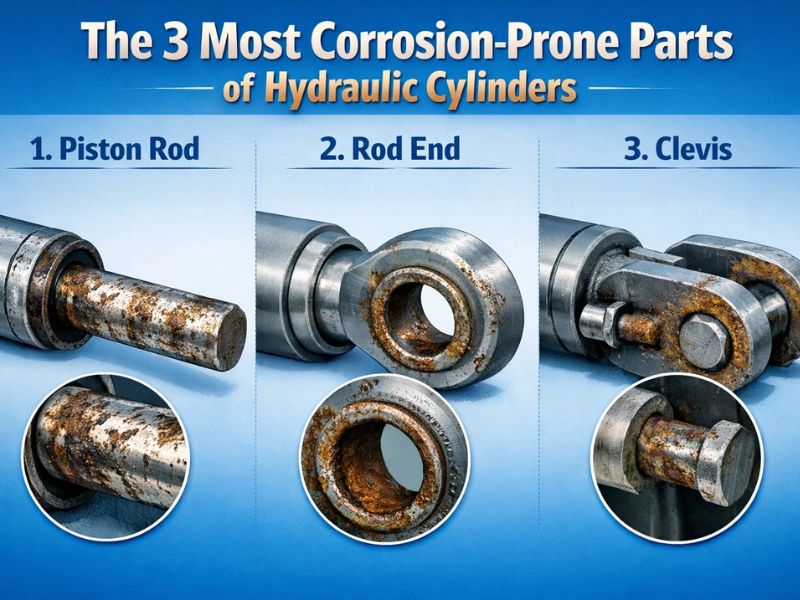
Hydraulic cylinders are engineered with generous safety factors for load and pressure, so it's easy to assume overload is what ends a cylinder's service life. In practice, corrosion of external components is one of the leading causes of cylinder downtime, and it usually starts well before the cylinder itself is anywhere near its rated limits. Three components carry most of that risk: the piston rod, the rod end, and the clevis. Knowing where and how corrosion attacks each one is what makes the difference between a machine that reaches its designed service life and one that's rebuilt every couple of years.
Piston Rod: The Primary Corrosion Hotspot
Of the three, the piston rod takes the most direct and continuous exposure. It's in contact with moisture, dirt, salt, and process chemicals on every stroke, and every time it retracts, it drags whatever's on its surface back toward the seal system.
Chrome plating helps, but it isn't a guarantee. Microscopic pinholes and defects in the chrome layer let moisture reach the base metal underneath, and once corrosion starts under the plating, it progresses whether or not the surface still looks intact. Outdoor equipment, agricultural machinery, and coastal installations accelerate this timeline considerably.
Once pitting starts on the rod surface, the pits act like cutting edges against the rod seal, and wear accelerates from there. What begins as minor surface rust can escalate quickly into oil leakage, pressure loss, and internal damage, and a cylinder that's otherwise structurally sound can become unrebuildable once the rod itself is pitted, since there's no way to restore a smooth sealing surface without replacing it.
In corrosion-prone applications, the material spec on the piston rod often does more for service life than any amount of added load capacity. Stainless steel piston rods, along with higher-quality surface finishes and coatings on standard rods, are the practical way to push that failure mode out further.
Rod End: Small Component, System-Level Impact
Rod ends typically sit at the lowest point of the assembly, exactly where water and debris settle. The spherical joint geometry traps moisture by design, and standard carbon steel rod ends corrode quickly once their protective coating is compromised. In the field, it's common for a rod end to seize or lose articulation well before the cylinder itself shows any visible damage.
A corroded or seized rod end doesn't fail in isolation. It restricts movement and introduces misalignment into the linkage, and that misalignment transfers uneven load back into the piston rod and its seals, which accelerates rod scoring and gland damage. A failed rod end can shorten the service life of an otherwise healthy cylinder simply by loading it incorrectly.
The fix is matching rod end material and design to the actual operating environment rather than defaulting to the cheapest option, and specifying sealed spherical bearing designs where moisture ingress is a concern. A higher-quality rod end here is usually far cheaper than the cylinder repair it prevents. Stainless steel rod ends are the standard answer for outdoor, agricultural, and marine applications.
Clevis: The Most Overlooked Corrosion Risk
Clevis connections are mechanically simple, and that simplicity leads to the assumption that they're maintenance-free. In practice, they're one of the more corrosion-prone joints in a hydraulic system.
The U-shaped geometry of a clevis traps water and debris by design, and combined with the pin-and-hole connection, it creates ideal conditions for crevice corrosion. Once corrosion starts, protective coatings break down quickly, especially in outdoor or wash-down environments.
The clevis itself rarely fails structurally, but a corroded one turns a routine cylinder swap into a drawn-out repair: once it seizes in place, removing it without damaging surrounding hardware gets difficult fast. Proper lubrication and drainage-conscious installation reduce that risk considerably, and a stainless steel clevis is the straightforward upgrade when replacing hydraulic cylinder hardware in a corrosive environment.
Heavy-duty cylinders are built to withstand serious pressure, but it's the environmental exposure of the piston rod, rod end, and clevis that usually determines a machine's actual service life, not the cylinder's rated capacity. Upgrading to corrosion-resistant materials on these three components is one of the most effective ways to prevent premature seal failure. Profab Machine manufactures custom stainless steel piston rods, rod ends, and clevis hardware for hydraulic cylinder applications. Contact Profab Machine to work through the right material specification for your equipment.
FAQ
Can I just sand down a pitted piston rod and keep using it?
No. Once a rod is pitted, the smooth surface required for a hydraulic seal is compromised. Sanding creates low spots that let oil bypass the seal, or edges that nick the seal as it passes over the pit. For high-pressure applications, replacing the rod with a stainless steel piston rod is usually cheaper than the ongoing cost of seal replacements and fluid loss.
Why is my rod end seizing even though I grease it regularly?
Standard carbon steel rod ends are prone to crevice corrosion, where moisture gets trapped between the ball and the housing. In a highly acidic or salty environment, grease alone can't stop that chemical reaction. Switching to stainless steel rod ends or sealed spherical bearings provides a physical barrier that grease can't reliably maintain on its own.
Is stainless steel worth the extra cost for hydraulic components?
In corrosive service, generally yes. The upfront cost is higher than chrome-plated carbon steel, but the return comes from fewer seal replacements, less unplanned downtime, and cylinders that reach their designed service life instead of being rebuilt early because of rod, rod end, or clevis corrosion.