
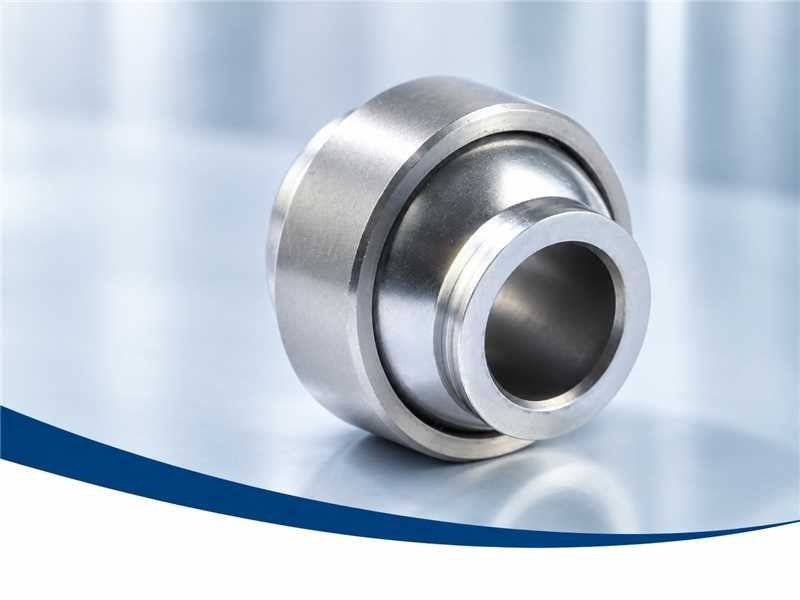
Pick a spherical bearing size in this order: the bore from the pin, the outside diameter from the housing, and the width from the gap the bearing sits in. Then check the tilt angle and the load, because a bearing that fits the envelope can still be wrong for the motion. Sizes come in metric and inch steps, and the tables below cover both. The first table gives the dimensions and what each one is set by.
| Dimension | Symbol | Set by | Check before you order |
|---|---|---|---|
| Bore | d | The pin or bolt diameter | Pin tolerance and the fit you want on the inner ring |
| Outside diameter | D | The housing bore or eye | Wall left around the bearing, and how it is retained |
| Inner ring width | B | The gap between the clevis ears or spacers | Clearance on each side, and room for tilt |
| Outer ring width | C | The width of the housing seat | Seat depth and the retaining method |
Start With the Bore: Match the Pin
The bore is the diameter of the pin, bolt or shaft that goes through the inner ring. Measure the pin, not the old bearing, because a worn bearing and a stepped pin can both mislead. Sizes come in two systems. Metric bores step in round millimeters and inch bores step in fractions of an inch, so decide first which system the pin belongs to.
A metric bore and an inch pin are often close but not the same. The table pairs common inch pins with the inch size that matches them exactly, and shows how far the nearest metric bore is off, calculated from 25.4 mm to the inch.
| Inch pin | Pin in mm | Inch bearing that fits | Nearest metric bore | Metric bore minus pin |
|---|---|---|---|---|
| 1/4 in | 6.350 | COM4 | 6 mm | -0.35 mm (pin too large) |
| 5/16 in | 7.938 | COM5 | 8 mm | +0.06 mm |
| 3/8 in | 9.525 | COM6 | 10 mm | +0.475 mm |
| 7/16 in | 11.113 | COM7 | 12 mm | +0.89 mm (loose) |
| 1/2 in | 12.700 | COM8 | 12 mm | -0.70 mm (pin too large) |
| 5/8 in | 15.875 | COM10 | 16 mm (38 mm outside diameter) | +0.125 mm |
| 3/4 in | 19.050 | COM12 | 20 mm | +0.95 mm (loose) |
| 1 in | 25.400 | COM16 | 25 mm | -0.40 mm (pin too large) |
A negative figure means the pin is larger than the bore and will not fit. A large positive figure leaves a loose pin, which wears the bore. For an inch pin, order the inch size from the inch table below instead of a nearby metric one. A 1 in pin also fits a heavier inch series with a 2.000 in outside diameter.
Outside Diameter: Match the Housing
The outside diameter is set by the housing bore or the eye of the part that holds the bearing. For the same bore, more than one outside diameter exists, because the bearing can be made in a lighter or a heavier series. In the Profab metric range a 20 mm bore comes with a 35 mm or a 46 mm outside diameter, and a 12 mm bore with 22 mm or 30 mm.
| Bore (mm) | Outside diameter (mm) |
|---|---|
| 6 | 14 or 18 |
| 8 | 16 or 22 |
| 10 | 19 or 26 |
| 12 | 22 or 30 |
| 17 | 30 |
| 20 | 35 or 46 |
| 25 | 42 or 56 |
| 30 | 47 or 66 |
These are selected sizes from the Profab range, which runs from 3 to 30 mm bore as standard. Larger sizes and non-standard outside diameters are made to drawing. Check the wall left around the bearing in the housing.
Width: Inner Ring, Outer Ring and the Gap
A spherical plain bearing has two widths. The inner ring is wider than the outer ring. Two published sizes show the pattern. A 17 mm bearing of the ES type is 14 mm wide on the inner ring and 10 mm on the outer. A 20 mm bearing of the E series has a 35 mm outside diameter and a width of 16 mm.
The housing seat takes the outer ring width, and the gap between ears, spacers or shoulders takes the inner ring width. Leave a small clearance on each side so the ring is not squeezed, and leave room for the tilt you need.
Widths belong to the series
ISO 12240-1 defines dimension series for radial spherical plain bearings. Check the series, not just the bore. A wide-inner-ring type gives more tilt at the cost of more axial space. Makers also publish shaft and housing fits by series, covered below.
Standard Metric Sizes From 4 to 30 mm Bore
This table covers the 4 to 30 mm bores and gives the five numbers that decide whether a size fits: bore, outside diameter, the two widths and the tilt angle. All sizes are in millimeters.
| Bore d | Outside diameter D | Inner ring width B | Outer ring width C | Tilt angle (degrees) |
|---|---|---|---|---|
| 4 | 12 | 5 | 3 | 16 |
| 5 | 14 | 6 | 4 | 13 |
| 6 | 14 | 6 | 4 | 13 |
| 8 | 16 | 8 | 5 | 15 |
| 10 | 19 | 9 | 6 | 12 |
| 12 | 22 | 10 | 7 | 11 |
| 15 | 26 | 12 | 9 | 8 |
| 17 | 30 | 14 | 10 | 10 |
| 20 | 35 | 16 | 12 | 9 |
| 25 | 42 | 20 | 16 | 7 |
| 30 | 47 | 22 | 18 | 6 |
Reference data from the Profab product catalog for the GE..C series, a steel and PTFE-lined design, so it is not specific to stainless steel. The bore, outside diameter and width figures agree with the published sizes of other major makers. Tilt angles are reference values and one maker lists 10 degrees for the 12 mm size. Confirm the size and tilt angle for your grade at quotation.
Standard Inch Sizes From 0.19 to 1 in Bore
The inch series uses the same five numbers. Sizes are in inches, the bore is also given in millimeters, and the tilt angle is in degrees.
| Part | Bore d (in) | Bore d (mm) | Outside diameter D (in) | Inner ring width B (in) | Outer ring width C (in) | Tilt angle (degrees) |
|---|---|---|---|---|---|---|
| COM3 | 0.1900 | 4.83 | 0.5625 | 0.281 | 0.218 | 11 |
| COM4 | 0.2500 | 6.35 | 0.6562 | 0.343 | 0.250 | 13.5 |
| COM5 | 0.3125 | 7.94 | 0.7500 | 0.375 | 0.281 | 12 |
| COM6 | 0.3750 | 9.53 | 0.8125 | 0.406 | 0.312 | 10 |
| COM7 | 0.4375 | 11.11 | 0.9062 | 0.437 | 0.343 | 8 |
| COM8 | 0.5000 | 12.70 | 1.0000 | 0.500 | 0.390 | 9.5 |
| COM9 | 0.5625 | 14.29 | 1.0937 | 0.562 | 0.437 | 9.5 |
| COM10 | 0.6250 | 15.88 | 1.1875 | 0.625 | 0.500 | 8.5 |
| COM12 | 0.7500 | 19.05 | 1.4375 | 0.750 | 0.593 | 9 |
| COM14 | 0.8750 | 22.23 | 1.5625 | 0.875 | 0.703 | 9.5 |
| COM16 | 1.0000 | 25.40 | 1.7500 | 1.000 | 0.797 | 10 |
Reference data from the Profab product catalog for the COM series. The stainless steel version in the catalog lists the same figures, and the standard version is made of plated alloy steel. The figures match those published by the other maker of the COM series. Tilt angles are reference values. Larger inch sizes, up to 2 in bore, are made in a heavier series. Confirm the size and tilt angle for your grade at quotation.
Worked Example: A 20 mm Pin in a Clevis
- Bore: a 20 mm pin gives a 20 mm bore.
- Outside diameter: the housing eye is bored 35 mm, so the 35 mm outside diameter series is chosen. The 46 mm option would need a larger eye.
- Width: the clevis gap is 17 mm. A 20 mm bearing with a 16 mm inner ring leaves 1 mm of total clearance, about 0.5 mm per side. That works for a fixed joint with little tilt.
- Tilt: if the joint must tilt, the ears have to clear the inner ring at the tilt angle, so check the angle figure for that series. The angle differs by series, and our GEC series size 20 lists 9 degrees.
- Load: check the load, as the next section shows. The radial and axial split is covered in how to choose for radial and axial loads.
- Fit: pick the shaft and housing fit from the fit table below. For an E series bearing, use the E, G row.
The same steps work in inches. A 3/4 in pin and a housing eye bored to suit a 1.4375 in outside diameter point to the COM12, which has a 0.750 in bore and a 0.750 in inner ring. In a clevis gap of 0.80 in, the inner ring leaves 0.05 in of total clearance, about 0.025 in per side, and the table lists 9 degrees of tilt.
Check the Load Before You Lock the Size
A size that fits the envelope can still be too small for the load. One maker's published selection guide uses two ratings from the size table as the measuring stick: the basic dynamic rating C and the basic static rating C0. Four checks follow from it.
| Check | What to do | Published guide value |
|---|---|---|
| Equivalent radial load P | Convert the thrust load Fa into radial terms with a factor Y that rises with the ratio Fa/Fr | For a load of constant size and direction, Y is 0.8 for Fa/Fr up to 0.1, 1 up to 0.2, 1.5 up to 0.3, 2.5 up to 0.4 and 3 up to 0.5. The table stops at 0.5 |
| Static safety factor fS | Compare C0 with P for a stationary load or slight rocking | Aim for 3 or more, allowing for how stiff the shaft and housing are |
| Contact pressure and pV | For continuous motion under a load in one direction, check the contact pressure p and the pV value | Sliding speed up to 100 mm/s in oscillating motion and 300 mm/s in rotary motion, with favorable lubrication, stated for a lubricated steel bearing |
| Service life | For oscillating duty, use C to estimate the life in rocking cycles | Adjusted by factors for load direction, lubrication, temperature, size and material |
These values belong to one maker's method for lubricated steel bearings and are not confirmed for stainless or lined bearings, so read C and C0 from the same maker's table and do not mix methods. Profab does not publish load ratings in its size table. Send the radial load, the thrust load and the motion with your quote request and we confirm the size.
Fits: Keep the Rings From Moving
The fit has to stop any movement between the ball bore and the shaft, and between the outer ring and the housing. A fit that is too tight can also be a fault, because it can affect the bearing clearance. One maker of rod ends and spherical plain bearings gives these suggestions by series.
| Series | Shaft fit | Housing bore fit |
|---|---|---|
| E, G | j6 or h6 | M6 or J6 |
| K | k6 or m6 | M7 or N7 |
| W | k6 or m6 | M6 or J6 |
These are one maker's suggestions for its own parts. A PTFE-lined or maintenance-free bearing, a coating or a different maker can call for another fit, so confirm the fit at quotation.
Common Size Mistakes
| Mistake | What happens | How to avoid it |
|---|---|---|
| Sizing from a worn bearing | The bore reads large, the pin is a different size | Measure the pin and the housing with a gauge |
| Mixing inch and metric | Pin will not enter, or it is loose | Use the pin table and order the inch size for an inch pin |
| Choosing by bore alone | Outside diameter or width does not fit the housing | Fix all three sizes before you order |
| Sizing by envelope only | The bearing fits but is too small for the load | For a stationary load or slight rocking, compare C0 with the equivalent radial load and aim for a safety factor of 3 or more. For oscillating duty, also check C and the life |
| Fit too tight | The fit can affect the bearing clearance | Use the fit table for the series and confirm it for lined bearings |
| No room for tilt | Ears or washers touch the inner ring at full travel | Check the tilt angle and add spacers if needed (see the misalignment angle guide) |
| Ignoring the sliding system | Right size, wrong liner for the duty | Pick metal-to-metal or PTFE-lined by the duty, after the size |
What to Send for a Spherical Bearing Quote
Send the details below to Profab Machine. We make stainless steel spherical bearings in 304, 316L and 17-4PH, in metric and inch sizes, and we confirm the series, tilt angle and width at quotation.
- Pin diameter and tolerance, inch or metric
- Housing bore or eye diameter, and the seat width
- Gap between the ears or spacers, and the tilt angle needed
- Radial and axial load, motion and the environment
- Grade, liner (metal-to-metal or PTFE-lined) and quantity
Conclusion
Choose the bore from the pin, the outside diameter from the housing and the width from the gap, and treat them as one series. Then check the tilt angle and the load before you order. If you need a size outside the standard tables, send the list above to Profab Machine and we will confirm the size before we quote.