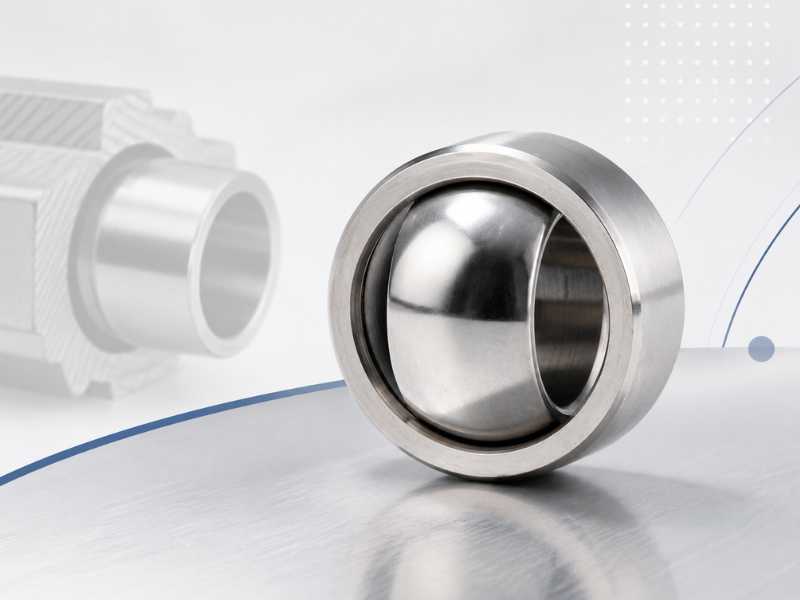
Pick the wrong fit and the bearing fails fast. The bearing itself usually isn't the problem. The outer ring is spinning in the bore, or the housing has cracked from over-interference. The choice between press fit and slip fit for a stainless steel spherical plain bearing follows a logic that comes from the load path, the housing material, and whether the inner ring rotates or oscillates on the shaft. Here's how to work through it.
The Default Rule: Press the Outer Ring, Slide the Inner Ring
For most oscillating applications, including actuator linkages, agricultural pivots, and industrial conveyor joints, press the outer ring into the housing and give the inner ring a slip or light transition fit on the shaft or pin.
The outer ring is stationary relative to the housing. Any looseness at that interface lets it rotate under cyclic loading. Once it starts, even fractionally, fretting corrosion sets in. You'll see the reddish-brown iron oxide powder around the bore face. The bore enlarges, the interference disappears, and the rotation rate climbs. It goes fast after that.
The inner ring is designed to oscillate relative to the outer ring through the spherical contact surface. It doesn't need to be locked to the shaft the way a rolling element bearing's inner ring does. A slip fit or light transition fit on the shaft lets it function correctly while keeping the pin removable for inspection or replacement.
Per ISO 12240-1, the recommended fit for radial load applications is a K7 or M7 housing bore against the standard bearing outer ring OD. For the inner ring on a stationary shaft in an oscillating application, an h6 or h7 shaft gives you the right small positive clearance.
When a Slip Fit on the Outer Ring Is Acceptable
In general, a slip fit on the outer ring is only acceptable when the bearing design and housing arrangement are specifically intended for it, or when the manufacturer’s fit table allows it for the actual load condition. Do not assume a slip fit is safe just because the part is a rod end or because the load is light; confirm the product type and the retention method first.
What Changes With Stainless Steel
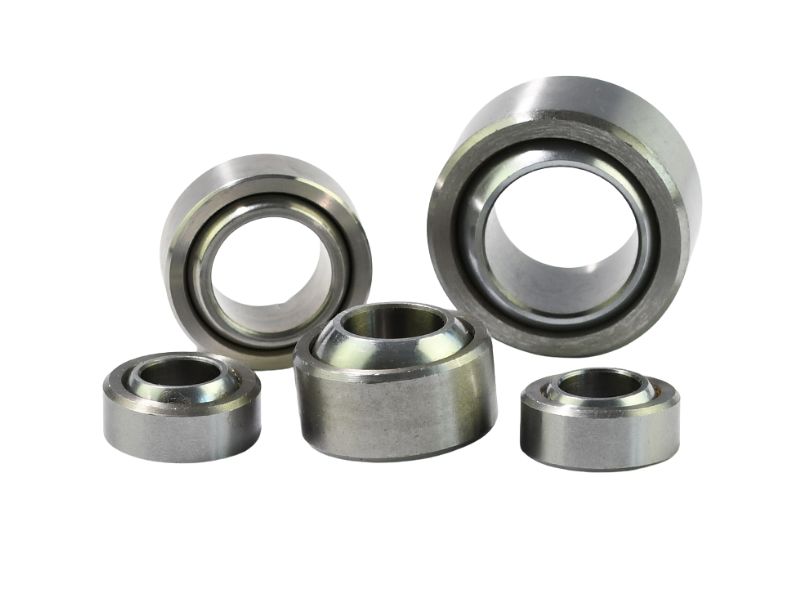
Standard spherical plain bearing installation guidance is written around bearing steel housings and shafts. Stainless changes the calculation in two ways.
Austenitic grades such as 304 and 316L have lower yield strength than carbon or alloy steel in the annealed condition. A housing bore can deform plastically under an interference that a steel housing handles without issue. For stainless housings, target the lower end of the recommended interference range. An H7/r6 fit that works fine in a 1045 steel housing may overstress a 316L wall if that wall is thin. If your housing wall thickness is less than roughly 1.5× the bearing outer ring wall thickness, run a stress calculation before pressing.
The second issue is galling. Austenitic stainless on austenitic stainless picks up on itself during installation. For stainless-on-stainless assemblies, follow the manufacturer’s mounting instructions and use only the recommended assembly lubricant or anti-seize specified for that product. Do not assume a molybdenum-disulfide paste is acceptable unless the bearing maker explicitly permits it.
PTFE-Lined Bearings: One Extra Step After Installation
Self-lubricating spherical plain bearings with a PTFE composite liner need one check that metal-to-metal bearings don't. Pressing slightly compresses the outer ring, which reduces the internal radial clearance between the ball and the housing bore. If the interference is on the tight end of the tolerance range, that clearance reduction can be enough to preload the bearing and raise breakaway torque noticeably.
After pressing a PTFE-lined bearing, check the breakaway torque or measure the inner ring bore shrinkage before assembling the pin. For GE series bearings, residual play after installation should sit within the reduced clearance band in the manufacturer's data sheet. Too tight? Machine the housing bore slightly, or verify that breakaway torque under your expected load is still within range.
This step gets skipped constantly. It's the most common reason a correctly-specced PTFE bearing feels stiff from day one.
https://youtu.be/B4ucmaB9dHgFracture Line Orientation in Two-Piece Outer Rings
Some spherical plain bearing designs use a fractured or split outer ring to allow assembly. When installing these, position the fracture line at 90° to the main load direction. A fracture sitting in the load zone lets the ring open slightly under peak load, altering contact geometry and cutting load capacity. Most manufacturers mark the fracture. Confirm the position visually before pressing, and hold the correct orientation until the ring fully seats.
Fit Selection: The Short Version
Use the manufacturer’s fit tables for the exact bearing series, housing material, and shaft condition. As a starting point, radial spherical plain bearings often use H7 for light-load housings, M7/N7 for heavy-load housings, and m6 (or n6) for interference on the shaft; h6 or g6 may apply only in specific hardened-shaft cases. Verify stainless-on-stainless and aluminum housings separately, and confirm residual clearance after installation for PTFE-lined bearings.
Profab Machine manufactures greasable stainless steel spherical bearings to the fit tolerances a given housing and shaft combination needs. If your housing geometry or material combination falls outside standard installation guidelines, fit tolerances can be worked through against your actual design. If a bearing outer ring rotates in the housing despite a correct-looking installation, see why a spherical plain bearing spins in the housing for how to diagnose it.