Most of what gets written about sealed versus open bearings is aimed at roller bearings. The logic there is familiar: sealed units keep grease in and contaminants out, open units allow easy relubrication and run at higher speeds. That framework doesn't transfer cleanly to spherical plain bearings. The sliding contact geometry, the role of PTFE liners, and the way contamination actually enters and damages these bearings all work differently. Applying roller bearing selection logic to a spherical plain bearing gets you the wrong answer more often than not.
Here's how the actual decision works.
What Open and Sealed Mean for Spherical Plain Bearings
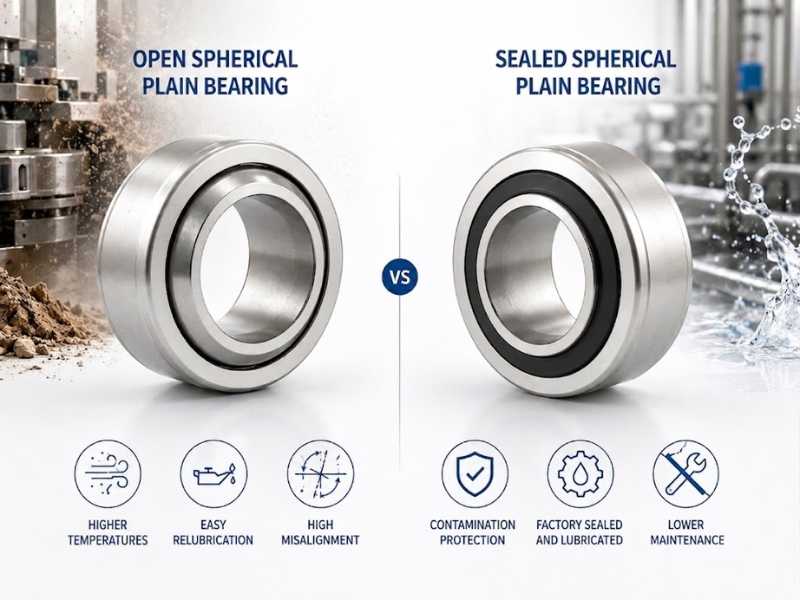
An open spherical plain bearing has no sealing elements on the side faces of the inner ring. The gap between the inner ring and the housing bore is exposed. In a metal-to-metal bearing, this means the contact surface and any grease film applied to it are accessible to whatever the bearing is operating in. Dust, moisture, process debris, and cleaning agents can reach the sliding contact zone directly.
A sealed spherical plain bearing adds a lip seal or wiper seal on each side of the inner ring. The seal lip sits against the inner ring face and flexes as the inner ring articulates. Its job is to retain grease inside the contact zone and prevent contaminants from entering from outside.
In the ISO 12240-1 designation, GE typically refers to the open spherical plain bearing series. Sealed versions are usually identified by suffixes such as ES or 2RS, depending on the manufacturer, while GEH generally refers to a wide inner ring series rather than the sealed version. Compared with an open bearing of the same size and load class, a sealed design usually produces slightly higher friction torque because the seal lips add contact resistance.
The PTFE Complication
This is where the selection logic for spherical plain bearings diverges most sharply from roller bearings.
Many spherical plain bearings are not grease-lubricated at all. PTFE-lined bearings use the liner material itself as the sliding interface. No external grease is applied to the contact surface because the PTFE provides the lubrication. Adding grease to a PTFE-lined bearing is unnecessary and sometimes counterproductive, since the grease can trap debris against the liner and accelerate wear rather than reduce it.
For a PTFE-lined bearing, the role of a seal changes entirely. The seal is no longer there to retain grease. Its only function is to prevent contamination from reaching the PTFE surface. Abrasive particles, grit, and fine metallic debris are the primary threats. A single hard particle embedded in the PTFE surface under load creates a point of accelerated wear that spreads outward.
So for PTFE-lined bearings in contaminated environments, a sealed variant provides meaningful protection even though there's no grease to retain. For PTFE-lined bearings in clean environments, like enclosed industrial automation or dry food processing lines with no washdown, an open bearing is perfectly acceptable and slightly cheaper.
For metal-to-metal bearings with external grease lubrication, the sealed variant retains the grease film and excludes contamination simultaneously. In this configuration, the selection logic is closer to roller bearing reasoning.
When to Choose an Open Bearing
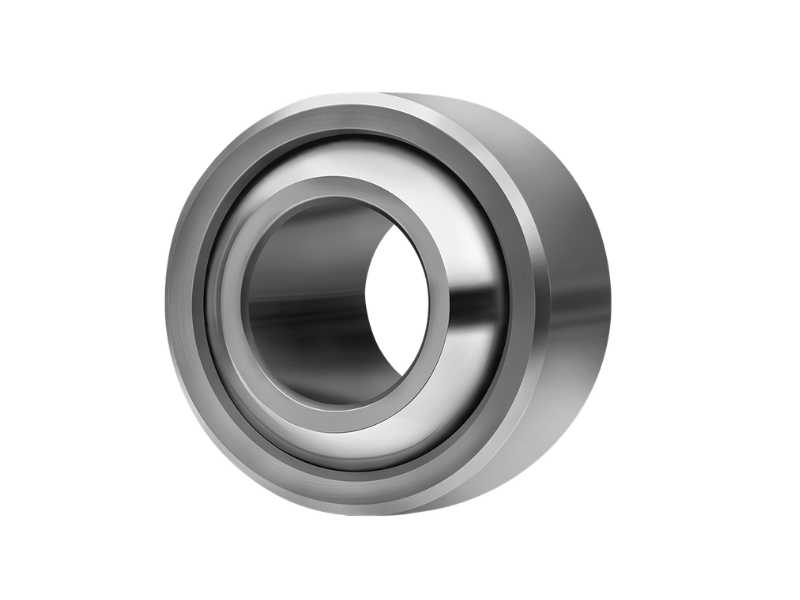
Open spherical plain bearings are the right choice in four situations.
The first is a clean, dry indoor environment. Machine tool linkages, enclosed automation, and precision assembly equipment don't expose the bearing to contamination sources that would warrant seal friction and cost. An open bearing in a clean environment performs identically to a sealed one and requires no additional consideration.
The second is a high-temperature application. Elastomeric lip seals have temperature limits. NBR seals typically operate up to around 100°C. FKM (Viton) seals extend that to roughly 200°C. Above these limits, the seal degrades and loses contact force, eventually providing no retention at all while adding friction. In high-temperature linkage applications, an open bearing with a metal-to-metal contact surface and a high-temperature grease specified for the actual operating range outperforms a sealed bearing with a seal that has already failed.
The third is when relubrication access is part of your maintenance procedure. Some heavy industrial applications with high loads and long service intervals need periodic relubrication via a grease fitting. Sealed bearings in this category typically have a grease fitting that purges the old grease out through the seal lip. This works, but in practice the seal lip can interfere with full grease distribution across the contact surface, particularly at high viscosity in cold conditions. An open bearing with a zerk fitting and an accessible contact zone allows more complete grease replacement.
The fourth is high angular misalignment applications. Sealed bearings have a seal lip that contacts the inner ring face. At large articulation angles, this contact geometry can cause the seal to lift, fold, or trap debris at the lip edge. For applications where the bearing oscillates near its maximum rated angle regularly, an open bearing avoids the seal geometry complications that arise at large articulation.
When to Choose a Sealed Bearing
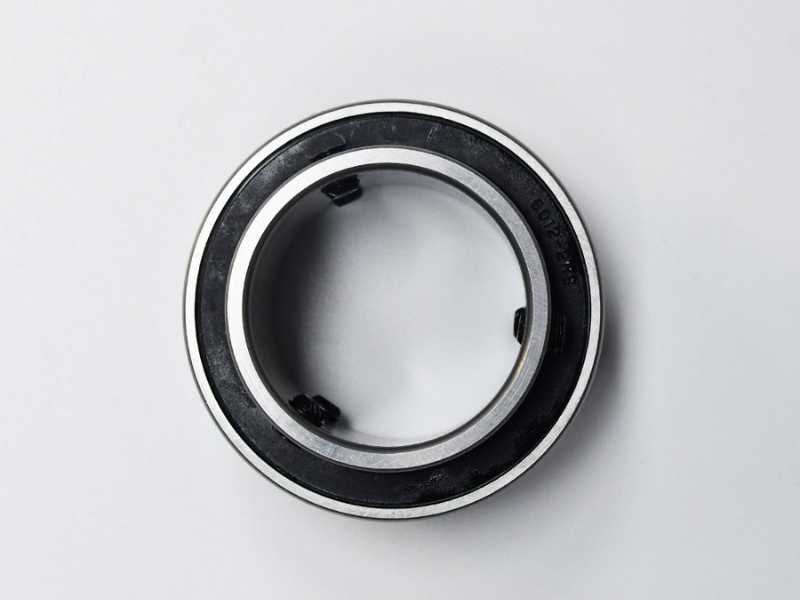
Sealed spherical plain bearings earn their place in four conditions.
Outdoor and exposed installations are the clearest case. Solar tracking actuators, agricultural equipment pivots, and construction machinery joints operate in environments where dust, rain, mud, and debris are constants. An open bearing in these conditions requires frequent relubrication to maintain a grease film thick enough to prevent contamination from reaching the contact surface. A sealed bearing handles the exclusion passively.
Washdown environments, including food processing and pharmaceutical equipment, present a specific challenge. High-pressure water jets used during CIP cycles force water and cleaning agents into any available gap. A sealed bearing with a wiper lip seal provides a barrier against this ingress. The seal material matters here: standard NBR seals are not resistant to the alkaline cleaning agents used in NaOH-based CIP at concentrations of 0.5 to 2%. FKM seals handle this chemistry better and should be specified whenever the bearing will be in a zone exposed to washdown. Check the seal material specification before assuming a "sealed" bearing is suitable for food-grade washdown. If your bearing is also PTFE-lined, the seal material and the liner material are two separate chemical compatibility questions. A FKM seal that survives CIP chemistry does not guarantee the PTFE liner is unaffected by repeated hot NaOH exposure above 70°C. Evaluate both independently.
Marine and coastal environments combine salt spray with continuous moisture and occasional submersion. The same seal selection logic applies: a sealed bearing in 316L with FKM seals outlasts an open bearing with the most diligent maintenance program in these conditions, because the maintenance interval required to keep an open bearing clean in salt spray is unrealistically short in most operational contexts.
Inaccessible or infrequent maintenance locations are a fourth driver. If a bearing is buried inside a sealed assembly, mounted at height, or part of a system where scheduled downtime is infrequent, a sealed bearing removes the dependency on maintenance access. The bearing's service life becomes a design parameter rather than a maintenance variable. ISO 12240-1 covers the dimensional and load rating standards for both GE and GEH series, and specifying the sealed GEH variant in these inaccessible locations is standard engineering practice.
The Seal Material Decision
Once you've decided a sealed bearing is right for your application, the seal material is a separate and often overlooked decision.
NBR (nitrile rubber) is the standard seal material in most catalog bearings. It handles mineral oil, water, and moderate industrial chemicals at temperatures up to roughly 100°C. For most dry industrial and light agricultural applications, it's fine.
FKM (fluoroelastomer, sold under the trade name Viton among others) extends chemical resistance to include most cleaning agents, hydraulic fluids, and aromatic hydrocarbons, with a temperature ceiling around 200°C. It costs more than NBR and is less available as a stock item, but for food processing and chemical process equipment, it's the correct specification.
PTFE-based seals are used in the most chemically aggressive environments. They handle essentially all industrial solvents and cleaning agents and operate across a wide temperature range. Their trade-off is lower elasticity, which means seal contact force depends more on geometric precision and less on material compliance. For high-angular-misalignment applications, this can become a sealing gap issue at the extremes of articulation.
One Decision the Catalog Doesn't Make for You
The sealed or open decision and the contact surface decision are independent. A sealed PTFE-lined bearing makes sense in a dusty outdoor application where contamination resistance matters but grease relubrication is not practical. An open metal-to-metal bearing with a grease fitting makes sense in a high-load indoor application where the maintenance schedule can support it.
The two decisions interact, but neither determines the other. Make them separately against your actual operating conditions.
Profab Machine manufactures stainless steel spherical plain bearings in PTFE-lined and high-misalignment configurations. Seal material specifications for food-grade or chemical process environments can be confirmed against your operating conditions.