
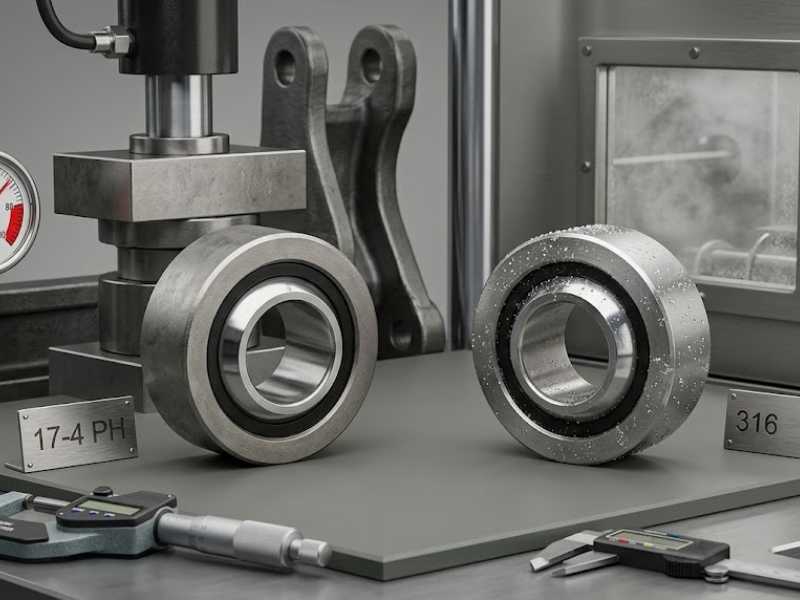
Most engineers default to 316 as soon as stainless steel enters the conversation. It is familiar. It is widely stocked. It feels like the conservative call. In spherical bearing service, though, that reflex can lead to premature wear, distorted contact surfaces, or a redesign that costs more than it should. Cyclic loading, angular misalignment, and localized contact stress change the equation quickly. The real choice between 17-4 PH and 316 is not about which alloy sounds more corrosion-resistant. It starts with load.
Two Very Different Materials Under the Same Label
You do not need a metallurgy degree to understand why 17-4 PH and 316 behave so differently once load is applied. Their internal structures tell most of the story.
316 is an austenitic stainless steel. At room temperature, its grain structure stays comparatively soft and ductile. That softness helps explain its good formability and excellent corrosion resistance, but it also limits how hard the material can be pushed mechanically. Typical yield strength sits around 275 MPa. Hardness comes in around 220 HB.
17-4 PH is a precipitation-hardening grade. It begins in a condition that machines well, then gains strength through a controlled aging heat treatment. After the H900 aging cycle (482°C for one hour), yield strength reaches approximately 1,170 MPa, with hardness up to 44 HRC. That is more than four times the yield strength of 316.
In a spherical bearing, that gap matters. Load is transferred through a small contact zone between the ball and the outer race. Higher material yield strength allows higher contact stress before permanent deformation begins, which means higher static and dynamic load ratings in the same bearing envelope.
The compromise is corrosion resistance. 316 contains 2.1% molybdenum, the element that gives it stronger resistance to pitting and crevice corrosion in chloride environments. 17-4 PH contains no molybdenum. Its corrosion resistance is generally comparable to 304 in most media: dependable in atmospheric and mildly aggressive conditions, but not the first choice for sustained or severe chloride exposure. There is also a specialized design consideration: 316 is non-magnetic, while 17-4 PH is magnetic after aging, which can matter around electronics-adjacent assemblies or certain medical equipment.
Where 316 Holds Its Ground
316 earns its place when corrosion resistance controls the design. In food processing equipment, pharmaceutical manufacturing lines, marine deck hardware, and systems that see regular CIP (clean-in-place) chemical wash cycles, its passive film stability and chloride resistance provide reliable service at a practical cost compared with higher-alloy options.
For spherical bearings, 316 is often specified in food and beverage lines, textile machinery, pharmaceutical processing equipment, and marine hardware exposed to salt air or intermittent seawater contact. These settings can involve dilute acids, chlorinated cleaning agents, or salt spray. Material contamination can also become a regulatory issue, which rules out many standard bearing materials.
The weakness appears when load rises. Bearing suppliers commonly position 316 stainless for moderate loads at slow, intermittent speeds. It is softer than 440C bearing steel or 17-4 PH, so tight dimensional tolerances are harder to hold through grinding. In practice, that often means a semi-precision bearing with less margin for high contact pressure.
For maintenance-free PTFE-lined spherical plain bearings, maximum allowable static contact pressure typically runs around 345 MPa (50,000 psi), with maximum dynamic contact pressure significantly lower at around 86 MPa (12,500 psi). With 316’s yield strength at 275 MPa, the material is already close to its structural limit at the upper end of the static contact range. There is little useful reserve for shock loading or sustained high-cycle oscillation.
When an application uses 316 spherical bearings under moderate, predictable loads in a corrosive environment, the selection makes sense. When loads are heavy, cyclic, or impact-prone, 316 will usually wear faster than the specification implies. The failure may look like mechanical wear rather than corrosion, which can send a failure analysis in the wrong direction.
Load Is the Deciding Variable
The selection logic between 17-4 PH and 316 comes back to a simple engineering question: how does the actual load demand compare with the bearing’s capacity?
Spherical bearings carry two types of load. Static load is the maximum non-moving force the bearing can absorb without permanent deformation. Dynamic load is the rated load under oscillating or continuous movement over a defined service life. Material yield strength sets the ceiling for both.
With 17-4 PH at H900 condition delivering yield strength around 1,170 MPa versus 316’s 275 MPa, the allowable contact stress capacity of a 17-4 PH bearing race is dramatically higher. In practical terms, a 17-4 PH spherical bearing in the same bore size can carry substantially higher radial and axial loads before the contact surfaces begin to deform.
Dynamic service requires a more careful look. H900 delivers the highest hardness and peak static strength, but it also brings lower toughness and reduced resistance to fatigue cracking. H1025 (aged at 552°C for four hours) produces tensile strength in the range of approximately 1,100 MPa (155 ksi minimum per ASTM A564) with significantly better impact toughness and stress corrosion cracking resistance than H900. For spherical bearings working under cyclic oscillating loads, construction linkages, industrial actuators, or marine structural joints, H1025 is usually the better heat treatment condition.
Quick load-based selection logic:
- Light to moderate static load + aggressive corrosion environment → 316
- Heavy static load + mild corrosion environment → 17-4 PH (H900)
- Cyclic or dynamic load + moderate corrosion → 17-4 PH (H1025)
- High-cycle fatigue + impact loading → 17-4 PH (H1025 or H1150)
Industry-by-Industry Breakdown
The right grade depends on the bearing’s environment and duty cycle.
The table below maps common application environments to the more appropriate material based on load intensity and corrosion exposure:
| Application | Load Type | Corrosion Level | Recommended Grade |
|---|---|---|---|
| Marine deck hardware (above waterline) | Light to moderate | High chloride | 316 |
| Offshore structural linkage | Heavy static / cyclic | High chloride | 17-4 PH (H1025) |
| Food processing line (CIP cleaning) | Light to moderate | Chemical wash | 316 |
| Industrial actuator linkage | Heavy cyclic | Mild | 17-4 PH (H1025) |
| Pharmaceutical equipment | Light | Chemical / sanitary | 316 |
| Construction equipment, heavy links | Heavy static | Atmospheric | 17-4 PH (H900) |
| Aerospace structural joint | High cyclic + impact | Variable | 17-4 PH (H1025) |
The pattern is clear. 316 belongs in food, pharmaceutical, and light marine applications where regulatory compliance and chemical resistance dominate the specification. 17-4 PH belongs where loading is heavy, cyclic, or both, provided the corrosion environment can be handled through treatment, inspection, or maintenance.
Offshore structural equipment is one place where the boundary becomes less tidy. These spherical bearings may face heavy dynamic loads and constant chloride exposure at the same time. In that situation, engineers often choose 17-4 PH with electropolishing or passivation treatment because contact stress overload can be more severe than a managed corrosion risk. As noted in the technical reference for 17-4 stainless steel, crevice corrosion can still occur in stagnant seawater environments, so designs should allow for drainage and inspection access.
The Heat Treatment Variable Nobody Specifies Clearly
Specifying “17-4 PH” on a drawing is not enough. Without the heat treatment condition, a major engineering variable is still undefined.
The three most common aging conditions:
H900 (aged at 482°C): Maximum hardness and strength, around 44 HRC and tensile strength up to 1,310 MPa. Best suited for applications where static load capacity and wear resistance are the primary demands. Lower toughness makes it a poor fit for impact or shock-dominated service.
H1025 (aged at 552°C): Balanced condition with tensile strength approximately 1,100 MPa (ASTM A564 minimum 155 ksi), significantly improved impact toughness, and better resistance to stress corrosion cracking than H900. The practical recommendation for most spherical bearing applications in dynamic and oscillating service.
H1150 (aged at 621°C): Lowest strength among the heat-treated conditions, but maximum toughness and ductility. Used when impact loading is extreme and some reduction in load rating is an acceptable trade.
For most industrial spherical bearing applications, H1025 is the logical starting point. H900 can improve load capacity on paper, but it also raises brittleness risk in assemblies exposed to vibration or oscillation. A bearing expected to survive tens of thousands of oscillation cycles needs toughness as well as hardness.
As described in the Wikipedia overview of precipitation hardening stainless steels, this class of alloys achieves its strength through the precipitation of intermetallic compounds during aging, a mechanism fundamentally different from the cold-work hardening of austenitic grades like 316.
Procurement note: When sourcing 17-4 PH spherical bearings, always confirm the heat treatment condition on the material test report (MTR). H900 and H1025 look identical on the outside but have meaningfully different toughness profiles. For dynamic applications, specify H1025 explicitly in your procurement documents, not just “17-4 PH.”
Making the Call
The 17-4 PH versus 316 decision for spherical bearings is not a contest over which stainless steel is better. Each alloy has a clear operating range where it is the right choice.
Use 316 when corrosion resistance is the controlling requirement: food-grade compliance, marine splash zones, pharmaceutical equipment, or applications with regular chemical cleaning cycles. Accept the lower load rating and size the bearing accordingly.
Use 17-4 PH when load controls the specification: heavy static loads, high-cycle dynamic oscillation, structural linkage applications, or any case where failure from contact stress overload carries greater consequences than managing the corrosion environment through surface treatment or maintenance.
When heavy loading and aggressive corrosion appear together, the usual answer is 17-4 PH with passivation and a maintenance protocol, not 316 forced beyond its contact pressure capacity. A bearing specified correctly for load and maintained for corrosion will outlast a corrosion-optimized bearing that fails early from mechanical overload.
For procurement teams: always request material test reports confirming the alloy grade and, for 17-4 PH, the aging condition. The heat treatment code is the detail that connects the datasheet to the actual component installed in your assembly.
Profab Machine supplies stainless steel spherical bearings in both 316 and 17-4 PH grades, with full material traceability and MTR documentation available. Custom bore sizes, OD dimensions, and heat treatment conditions are supported for OEM and industrial procurement requirements. Contact Profab Machine for specifications and sourcing inquiries.
Ray Wang
Ray Wang is an engineer at our company with more than 20 years of experience in stainless steel applications and automotive parts. Over the years, he has built deep expertise in precision machining, material behavior, and practical engineering solutions. His hands-on background and strong focus on quality help ensure every project meets demanding performance and reliability standards.
Ray Wang
Ray Wang is an engineer at our company with more than 20 years of experience in stainless steel applications and automotive parts. Over the years, he has built deep expertise in precision machining, material behavior, and practical engineering solutions. His hands-on background and strong focus on quality help ensure every project meets demanding performance and reliability standards.