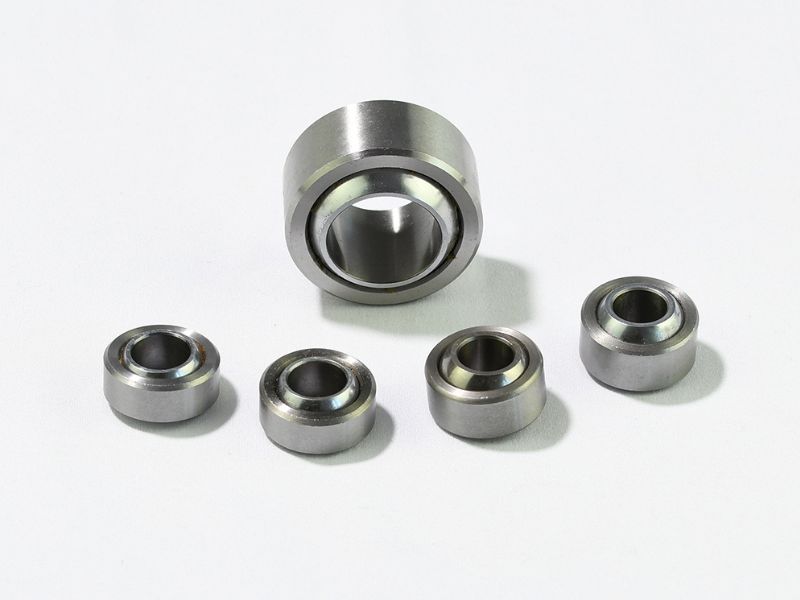

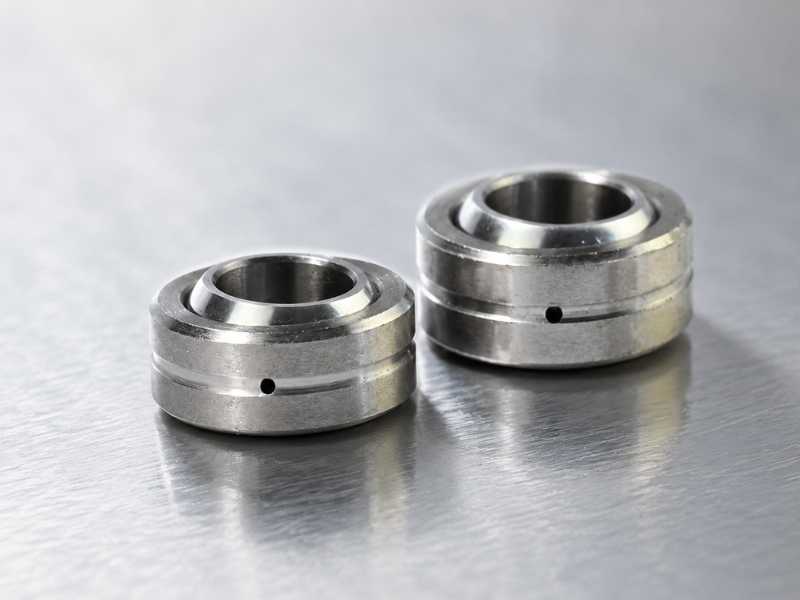
Stainless steel spherical bearings are designed to tolerate misalignment and oscillating loads. When they fail prematurely, the cause is almost never a random event. It’s a combination of identifiable engineering decisions made upstream: wrong grade, wrong fit, wrong lubrication strategy, or a load spectrum that never got properly analyzed.
This post walks through the most common failure modes, why they happen, and what the selection and installation decisions that led there actually looked like.
1. Fretting and Micro-Slip at the Bore Interface
This is the failure mode that catches engineers off-guard most often. The spherical bushing sits in a housing bore. Under oscillating loads, the outer ring can begin to micro-slip against the housing. Fretting generates iron oxide debris (a dark reddish powder around the joint), which acts as an abrasive and accelerates bore wear.
In stainless steel applications, the situation is more complicated. Austenitic stainless grades like 304 and 316 have a relatively low hardness (typically HRC 18–22 in the annealed state) and a high coefficient of friction against themselves. If the outer ring and housing are both stainless, fretting risk is higher than in a standard steel-on-steel fit. The fix isn’t always a harder material. It’s a tighter housing tolerance and correct interference fit per ISO 286 or ANSI B4.1.
A spherical bushing that’s been pressed in with insufficient interference will always fret under dynamic load. The recommended practice for oscillating applications is to treat the fit as H7/r6 or tighter, not the looser H7/p6 that some machinery books cite for static assembly.
2. Wrong Grade for the Corrosion Environment
The stainless designation misleads buyers more than any other factor. A spherical bearing specified as “stainless” without further qualification could be 304, 316, or 410.
In chloride-bearing environments, like coastal machinery, food conveyors, and marine actuators, 304 spherical bearings will develop pitting corrosion on the inner ring raceway and the sliding contact surface within months. The pits interrupt the PTFE liner (in self-lubricating types) or disrupt the oil film (in grease-lubricated types), and contact stress at pit edges drives spalling.
316L is the correct baseline for anything in contact with salt water, cleaning chemicals, or food-grade acids. For applications above 60°C with aggressive CIP chemistry, or for offshore environments where the bearing sees intermittent seawater immersion, Duplex 2205 or Super Duplex 2507 is worth evaluating. The ASTM A276 standard and Wikipedia’s stainless steel grade comparison provide a useful starting framework for material selection decisions.
What the failure looks like: pitting on the inner ring surface, brown staining that doesn’t clean off, spalled material embedded in the PTFE liner. In severe cases, the liner detaches and the metal-to-metal contact destroys the spherical surface within weeks.
3. Preload Loss and Radial Play Growth
A spherical plain bearing or spherical bushing is designed with a defined initial internal clearance. Over service life, wear at the sliding contact surfaces increases this clearance. When play grows beyond the design limit, the bearing begins to rock rather than rotate smoothly, and the load zone narrows to a small arc on the raceway. Contact stress at that arc increases disproportionately, accelerating wear.
In food processing and pharmaceutical equipment, this failure mode is common because operators avoid aggressive relubrication to prevent contamination. Self-lubricating PTFE-lined spherical bushings are marketed as maintenance-free, and technically they are—within a defined load and cycle limit. That limit is usually around 50,000–100,000 hours at rated load. Exceeding that service interval without inspection is what leads to the rapid end-of-life phase where play grows quickly.
The engineering check here is straightforward: measure radial play with a dial indicator at defined service intervals. For most industrial spherical bearings in the GE series, allowable play growth before replacement is around 0.1–0.15 mm, depending on bore diameter. Beyond that threshold, the bearing should be replaced regardless of visual appearance.
4. Misalignment Beyond the Angular Compensation Range
The defining feature of a spherical bearing is angular compensation. The inner ring can pivot relative to the outer ring—typically ±5° to ±15° depending on the series (GE vs GEG, for example). When the actual shaft misalignment in the assembly exceeds this angular range, the edge of the inner ring contacts the outer ring at a hard stop. Load is no longer distributed over the spherical surface; it concentrates at the edge contact point.
Edge loading under repeated cycling causes rapid spalling and, in severe cases, produces visible burrs at the edge of the inner ring. This is often misdiagnosed as a material defect or an overload condition. The actual cause is an installation misalignment that the bearing was never designed to absorb.
The correct approach is to verify that the angular misalignment in the fully assembled and loaded state does not exceed the bearing’s rated angular clearance. This needs to be checked under load, not just in the static unloaded assembly. Gravity, preload, and thermal expansion all affect the actual misalignment angle at operating conditions.
5. Overloading Outside the Dynamic Load Rating
Spherical plain bearings are rated for a specific dynamic radial load (C) and a static load (C0). Operating above these values doesn’t cause immediate failure. It compresses the expected service life. The relationship follows the standard bearing life equation (plain bearing PV and wear life equations), where doubling the load reduces fatigue life by a factor of roughly 8 to 27, depending on the bearing type.
In practice, engineers frequently underestimate dynamic load components. A linkage that appears to carry a 5 kN static load may see 15–20 kN peak loads during machine startup, braking, or impact. If the selection was based on the static design load and the bearing was sized to C/P = 3 or 4 without a dynamic multiplier, the bearing is operating outside its rated life from day one.
The solution is to capture peak loads during commissioning using a load cell or strain gauge on the linkage, then verify the C/P ratio against the actual peak, not the nominal design load. For oscillating applications, the dynamic multiplier applied to peak loads should typically be 1.5–3 depending on shock character.
6. Galvanic Corrosion from Mixed Metals
In assemblies where a stainless spherical bearing interfaces with aluminum housings, carbon steel shafts, or zinc-plated fasteners, galvanic couples form whenever moisture is present. The stainless acts as the cathode; the less noble metal corrodes. But the stainless surface itself can be affected: corrosion products from the anodic metal deposit onto the spherical contact surface and embed in PTFE liners, acting as abrasives.
The practical answer is to use stainless on stainless where possible, or to isolate dissimilar metals with a dielectric coating or polymer shim at the interface. In marine applications, an aluminum housing with a stainless spherical bushing pressed in will show accelerated bore corrosion at the housing-to-outer-ring interface if the assembly is frequently wet.
Choosing the Right Spherical Bearing for Your Application
Most of the failure modes above are preventable at the specification stage. The decisions that matter: correct material grade for the corrosion environment, correct fit tolerance for the housing bore, self-lubricating vs. grease-lubricated based on relubrication accessibility, and an accurate peak load estimate that accounts for dynamic events, not just static design loads.
Profab Machine manufactures stainless steel spherical bearings in COM, SLB, YPB and GEC series, with bore sizes from 5 mm to 100 mm, in 304, 316L, and 17-4PH. If your application involves oscillating loads in a corrosive environment, material grade and liner selection can be discussed against your actual operating conditions.