Stainless steel finish is the last step in fabrication, and it does more than change how a part looks. It sets the surface roughness that determines how well a part resists corrosion, sheds contamination, and holds up under handling. The right finish depends on where the part is going: a tank interior in a food plant needs something very different from a decorative handrail. This article covers the standard mill and polished finish grades, how to compare them, and where non-stainless plated hardware fits into an otherwise stainless assembly.
What a Stainless Steel Finish Actually Sets
A stainless steel finish is a fabrication step that determines the metal's corrosion resistance, wear resistance, electrical conductivity, weldability, and hygiene performance, not just its appearance. The key metric behind all of that is surface roughness, measured as Ra (average roughness) in North America or Rz (mean roughness depth) in Europe. These finish designations follow the ASTM A480 standard for stainless sheet, strip, and plate, which is why "No.4 finish" or "2B finish" means the same thing across suppliers.
Mill Finishes
Mill finishes come straight off the rolling and annealing line with no additional polishing. They're the starting point every other finish builds on.
No.1 Finish (1D)
The No.1 finish removes the dark scale formed during hot rolling, annealing, and acid pickling, leaving a dull, non-reflective, uneven surface with a high roughness (Ra 3.0–7.5 µm). It isn't aesthetically appealing, but it's tough and inexpensive. Common in furnace parts, heat exchangers, and other non-decorative industrial construction where appearance doesn't matter.
No.2D Finish
The 2D finish is cold-rolled, annealed, and pickled like the 2B finish below, but skips the final polished-roll pass, leaving a smooth but dull, non-reflective surface. Its non-directional texture retains lubricants well during deep-drawing operations, which makes it the practical choice for parts that need to be formed into complex shapes: automotive exhaust components, chemical processing equipment, and refinery hardware.
No.2B Finish
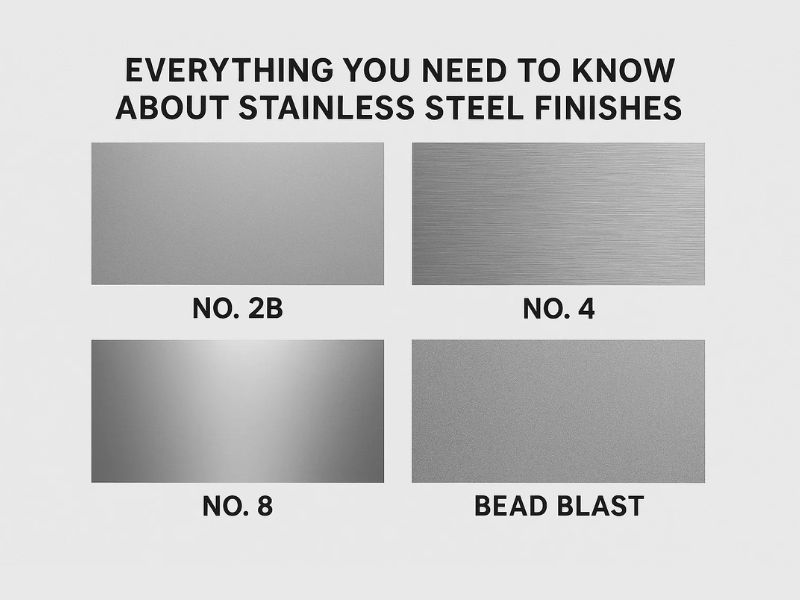
The 2B finish is cold-rolled, annealed, pickled, and finished with a light temper pass through polished rolls, producing a smooth, moderately reflective surface (Ra 0.1–0.8 µm) with excellent flatness. It's the most common and versatile mill finish, widely used in cookware, small tanks, food processing equipment, and pharmaceutical machinery for its balance of durability, hygiene, and cost. It also serves as the standard starting surface for mechanically polished finishes like No.3 and No.4.
BA Finish (2R)
Bright annealed (BA) stainless is cold-rolled and then annealed in a controlled, oxygen-free atmosphere rather than pickled, which produces a smooth, bright, mirror-like surface (Ra 0.05–0.1 µm) without any mechanical polishing step. Because it achieves high reflectivity and very low roughness without abrasive processing, BA is specified where both hygiene and appearance matter: surgical instruments, trim appliances, and traffic mirrors.
Polished Finishes
Polished finishes are produced by mechanically abrading the surface with progressively finer abrasives, ranging from a coarse satin texture to a near-mirror shine.
No.3 Finish
Directional wet-polishing of a 2B surface with a coarse 100–120 grit abrasive belt produces a satin, matte finish with a visible linear grain and roughness typically above 1.0 µm. Used in food processing equipment, laboratory apparatus, and architectural work that calls for a coarse brushed look.
No.4 Finish
The most widely recognized stainless finish. Directional wet-polishing with a finer 120–180 grit produces a smoother, brighter, slightly reflective surface with fine parallel lines, Ra typically 0.2–1.0 µm. Standard in elevators, kitchen sinks, restaurant equipment, and architectural panels.
No.5 Finish (Satin/Brushed)
Also called EN 2K. Made with a series of progressively finer abrasives to produce a uniform matte texture with fine parallel lines. The slightly rougher surface resists scratches and abrasion better than a No.4 finish, which makes it a common choice for cladding, handrails, and signage.
No.6 Finish (Dull Satin)
Tampico brushing a No.4 surface produces a non-directional, dull satin look, smoother and less reflective than No.5. It was more common in late-20th-century architecture and today mostly appears on statues and ornamental work.
No.7 Finish
Buffing a finely ground surface produces a high-luster, near-mirror appearance, though faint grit lines from the grinding stage can still be visible. Used mainly for ornamental and architectural features like column covers and decorative wall panels.
No.8 Mirror Finish
The most reflective finish under ASTM standards, produced by polishing with progressively finer abrasive grits and extensive buffing. Faint buff lines may remain under close inspection, but the result is a smooth, mirror-like surface used for signage, reflectors, and architectural sculpture, notably Chicago's Cloud Gate ("the Bean").
Comparing the Finishes
Surface Roughness and Hygiene
For food processing, pharmaceutical, and medical applications, Ra matters more than appearance. A lower Ra value means fewer microscopic valleys for contaminants to lodge in, which is why a 2B finish (0.1–0.8 µm) is easier to sanitize than a No.1 finish, even though both are technically "unpolished." Sanitary industries specify low-Ra finishes to meet cleanability requirements, not for looks.
| Finish Name (ASTM & EN) | Production Method | Appearance | Typical Ra (µm) | Primary Advantages | Common Applications |
|---|---|---|---|---|---|
| No. 1 (1D) | Hot-rolled, annealed, pickled | Dull, non-reflective, rough | 3.0-7.5 | Durable, low cost, high temperature use | Industrial, furnace parts, heat exchangers |
| No. 2D (2D) | Cold-rolled, annealed, pickled | Smooth, non-reflective, dull | 0.2-0.8 | Ideal for deep drawing, retains lubricants | Chemical equipment, car exhausts |
| No. 2B (2B) | Cold-rolled, annealed, pickled, temper passed | Smooth, moderately reflective, slightly shiny | 0.1-0.8 | Versatile, cost-effective, good hygiene | Food processing, cookware, pharmaceutical machinery |
| BA (2R) | Cold-rolled, bright annealed | Smooth, bright, mirror-like | 0.05-0.1 | High reflectivity without polishing, good hygiene | Surgical instruments, trim appliances, traffic mirrors |
| No. 3 (1G-2G) | Directionally wet-polished (100-120 grit) | Satin, matte, with linear grain | >1.0 | Good aesthetics, cleanable | Food processing, brewery equipment, architecture |
| No. 4 (1J-2J) | Directionally wet-polished (120-180 grit) | Smoother, brighter, with fine lines | 0.2-1.0 | Most popular, cleanable, aesthetic | Kitchen sinks, elevators, restaurant equipment, appliances |
| No. 5 (2K) | Directionally wet-polished (series of abrasives) | Matte, non-reflective, parallel lines | 0.5-0.8 | Scratch resistant, durable | Architectural cladding, handrails |
| No. 6 (1K-2K) | Tampico brushed on a No. 4 finish | Soft, dull, satin, non-directional | <0.5 | Unique aesthetic, less common today | Statues, architectural accents |
| No. 7 | Buffed on a finely ground surface | High-luster, nearly mirror-like | Not standardized | Highly reflective, ornamental | Column covers, ornamental trim |
| No. 8 | Polished with progressively finer abrasives, then buffed | Highly reflective, mirror finish | Not standardized | Ultimate aesthetic, pristine reflection | Signs, reflectors, wall panels, sculpture |
Coatings for the Non-Stainless Hardware in an Assembly
Stainless assemblies aren't always all-stainless. Tie-rod balls, shaft bodies, and other high-wear contact points are sometimes specified in plated carbon steel rather than stainless, usually for cost or a specific hardness/wear requirement the stainless grades don't hit as economically. Where that's the case, the plating on those components is a separate finish question from the mill or polish grade on the stainless body.
Electroplating is the standard route for these components: chrome, nickel, or zinc deposited electrochemically to build hardness, wear resistance, and corrosion protection onto the part's surface.
- Chrome plating increases surface hardness and corrosion resistance. Decorative chrome runs 0.5–1 µm thick; hard chrome for wear surfaces runs 5–80 µm. Common on tie-rod balls, shaft bodies, and ball heads.
- Nickel plating targets wear resistance and corrosion protection, typically 10–30 µm thick, common on tie-rod SA-series components.
- Zinc plating is the economical option for corrosion protection with a decorative finish, typically 5–15 µm thick, used on ball bearing sleeves, metal tubes, tie-rod bodies, threaded nuts, and ball head housings.
Cost runs chrome above nickel above zinc, which is usually the deciding factor once the functional requirement (hardness, wear, or basic corrosion protection) is met. For carbon-steel fasteners paired with a stainless assembly, black oxide (bluing) or phosphating are the other common pretreatments, both cheaper than plating but offering less corrosion protection, appropriate for indoor or low-exposure hardware rather than anything that will see moisture or salt.
Long-Term Maintenance and Care
Maintenance needs scale with the finish. Directional finishes like No.4 should be cleaned along the grain to avoid visible scratching; smooth, non-directional finishes like No.8 are more forgiving. Following the correct cleaning direction and method for the specific finish matters more over the part's life than the initial finish choice does.
Custom Finishes
Standard finishes don't cover every case. Engineers sometimes specify custom Ra or Rz targets for sensitive applications, such as superconductor components or medical implants, where reliability and precision leave no room for a generic mill or polish grade.
The Economics of Stainless Steel Finishes
Mill finishes like 2B are the cheapest upfront, but the lowest purchase price isn't always the lowest lifecycle cost. A cheaper, less hygienic finish can corrode faster or need more frequent cleaning and maintenance, which adds up over the part's service life. A finish that's easier to clean and more contamination-resistant can cost less overall by reducing maintenance and downtime, even at a higher initial price. Specify against total lifecycle cost, not just the purchase order line item.
Conclusion
From the rugged No.1 finish in industrial settings to the mirror brilliance of a No.8 finish, every stainless surface trades off differently on cost, hygiene, and appearance. The right choice follows the environment, function, and maintenance the part will actually see. Profab Machine works through finish selection, including plated hardware for mixed-material assemblies, against the actual application. Contact Profab Machine to work through the right specification for your project.
FAQ
What is the best stainless steel finish for outdoor use?
Mill finishes like No.1 hold up well outdoors since their higher roughness doesn't compromise strength, and they're inexpensive to specify for structural or non-decorative outdoor parts. For outdoor applications where appearance also matters, a 2B or No.4 finish combined with the correct grade (316 over 304 in coastal or salt-exposed environments) is the more common specification.
Which stainless steel finish hides fingerprints best?
Brushed and satin finishes, such as No.4 or No.5, hide fingerprints and smudges better than a mirror finish. The textured surface breaks up reflections, which is why these finishes are common in high-touch areas like kitchens and elevator interiors.
Can you mix different stainless steel finishes in one project?
Yes, and it's common practice. Mirror or No.7/No.8 finishes are typically reserved for accent or highlight surfaces, while brushed finishes like No.4 cover the higher-traffic, higher-touch areas where a mirror finish would show wear and fingerprints quickly.