Choose Swiss turning when the part is slender, small in diameter and repeated, so the guide bushing can support the cut close to the tool. Choose conventional CNC turning when the part is short and stubby or larger in diameter. A fixed-headstock or turn-mill route sits between the two for short parts.
Two checks decide most cases. The first is the length-to-diameter ratio, where trade sources put the switch point at about 3:1 to 4:1. The second is the bar diameter: the usual rule of thumb is bar of 1¼ in (about 32 mm) or smaller, and machines are catalogued up to 38 mm. Stainless steel adds a third check, because 304 and 316L cut differently from carbon steel and punish an unsupported or dwelling cut.
| Question | Swiss turning | Conventional CNC turning |
|---|---|---|
| Length-to-diameter | Suited to ratios from about 3:1 to 4:1 and up | Fine for short parts; a long thin part flexes away from the tool |
| Bar diameter | Fixed per machine; usually about 32 mm or less | Larger bar |
| Bar stock | Straight, usually ground bar for the guide bushing | Ordinary bar, not ground, works |
| Features per part | Turning, cross holes and flats in one setup | Often a second operation, or live tools on a fixed-headstock machine |
| Best fit | Slender parts in repeat or small-batch runs | Short parts, large diameters, one-offs |
What the Guide Bushing Changes
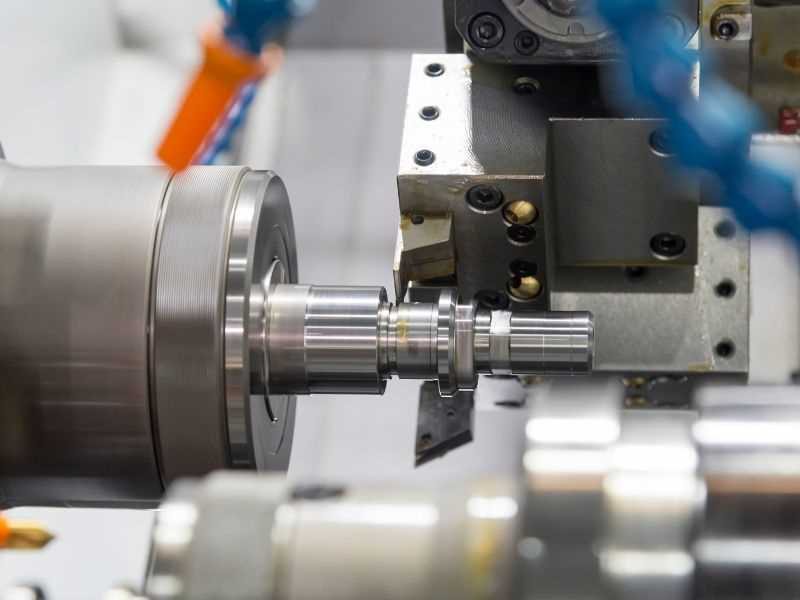
On a conventional lathe, a chuck grips the bar and the tool travels along it, so the farther a part sticks out, the more it bends away from the cutting force. On a Swiss-type lathe, a collet grips the bar and the headstock slides it through a guide bushing past a stationary tool. The bushing holds the bar right at the point of the cut.
Modern Machine Shop describes the result this way. The tool always works a fraction of an inch from the bushing's support. Parts with a ratio of 4:1 or more can then be cut far more aggressively without losing tool life or tolerance. CTE adds, in a 2011 article, that a rigid Swiss-style machine permits much heavier depths of cut than a conventional lathe.
Length-to-Diameter and Bar Diameter
CTE reports that a guide bushing suits relatively thin parts with a length-to-diameter ratio of at least 3 or 4 to 1. A 2007 Modern Machine Shop article built around Index, a turn-mill builder, says a Swiss-type lathe is needed at 4 to 1 or greater. A 2010 Modern Machine Shop shop report says ratios larger than 3:1 should be machined using the guide bushing. Treat 3:1 to 4:1 as the range where Swiss starts to pay off.
Diameter sets the other limit. A 2011 CTE article says Swiss-style machines are categorised by their maximum bar capacity, typically from 2 mm to 38 mm. The same article suggests the process for any part that can be machined from bar of 1¼ in (about 32 mm) or smaller. The Index Traub machines in the 2025 CTE article have spindle clearances of 13, 20 and 32 mm. A Swiss-type machine must be sized to the job, because the bar passes through a guide bushing of a fixed size. Above the capacity of the machine in question, conventional turning takes over.
Worked examples
| Part | Length ÷ diameter | Likely route |
|---|---|---|
| 6 mm pin, 40 mm long, repeat orders | 6.7 | Swiss candidate |
| 3 mm shaft, 45 mm long | 15 | Swiss |
| 12 mm 316L pin, 30 mm long | 2.5 | Conventional or fixed headstock, unless many cross holes and flats are needed |
| 40 mm bushing, 30 mm long | 0.75 | Conventional |
| 50 mm flange, 20 mm long | 0.4 | Conventional, since it is larger than the usual 32 mm class |
These are our own illustrations of the rules above. Tolerance, features and quantity can change the answer for a given drawing.
Bar Stock and the Convertible Machine
The guide bushing sets a requirement on the bar. An Index technical sales manager told CTE that the stock has to be really straight to slide through the bushing, which in practice means ground bar. Ground bar costs more: the 2010 shop report puts it at as much as four times the price of cold-drawn stock. The same report notes that some suppliers hold ordinary cold-drawn bar precisely enough to push through a guide bushing, so ground bar is the default and not the only option. BSSA also notes that cold-drawn austenitic bar can be harder to machine than annealed bar.
The line between the two routes is also softer than it looks. Some Swiss-type machines convert to fixed-headstock mode by removing the bushing housing. That takes about 10 to 15 minutes on the Index models. The 2010 report gives about 3 hours to change that shop's Tsugami BE20 from guide-bushing to chucker mode, so ask how long the change takes on the machine your supplier uses. Marubeni Citizen says its machines can then run short parts of up to 50.8 mm (2 in) from ordinary bar without ground stock. Production Machining notes that these convertibles suit parts that do not meet the length-to-diameter ratios of true Swiss work.
Adaptive guide bushings loosen the bar requirement from the other side. Citizen reports that its air-adjusted bushing can compensate for bar diameter deviations of up to 0.203 mm (0.008 in), so unground bar can be used on some jobs.
Turn-Mill and Fixed Headstock Instead of Swiss
A short part does not need the bushing. The 2007 Modern Machine Shop article says parts with lower length-to-diameter ratios may be machined economically on turn-mills, which have a fixed headstock. It quotes the CEO of Index, a turn-mill builder. He says its studies found that 70 to 80 percent of 1¼ in work assigned to Swiss machines could also be done quickly and accurately on fixed-headstock machines. That is one builder's figure for its own machines, so use it as a reason to ask for both routes, not as a rule.
The Index CEO adds that a fixed-headstock turret can supply more power for milling than a Swiss machine. The 2010 shop report says its bar-fed CNC lathe is still a viable option when batch sizes are in the hundreds, no milling is needed or the workpieces are fairly big. For the same drawing, the ratio, the features and the quantity decide between the machines.
Features and Handling
A Swiss-type machine usually carries live tools, a sub-spindle and a back-face tool station, so cross holes, flats, slots and back-end work happen in the same cycle. Modern Machine Shop's 1999 article makes the point that this machine competes with multi-setup processes, where a turned blank moves on to a second machine. Less handling saves time and removes chances for error. CTE adds that operations which prevent or remove burrs on the machine can save secondary deburring. Conventional lathes with live tooling can also finish parts in one setup, so a part with few features may not need the Swiss route.
The 1999 article also makes the case for small batches: changeover from one job to the next is quick, so short runs stay economical. Use it for the logic, not for the machine prices it mentions.
Cost, Volume and Bar Waste
The machine price is only part of the cost. The bar and the leftover bar add to it, and the 2010 shop report puts numbers on both. No neutral source we read gives a break-even quantity, so ask suppliers to quote both routes when the quantity could suit either.
| Cost driver | What the source reports | What it means for the part price |
|---|---|---|
| Ground bar | Up to four times the cost of cold-drawn stock | Material cost is higher on the guide-bushing route unless cold-drawn bar can run |
| Bar remnant | 10 in with the guide bushing, 4 to 5 in as a chucker, on one machine | More unused bar per bar on the guide-bushing route; most remnants are recycled |
| Batch size and features | A bar-fed lathe stays viable at hundreds of parts with no milling, or fairly big parts | Conventional turning can win when the part is simple |
The remnant and bar-cost figures come from one shop's Tsugami machines in a report from about 2010, so treat them as an example of the effect and not a price list.
Turning 304, 316L and 17-4PH
The SSINA machining handbook ranks the 200 and 300 series as the hardest stainless steels to machine, mainly because of gumminess and secondarily because of rapid work hardening. BSSA adds poor chip breaking, low thermal conductivity that lets heat build at the tool, and high thermal expansion that can disturb tolerance control.
The guidance that follows helps on either machine type:
- Keep a positive feed and avoid dwelling, because rubbing a surface work hardens it (SSINA).
- Keep tools sharp and the overhang short (SSINA). The Swiss bushing does the second part by design.
- Plan for chip control, since BSSA lists poor chip breaking among the austenitic grades. In a section on unattended running, CTE warns that gummy materials can ball up chips that interfere with the tool and break it, and that chips and coolant pushed into the guide bushing can score the bar or stop it clamping. A 2013 Modern Machine Shop blog says the cutting fluid on a Swiss machine is usually oil instead of water.
Grade also matters. SSINA puts free-machining 303 at about 25 to 30 percent faster than 304, and BSSA gives it a machinability index of 0.85 against 0.52 for 304 in the annealed condition. SSINA also warns that free-machining grades give up some corrosion resistance and are normally not used where welding or cold forming follows. Profab turns 304, 316L and 17-4PH. 316 and 316L are chosen for chloride resistance. BSSA notes that 17-4PH can be machined in the solution-treated condition and aged afterwards, which limits scale and distortion, and that machining in the final heat-treated condition should be considered where closer tolerances are required. Decide that order with the drawing in hand.
What Limits Tolerance on a Turned Part
Neither route holds tight tolerance by default, and on a Swiss machine the bar is part of the answer. A 2011 CTE article, co-written by a Citizen sales manager, says a Swiss-style machine can hold 60 percent of bar stock tolerance. If the bar varies by 0.001 in (0.025 mm), the part can vary by as much as 0.0006 in (0.015 mm). CTE says the hard part is a consistent diameter along the whole bar: a bar that is undersize by the same amount all along can be adjusted for. It also asks for bar with a bow of less than 0.001 in per 12 in and says an out-of-round bar gives an out-of-round part. Ask the supplier what bar and machine they use.
Modern Machine Shop's 1999 article adds that Swiss turning takes each cut to finish depth, with no rough, semi-finish and finish sequence, so there is less room to correct a drifting process. Profab typically holds turned diameters to ±0.01 mm, and our page on CNC tolerances in stainless steel sets out what that means for a drawing. Mark the diameters that matter so the route can be checked against them.
A Decision Order for Small Stainless Parts
- Diameter: above the bar capacity of the Swiss machine available (usually about 32 mm, catalogued up to 38 mm), choose conventional.
- Length ÷ diameter: from about 3:1 to 4:1, consider Swiss. Below that, a fixed-headstock or conventional machine is an option.
- Features: many cross holes, flats or back-end operations favor Swiss, and a plain turned part does not.
- Quantity and bar: small batches can stay economical on Swiss, but ground bar and bar remnants add cost, so ask for a quote on both routes when the quantity could suit either.
- Grade and tolerance: note 316L or 17-4PH and the critical diameters before the route is fixed, and ask what bar the supplier runs.
What to Send for a Turned Part Quote
Profab Machine turns stainless steel parts to your drawing at our shop in Fenghua, Ningbo. We review each drawing and confirm the turning route before we quote. See our CNC turning parts page for part types. Send:
- A drawing or sample, with the diameter and length of each part
- Critical diameters, tolerances and threads
- Number of features: cross holes, flats, grooves, threads
- Quantity per order and the expected repeat orders
- Grade (304, 316L, 17-4PH) and any finish
Conclusion
Swiss turning fits slender stainless parts, from about 3:1 to 4:1 length-to-diameter, within the bar capacity of the machine. Conventional or fixed-headstock turning fits short, larger or one-off parts. Check the ratio and the diameter first, then the grade, the bar and the quantity. If you have a drawing, send the list above to Profab Machine and we will confirm the process before we quote. Our guide to CNC design for stainless steel shows which features add machining time.
Sources
- CTE, "Let Precision Be Your Guide" (June/July 2025)
- CTE, "Swiss Made" (2011)
- SSINA, Stainless Steel for Machining handbook
- Modern Machine Shop, "Consider L:D When Choosing a Lathe for Small Parts" (2007)
- Modern Machine Shop, "Banking On A Swiss-Type" (1999)
- Modern Machine Shop, "Recognizing the Swiss Advantage" (2010 shop report)
- Modern Machine Shop, "How Swiss-Type Machining Is Different" (2013 blog)
- Production Machining, "Swiss-Types Offer Advantages Beyond Watchmaking" (2020)
- BSSA, influence of steel family on machinability