Use roller conveyors where loads travel one way along a fixed path, and ball transfer units where a person or a machine must turn, aim or slide a load in any direction. The two are not rivals on most lines. Rollers carry the load along the run, and ball transfer units take over at the junction or the station. The table compares them on the points that decide the choice.
| Question | Roller conveyor | Ball transfer units |
|---|---|---|
| Direction of travel | One main direction | Any direction |
| What it is | A frame carrying a row of rollers | A single load-bearing component, not a conveyor |
| Movement | Gravity (a slight incline, set by test), powered rollers or chain drive | Unpowered; the operator pushes, turns or aligns the load |
| Control of the load | Guided along a fixed path | Free; the operator sets speed, direction and final position |
| Load bottom | Smooth flat bottoms, and uneven or rimmed bottoms on rollers rather than skate wheels | Rigid flat bottoms; soft, flexible or uneven bottoms catch between the balls |
| Support rule | At least three rollers under the shortest product | Spacing at the smallest edge ÷ 2.5 (one maker uses ÷ 3.5), and one third of the load per unit |
| Speed | Set by the drive or the incline | Published figures run from 1 to 2 m/s by range, and larger units can warm from friction at 1 m/s |
| Best position on a line | The straight run | Junctions, turning points and work stations |
What Each One Does
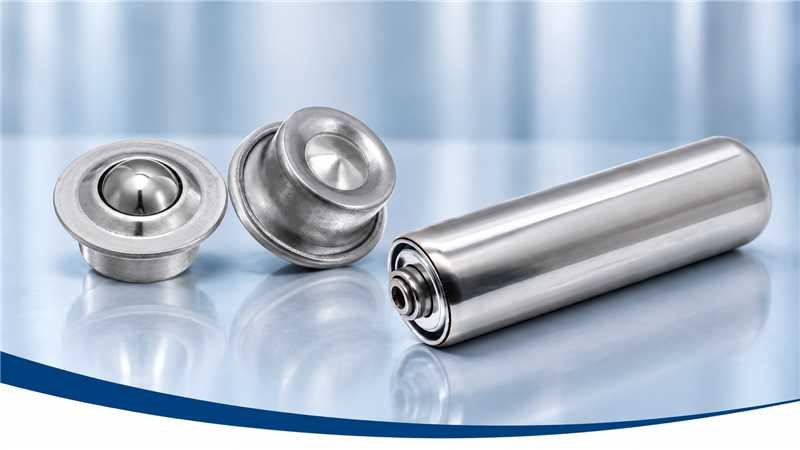
A roller conveyor is a frame that carries a row of rollers, and the product rides on them by gravity, a push or a drive. It moves product along the line in one direction. A ball transfer unit is a load ball held in a housing on smaller support balls, so a package, pallet or workpiece can move across it in any direction.
The difference is therefore one of function. A ball transfer unit supports a load from below and lets it roll anywhere, but it has no drive and gives no guidance. Rollers guide the load along a fixed path and can be powered.
Load: Point Contact Against Line Support
A ball transfer unit touches the load at a single point, so the underside of the product matters more than the rating of the ball. One maker explains that the share each ball takes depends on the flatness, hardness and smoothness of the load surface, which is why an equal share is seldom reached. The same maker rates its units from 10 lb to 750 lb and says that rating does not decide which balls to use or how many.
The spacing rule comes from the maker sheets. Take the smallest edge of the load and divide it by 2.5, or by 3.5 in one maker's sheet. Size the units so that no single unit carries more than a third of the load. The method is in how to space ball transfer units.
A roller conveyor spreads the load along a line instead. The pitch is set so that at least three rollers always carry the shortest product, and rollers are fitted as close together or as far apart as the load and the application need. Ask the maker for the rating at your pitch.
Which Loads Suit Each One
Ball tables work best with stable, rigid loads that have a flat base, such as totes, small cases and rigid cartons, and with solid metal or wooden pallets. The load has to rest across several balls without sagging, catching or tipping, and the surface has to be rigid enough that the balls do not sink into it. Soft bags, flexible-bottom containers and uneven loads do not move smoothly across a ball table. One maker advises against ball units for sacks or heavy cartons, and suggests a caster transfer unit instead of balls for delicate surfaces such as cartons.
On gravity lines, a conveyor guide puts items with an uneven or open bottom, or with a rim, on rollers rather than on skate wheels. For soft or flexible loads, a belt or a roller conveyor may be a better choice than a ball table.
When to Choose Rollers
Choose rollers when the load follows one path and the line has to move it on its own. Three drive types cover most lines. A gravity roller conveyor needs no motor and moves product by hand, by a slight incline or by momentum from upstream equipment. The right incline depends on the product, so test it with real loads. A powered roller conveyor lets zones switch on and off so product accumulates without pushing against the next carton. A chain-driven live roller moves drums, totes and pallets that light drives cannot.
When the aim is continuous movement from one point to another, a powered or gravity conveyor is the better tool. A ball table only helps at the points where a person needs to steer the load.
When to Choose Ball Transfer Units
Choose ball transfer units where a load must turn or slide in several directions. A maker's technical sheet notes that a conveyor system has many more directions of movement at intersections and branch points than along straight sections. That is where ball units are used, because a roller conveyor moves product in one direction.
They suit packing, labeling, scanning and inspection stations, where an operator turns or aligns a carton by hand and no drive parts are needed under the load. The operator sets the speed, the direction and the final position. They work best with an even load bottom, and an uneven one may call for closer spacing.
Speed and Friction of Ball Transfer Units
Published sources give a maximum conveying speed of 1 to 1.5 m/s for some ranges and up to 2 m/s for others. One sheet adds that larger units can warm from friction at 1 m/s, depending on the load. It gives a friction value of roughly 0.005 at that speed, and notes that the real value may differ significantly. Check the speed limit of the series you choose before you use a ball table for fast travel.
Using Both on One Line
Many lines combine the two. Rollers carry the load along each straight run. A ball transfer table sits at the junction, where an operator turns the carton or pushes it onto the next branch. The ball table has no drive of its own, so the load must be moved by hand or by a pusher, and the next roller section takes over.
The two also share hardware. Ball strips can be fitted in a roller frame in place of rollers, at the same top height, so a ball section joins an existing roller line smoothly. Modular tracks that take either rollers or balls let one element be swapped without taking down the whole conveyor. Some ball units can also be fitted ball down as a caster, or with a pneumatic pop-up ball.
Map the load path first, and mark every point where the load must change direction or be aligned.
- Use rollers on the straight runs, and size the pitch so three rollers carry the shortest product.
- Use ball units at the turning points, and set the spacing from the smallest edge of the load.
- Check both for washdown. For rollers, name the bearing type as well as the tube grade; for ball units, the grade and the seal decide.
Stainless Choices for Washdown
Both products are made in 304 and 316L where carbon steel would corrode. A roller conveyor has five material parts: the tube, the axle, the bearing, the housing and the frame, so name each one in the specification. A ball transfer unit is specified by ball diameter, body size, mounting, load, direction and grade, and a stainless load ball in a carbon steel housing suits dry service.
Contamination is the other risk for a ball unit. One maker offers a sealed main ball for dirty work such as shot blasting, and another protects its units with oil-soaked felt seals over a range of -30 to 100 °C. Ask for the seal as well as the grade where dirt or washdown reaches the unit.
Common Mistakes With Ball Tables and Rollers
| Mistake | What goes wrong | What to do |
|---|---|---|
| Using a ball table for soft bags or flexible bottoms | The load sags or catches between the balls | Use rollers or a belt for those loads |
| Assuming the balls share the load equally | Flatness and hardness of the underside decide the share | Size by the underside and the spacing, not by the ball rating alone |
| Spacing from the long edge | The short edge can find too few balls | Set the spacing from the smallest edge of the load |
| Expecting a ball table to move the load | There is no drive, so someone has to push | Use a powered or gravity conveyor for continuous movement |
| Putting ball units on the straight run | Rollers do that job and also guide the load | Keep ball units for the turning and aligning points |
What to Send for a Quote
Send the details below to Profab Machine. We make stainless steel ball transfer units to your drawing and mounting.
Our stainless steel roller conveyors are made to your width, pitch and section length.
- Product length, width and weight, and the condition of the underside
- The load path, with every turning, branching and aligning point marked
- Whether the movement is manual, gravity or powered
- Washdown or chemical exposure, so we can match the grade and bearing
- Mounting space and height limits
Conclusion
Pick rollers for a fixed path and a drive, and ball transfer units for turning and aligning. Put each where it does its job, and check the support rule for both. If you need a line section or a ball table made to a layout, send the list above to Profab Machine and we will confirm the sizes before we quote.