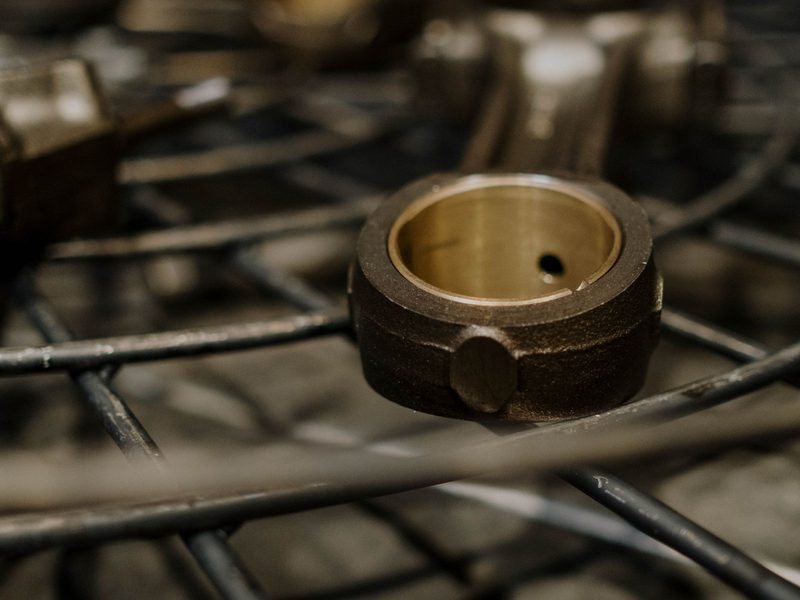
A press-fit bushing shrinks because the housing squeezes it. According to a design reference, the diameter change is roughly 70 to 100 percent of the interference between the bushing and the housing. A bushing that measures correctly on the bench can therefore bind a shaft once it is installed. Measure three sizes, not one: the bore before pressing, the housing bore, and the bore after pressing.
| Size | When to measure | What it tells you |
|---|---|---|
| Free-state bushing bore and OD | Before pressing | The starting point, and the interference you will actually get |
| Housing bore | Before pressing | Sets the interference together with the bushing OD |
| Installed bushing bore | After pressing | The only size the shaft sees |
Why the Bore Closes After Pressing
A bushing is made slightly larger on the outside than the hole it goes into, and the press forces it in against that interference. The bushing wall is compressed, and the housing stretches a little as well. A published design reference puts the change in diameter at 70 to 100 percent of the interference, and says that predicting the size change by calculation has not been shown to be accurate.
The same reference says the change can be characterized by fabricating several test cases and measuring the range of the actual fit. It adds that bushings are often designed with extra diametrical material so they can be reamed to the desired diameter after pressing. A carbon-graphite bushing maker goes further for its material: the bore shrinks nearly the full amount of the interference, and the assembly may take 24 hours to reach its final size.
A Worked Example: Why the Shaft Will Not Go In
Suppose a bushing has a 20 mm bore made to H7, which is 20.000 to 20.021 mm. It is pressed in with 25 µm (0.025 mm) of interference, a value within the 1 to 35 µm range of an H7/p6 fit at this size. The shaft is 20 mm g6, which is 19.980 to 19.993 mm (the g6 limits follow from the 7 to 41 µm clearance of an H7/g6 fit in our bushing guide).
- Closing of the bore: 70 to 100 percent of 25 µm is 17.5 to 25 µm.
- Installed bore: 20.000 to 20.021 mm becomes about 19.975 to 20.004 mm.
- Result: the largest shaft (19.993 mm) is larger than the smallest installed bore (19.975 mm). Some assemblies seize, and the clearance range is about -18 to +24 µm instead of the 7 to 41 µm that an H7/g6 fit is meant to give.
The figures are an illustration based on the 70 to 100 percent rule, not a prediction for your part. The point is that the catalog bore and the installed bore are different numbers, and a running fit has to be set on the installed one.
Three Ways to Get the Right Installed Bore
Machine the bore with an allowance
Tell the maker the housing bore and the running clearance you need, and the bushing is made with a bore that allows for the closing. Our bushing page says a press fit changes the installed bore, so we set the bushing to suit the housing bore and the fit you want. This route suits a known housing bore.
Ream or bore after pressing
Press in a bushing with extra stock on the bore, then ream it to the desired diameter.
Press test pieces first
When the fit is tight or the housing is unusual, press several sample bushings, measure the installed bore, and use the range of the results to choose the free-state bore. The published reference describes the same approach, because the size change has not been shown to be predictable by calculation.
What Changes How Much the Bore Closes
Interference is a major driver, but the stiffness of the housing matters too, because the housing gives a little as well. One machining service's article notes that aluminum has roughly a third of the stiffness of steel and recommends cutting the interference by 30 to 50 percent against an equivalent steel specification. Excess interference can distort or crack a housing and leave the bore out of round.
That article also reports an aluminum housing that cracked under 50 to 60 µm of interference during mechanical pressing, and the problem stopped after the interference was reduced and a thermal fit was used. If your housing is a light alloy, a thin wall or a casting, ask for the fit to be reviewed before you press.
Pressing Without Damaging the Bore
The way a bushing goes in also affects its final bore. Four habits help:
- Apply the force evenly on the end face of the bushing, never with a hammer on one side. The design reference warns that uneven force causes galling, peening or damage.
- Clean both surfaces and remove burrs from the bushing and the housing, as the design reference advises.
- Add a chamfer on the housing bore. The carbon-graphite maker specifies a 0.75 to 1.5 mm chamfer at 45° on the housing and says sharp edges can shave the bushing during installation.
- Watch stainless on stainless. Our spherical bearing guide notes that stainless on stainless can gall during a press fit, so use the assembly lubricant the bushing maker specifies.
Uneven press force or misalignment can leave an out-of-round bore or a misaligned shaft, as the same article notes.
Shrink fit as an alternative
For thin walls or large interference, a thermal fit avoids pushing the bushing against a hard interference. The reference prefers chilling the bushing to heating the housing, because the bushing has much less mass.
Tight After Installation: What to Check
| What you find | Likely cause | What to do |
|---|---|---|
| Shaft will not enter | The bore closed more than allowed for | Measure the installed bore; ream, or remake the bushing with an allowance |
| Bore is oval after pressing | Too much interference, or uneven press force | Reduce the interference; check the press alignment |
| Housing cracked | Interference too high for the housing material | Reduce the interference or use a thermal fit |
| Bore fine at first, tight a day later | Slow settling after pressing, reported for some materials | Measure again after the part has settled |
The last row follows the carbon-graphite maker's note on settling time. It applies to that material and is not a general rule for solid stainless sleeves, so measure again after the part has had time to settle if the first reading looks wrong.
What to Send for a Bushing Quote
Send the details below to Profab Machine. We make stainless steel bushings in 304, 316L and 17-4PH to your drawing or sample, and we set the bore for the installed size when we know the housing.
- Housing bore with its tolerance, the housing material and wall thickness
- Shaft diameter and tolerance, and the running clearance you need
- The installed bore you want after pressing
- Bushing length, flange or grooves, grade and quantity
- Whether the bushing will be reamed in place
Conclusion
A press fit closes the bore, so a running fit has to be set on the installed bore and not on the catalog one. Measure the free bore, the housing and the installed bore, and make test pieces when the fit is tight. If you need bushings made for a known housing, send the list above to Profab Machine and we will review the drawing with you before we quote.