
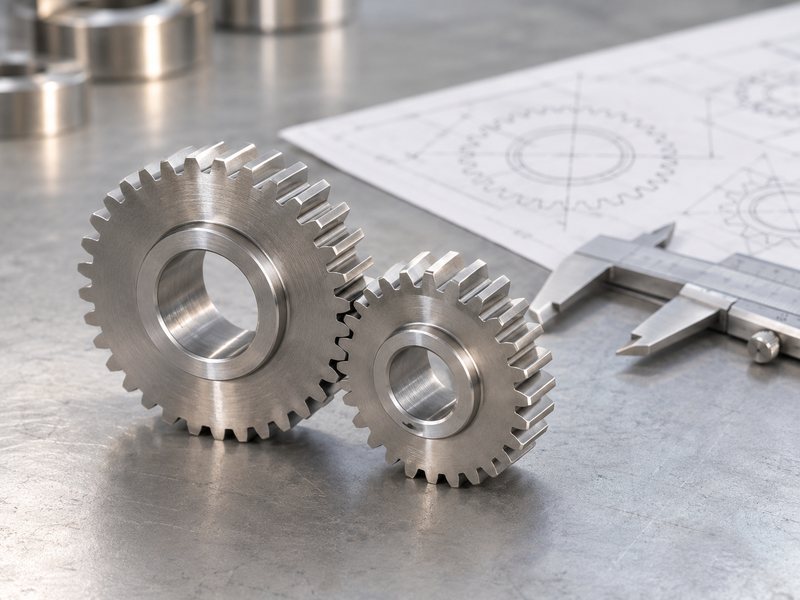
Diametral pitch is a ratio and pitch diameter is a size. Diametral pitch counts the teeth for each inch of pitch diameter, and pitch diameter is the diameter of the pitch circle. A gear specified as 24 teeth at 8 DP therefore has a 3.000 in pitch diameter, and two gears mesh because they share the diametral pitch, not because their pitch diameters match. This guide covers spur gears.
| Diametral pitch (P or DP) | Pitch diameter (D) | |
|---|---|---|
| What it is | Teeth per inch of pitch diameter | Diameter of the pitch circle |
| Kind of number | A ratio, not a dimension | A length |
| What it sets | Tooth size | Gear size, center distance and ratio with the mate |
| Must match on a mating pair | Yes | No |
Diametral Pitch Is a Ratio, Pitch Diameter Is a Size
The diametral pitch of a gear is the number of teeth for each inch of pitch diameter. It is a design ratio rather than an actual dimension, so it has no length to measure. Picture a circle one inch across with 16 teeth spaced around it. That is a 16 DP tooth, and the same teeth drawn on a two-inch circle give 32 teeth, which is still 16 DP.
A higher diametral pitch means smaller teeth, and a lower one means larger, thicker teeth. The pitch diameter is the diameter of the pitch circle, the circle on which the tooth spacing is set up, and it describes how big the whole gear is. A screw thread also has a pitch diameter, which lies between the major and minor diameters of the thread.
The Formulas That Link Them
With the number of teeth N and the diametral pitch P, the main sizes of a full-depth spur gear follow. The table lists the ones a drawing check needs.
| To find | Formula |
|---|---|
| Diametral pitch P | N / D |
| Pitch diameter D | N / P |
| Outside diameter Do | (N + 2) / P |
| Addendum a | 1 / P |
| Circular pitch p | 3.1416 / P |
| Center distance C of a pair | (D1 + D2) / 2, which is (N1 + N2) / (2P) |
Read a Callout: 24 Teeth at 8 DP
A callout reads 24 teeth, 8 DP. The pitch diameter is 24 / 8 = 3.000 in. The outside diameter is (24 + 2) / 8 = 3.250 in, the addendum is 1 / 8 = 0.125 in and the circular pitch is 3.1416 / 8 = 0.3927 in. A published tooth table for 8 DP gives an addendum of 0.1250 in and a circular pitch of 0.3927 in, so the formulas and the table agree.
The callout also needs a pressure angle. One catalog lists stock gears in 14-1/2 degree and 20 degree forms and defines the angle at the standard center distance. The same catalog says undercut occurs below 18 teeth at 20 degrees and below 32 teeth at 14-1/2 degrees, and recommends at least 13 and 16 teeth. A 24-tooth gear is clear of the 20 degree limit but not of the 14-1/2 degree one.
Pitch diameter and diametral pitch are theoretical values that cannot be measured directly. Both are worked out from other dimensions, such as the tooth count and the outside diameter.
Two Gears Mesh on Diametral Pitch, Not Pitch Diameter
Two gears mesh only when their diametral pitch is the same. One maker's calculator guide adds that the pressure angle has to match as well. Equal pitch diameters do not help. A 3.000 in gear at 8 DP has 24 teeth, while a 3.000 in gear at 12 DP has 36 teeth, and those two cannot run together.
Once the pitch is shared, the pitch diameters set the center distance and the ratio. Take a 24-tooth pinion and a 48-tooth gear at 8 DP. Their pitch diameters are 3.000 in and 6.000 in, the center distance is (3 + 6) / 2 = 4.500 in, and the ratio is 48 / 24 = 2. One catalog cuts its stock spur gears to run at this standard center distance, and moving the centers changes the backlash, as we explain in how much backlash a spur gear needs.
Diametral Pitch, Module and Circular Pitch
Metric gears are sized by module, and the module is 25.4 divided by the diametral pitch. Circular pitch is the arc distance between neighbouring teeth, and the diametral pitch equals pi divided by it. The table converts seven stock pitches from one catalog's list.
| Diametral pitch | Module (mm) |
|---|---|
| 8 | 3.175 |
| 10 | 2.540 |
| 12 | 2.117 |
| 16 | 1.588 |
| 20 | 1.270 |
| 24 | 1.058 |
| 32 | 0.794 |
The standard modules do not land on the standard inch pitches. A module of 1.25 equals 25.4 / 1.25 = 20.32 DP, and a 20 DP gear has a module of 25.4 / 20 = 1.27. The two are only 1.6 percent apart, which looks close, but the pitches are not equal.
The error shows up in the center distance. Take the same 24 and 48 teeth. At module 1.25 the center distance is (30 + 60) / 2 = 45.00 mm, and at 20 DP it is (24 + 48) / (2 x 20) = 1.8 in, or 45.72 mm. One catalog gives a stock 20 DP gear an average backlash of 0.003 in, about 0.08 mm, and suggests limiting a center-distance increase to half of that. The 0.72 mm difference is more than nine times the backlash and many times that limit, so the two systems cannot be swapped.
Find the Diametral Pitch of a Gear You Have
Count the teeth, measure the outside diameter and divide. The diametral pitch is (N + 2) / Do, and the result is approximate because the formula is for full-depth involute teeth.
- Count the teeth N.
- Measure the outside diameter Do across the tips of the teeth.
- Calculate P = (N + 2) / Do.
- Compare the result with the pitches that gear makers stock.
A gear with 24 teeth and a 3.250 in outside diameter gives (24 + 2) / 3.250 = 8.0, which is an 8 DP gear. One catalog table lists 3, 4, 5, 6, 8, 10, 12, 16, 20, 24, 32, 48 and 64 as stock pitches. A result near 20.32, 25.4 or 31.75 points to a metric gear of module 1.25, 1 or 0.8. If the converted module is not a standard size, the gear is an inch gear.
The formula is approximate and assumes full-depth teeth, so a result such as 20.2 cannot tell 20 DP from 20.32 on its own. Treat it as a short list of candidates, and confirm the pitch and the pressure angle from the drawing or with a tooth-form check before you order a mate.
Conclusion
Diametral pitch tells you how big the teeth are, and pitch diameter tells you how big the gear is. The pitch is the number that has to match between two gears, and the pitch diameter, with the tooth count, fixes the center distance and the ratio. Convert between inch and metric with m = 25.4 / DP, and do not treat 1.25 module and 20 DP as the same gear.
Profab Machine makes stainless steel gears to your drawing. Send the tooth count, the diametral pitch or module, the pressure angle, the outside diameter and the center distance with the request, so that the numbers agree with each other.
If you are still choosing between tooth forms, see our guide to helical gears versus spur gears.
Sources:
- Boston Gear spur gear engineering pages, PDF hosted by Stanford BDML
- Engineers Edge, Gear Diametral Pitch, Module Conversion Table Chart
- Technical guides from gear manufacturers