Different types of stainless steel clamps serve different industries, automotive, marine, industrial, food, and more. Choosing the right clamp prevents leaks, maintains pressure, and keeps equipment safe. Stainless steel options offer strong resistance to harsh chemicals and high pressure across all of them.
What Is a Hose Clamp?
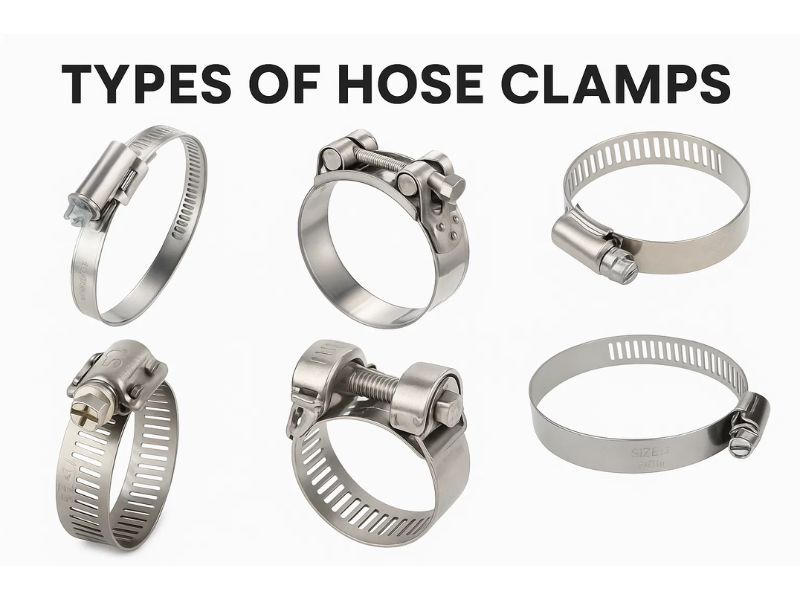
A hose clamp is a fitting that holds a hose onto a fitting and creates a tight seal so nothing leaks out. Industry groups set standards for hose clamps: SAE International's J1508 spec lists 32 clamp designs including screw, spring, and t-bolt types, while J1610 covers how hose-sealing performance is tested. Hose clamps come in many shapes and sizes, and each type is built for a specific job; the most common types are worm gear, spring, ear, wire, T-bolt, band, and plastic clamps.
Why Stainless Steel Hose Clamps Are the Best Choice
Stainless steel combines strong corrosion resistance with high tensile strength and durability, which is why it dominates for reliable, long-lasting, leak-proof clamping across fluid-contact environments.
Marine-grade 316 stainless is preferred wherever seawater, salt spray, or chlorinated environments are involved; the added molybdenum meaningfully improves resistance to salt corrosion over standard 304.
Types of Hose Clamps
Each clamp type has its own design and job. Knowing the differences helps you pick the right one.
T-Bolt Clamps
A T-bolt clamp uses a T-shaped bolt threaded through a bridge on the band, drawn tight with a nut rather than a screw slot. That design delivers significantly higher and more even clamping force around the full circumference of the hose than a worm gear clamp achieves, which is why T-bolts are the standard on turbocharger connections, intercooler piping, and other high-pressure or high-vibration silicone hose joints in performance and racing applications. The tradeoff is cost and installation: T-bolts run more expensive than worm gear clamps and need slightly more clearance to install.
V-Band Clamps
V-clamps are a favorite among tuning enthusiasts and in racing for one reason: speed. A V-shaped groove locks two flange sections together, and where a bolted connection means removing several fasteners, a V-clamp needs only one nut loosened for a full disconnect. That matters a lot in exhaust systems and turbochargers, where maintenance and adjustment happen frequently. Stainless V-band clamps also handle the extreme heat of engine exhaust well and seal reliably under it. They cost more than standard clamps, but the value holds up in applications that demand that level of performance.
Worm Gear Clamps
The worm gear clamp, also called a screw clamp, is the most common clamp type in everyday use. Rotating the screw tightens the band around the hose. Its advantages are simplicity, low cost, and easy installation, which is why it shows up everywhere from washing machine drain hoses to bicycle water lines to low-pressure automotive lines. The tradeoff is limited locking force: worm gear clamps aren't suited to high-pressure or high-temperature service, and over-tightening can damage the hose itself.
Quick Release Clamps
Quick release clamps are built for frequent assembly and disassembly, using a buckle or spring mechanism that installs or removes in seconds. That makes them a natural fit for racing, laboratory, and food processing settings that need regular cleaning and maintenance. They cost more than bolt or screw clamps, but save real time and reduce tool dependency in scenarios that prioritize efficiency.
Spring Clamps
Spring clamps use the inherent elasticity of metal to provide clamping force, and constant-tension spring band clamps maintain that pressure even as conditions change. In automotive cooling system hoses, for example, temperature swings cause rubber hoses to expand and contract; a screw clamp can loosen under that cycling, while a spring clamp adjusts automatically to keep a reliable seal. Stainless spring clamps install quickly but need specialized pliers to operate, which makes them more common on high-volume automotive production lines than in aftermarket repair work.
Ear Clamps
Ear clamps, also called Oetiker clamps, use one or two "ears" that get pinched closed with special pliers to tighten the band. They're common on small hoses in cars and factories, producing a strong seal that resists vibration loosening and fitting into tight spaces. Stainless steel ear clamps resist rust well, making them a solid choice for fuel lines and cooling systems, anywhere a tight, permanent-feeling seal is the priority.
Application of Hose Clamps
Different industries lean on different clamp types based on what the job actually demands.
High-performance vehicle tuning and racing needs a tight seal that handles engine heat:
- Worm drive clamps
- T-bolt clamps
- Fuel injection hose clamps
- Stainless exhaust clamps
- Spring clamps
- Ear clamps
- Quick release clamps
- Spring-loaded constant tension clamps
Marine work needs clamps that resist rust and saltwater:
- 316 stainless steel worm drive clamps
- Spring-loaded constant tension clamps
- Heavy-duty band clamps
- Double wire clamps
- Quick release clamps
Food and beverage applications, liquid transfer, cleaning systems, filling lines, and air lines, need hygiene, corrosion resistance, easy cleaning, and traceability:
- Hygienic band clamps
- Constant tension clamps
- T-bolt clamps
- 316 stainless steel worm drive clamps
Aerospace applications, fuel systems, hydraulic lines, air conditioning, engine accessories, and cockpit equipment, demand light weight, high precision, vibration resistance, high-temperature tolerance, reliable sealing, and traceability certification:
- Aerospace worm drive clamps
- Cushion or P-clamps
- T-bolt clamps
- V-band clamps
- Quick release clamps
Garden and agricultural use, irrigation systems, sprinklers, fertilizer delivery, pump lines, and greenhouse water lines, prioritizes corrosion resistance, sealing, ease of installation, and cost control:
- Stainless steel irrigation clamps
- Worm drive hose clamps
- T-bolt clamps
- Ear clamps
- Spring clamps
- Quick release clamps
How to Choose Hose Clamps for Your Project
Start with size: make sure the clamp fits your hose's diameter, with enough adjustment range to grip properly whether the hose runs slightly larger or smaller than expected. Next, consider installation method, some clamps need special tools, others go on quickly by hand. Always check the clamp meets the relevant industry standard for your application.
- Choose the right clamp type and size, sized to fit just beyond your hose's outer diameter.
- Slide the clamp onto the hose before attaching the hose to the fitting.
- Position the clamp about 1/8" to 1/4" from the hose end, sitting evenly all around.
- Tighten the clamp slowly and evenly, a little at a time. Stop when you feel resistance, then give it a small extra turn.
- Check your work: tug the hose gently to confirm it's secure, then run the system at low pressure and check for leaks.
Conclusion
The right hose clamp depends on the application, not just the hose size: T-bolt and V-band clamps for high-pressure, high-vibration performance work; worm gear clamps for everyday low-pressure use; quick release and spring clamps where frequent servicing matters; ear clamps for a compact, permanent seal. Match the clamp type to the actual operating conditions, and stainless steel across the board for anything that needs to resist corrosion long-term.
Profab Machine manufactures stainless steel hose clamps built for demanding automotive, marine, and industrial applications.
FAQ
What's the difference between a T-bolt clamp and a worm gear clamp?
A T-bolt clamp delivers higher, more even clamping force around the hose and holds up better under vibration and pressure. A worm gear clamp is simpler and cheaper but has limited locking force and isn't suited to high-pressure or high-temperature service.
Do I need 316 stainless steel for a marine hose clamp?
Yes, for sustained saltwater or salt-spray exposure. 316's molybdenum content resists pitting and crevice corrosion far better than standard 304 in chloride-rich environments.
How do I know what size hose clamp to buy?
Match the clamp's adjustable range to your hose's outer diameter, with enough range to tighten properly rather than sitting at either extreme of the clamp's range.