

Stainless Steel V Band Clamps
304, 316L and 321 V-band clamps with matched male and female flange kits. Bore sizes from 1.5 in to 6 in. Band widths of 19, 22 and 25 mm with documented torque ratings.
/ / Quick Specs
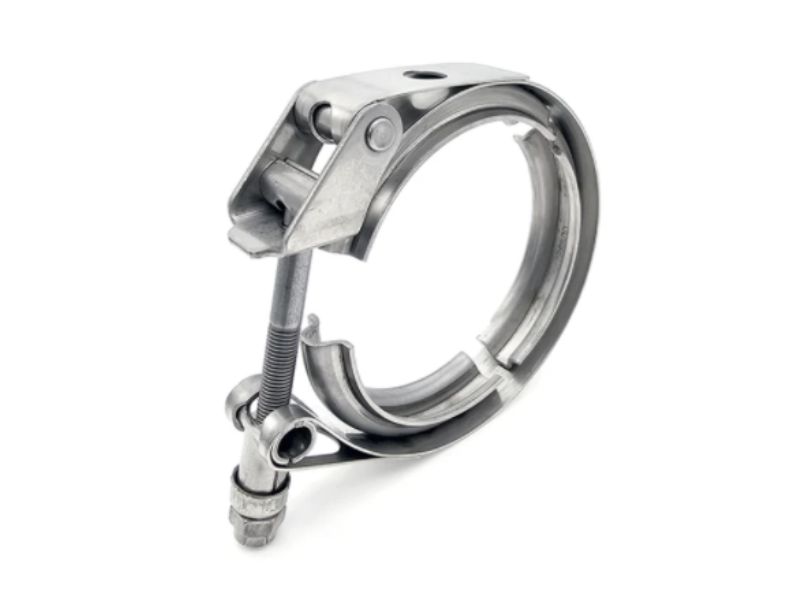
What Are Stainless Steel V-Band Clamps
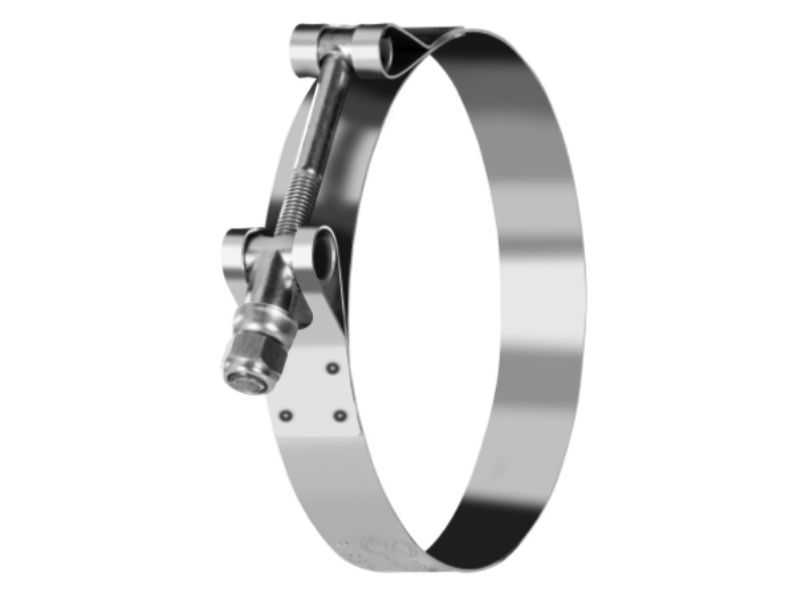
A V-band clamp locks two flanged tube ends together with a single metal band. The band carries a V-shaped internal profile. It closes over the matching tapered flange pair and drives the two faces into one metal-to-metal joint. One bolt or lever carries the entire load.
The joint seals by geometry, not by gasket material. A clamp and flange from different profile families leak no matter how hard you turn the bolt. That is why we quote the clamp and the flange pair as one matched set. The two halves either belong together or they do not work at all.
/ / The Procurement Engineer's Problem Profab Solves
A V-band joint that leaks puts the buyer between two suppliers who each point at the other. The clamp closes. The flanges seat. The joint still weeps. The causes are usually one of two. The clamp and flange came from different profile families, matched on bore size but not on insert angle or apex width. Or the joint ran hot, the band relaxed, and the preload that sealed it cold walked away. Published tests on V-band joints measured about 60 percent clamping force loss at 700°C skin temperature. Nobody re-torques a turbo outlet on schedule, so the leak surfaces later on the test cell or on the truck.
Profab quotes the clamp and the flange pair as one set from one production run. We check insert angle and apex width of every clamp against its flange on a profile projector before the set ships. Each size carries a documented torque value. High temperature service gets a re-torque interval written into the delivery notes. You buy a set that seats, not a clamp and a debugging job.
Types of V-Band Clamps
Three clamp styles cover most joints. The choice depends on how often the line opens and how hard the environment pushes.
/ / 01 — Standard
Standard Single-Bolt
A single M6 or M8 T-bolt closes the band over the flange pair. The most compact and lowest cost style. Use on joints that stay assembled for months. Torque to the documented value, typically 17 N·m on M6 sizes. Over-torque distorts the band, the round contact line breaks, and the joint weeps at the split.
// 02 — Quick Release
Quick Release V-Band Clamp
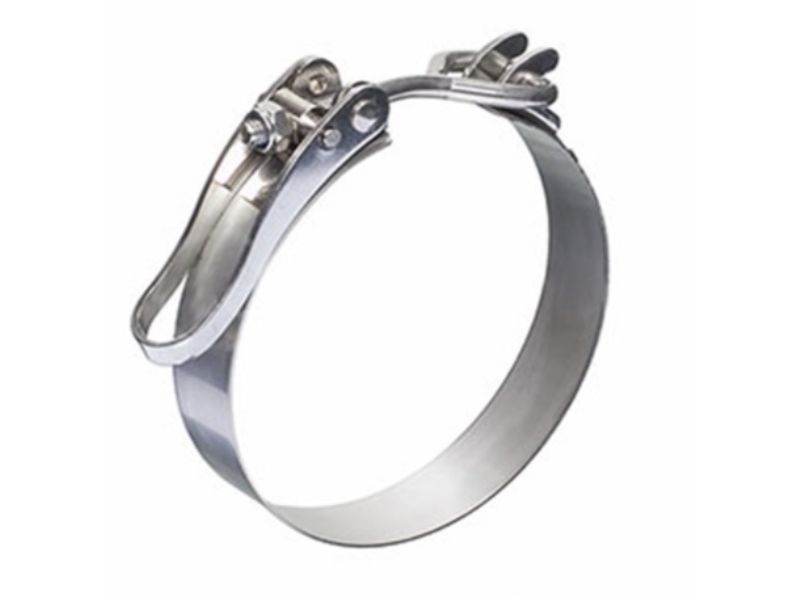
An over-center lever replaces the bolt. One flip opens the clamp. The lever re-applies its preset tension on every close, so service crews do not re-torque by feel. Built for lines that open on every service interval: dust collector access, reactor charging ports, engine test rigs.
// 03 — Double-Bolt
Double-Bolt Heavy-Duty V-Band Clamp
Two bolts spread the closing force across a wider band. Specified for large diameters and high vibration where a single M6 cannot hold the band round. Common on generator exhaust bellows and bulk solids conveying lines above 4 in.
Material Specification
Stainless Steel Grade Guide
Exhaust heat, salt air and washdown chemicals each punish a different stainless grade. Pick by where the joint lives, not by what the rest of the line was welded from.
304 Stainless
The workhorse for turbo outlets, intercooler pipework and dry process air lines. Fine in engine bays and indoor plants. Do not run it in continuous salt spray or chlorinated washdown. The flange weld zone pits first, then the band splits at the latch housing.
Turbo · Process Air · Indoor
316 / 316L
Molybdenum alloyed for chloride resistance. Use on marine wet exhaust, coastal plants and any line washed with chlorinated chemicals. The L-grade matters here because the flange welds to the tube. Low carbon keeps the weld zone from sensitizing. Without it, the heat-affected ring turns into a corrosion start line.
Marine · Chemical · Washdown
321 Stainless
Titanium stabilized for repeated heat cycling. A 304 clamp that heats and cools daily loses preload as the band creeps. 321 holds its dimensions longer above 500°C service. Specify it on turbine outlets and heat recovery lines. It costs more than 316 and carries a longer lead time. Inconel bands exist for extreme duty on request.
High Heat · Thermal Cycling
V-Band Clamp Specifications
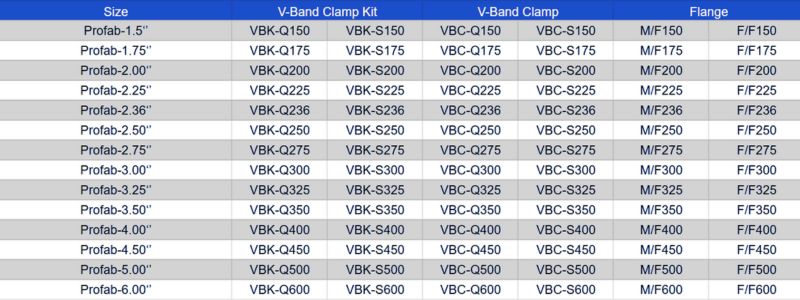
How to Measure V-Band Clamps
- Measure the tube OD at the point where the flange welds on. The flange bore runs about 0.8 mm larger, so the flange slides over the tube with a controlled gap for the weld.
- Identify the flange profile, not just the bore. V-band families differ in insert angle and apex width. Bring the flange to the supplier and check the clamp against it. A clamp from another family will not seat, whatever the bore size says.
- Check the flange OD as well. The clamp band must close over the flange’s outer edge, not over the tube. Read both dimensions before you order.
Why Profab V-Band Clamps
01
A CLAMP AND FLANGE PAIR THAT SEATS ON FIRST FIT
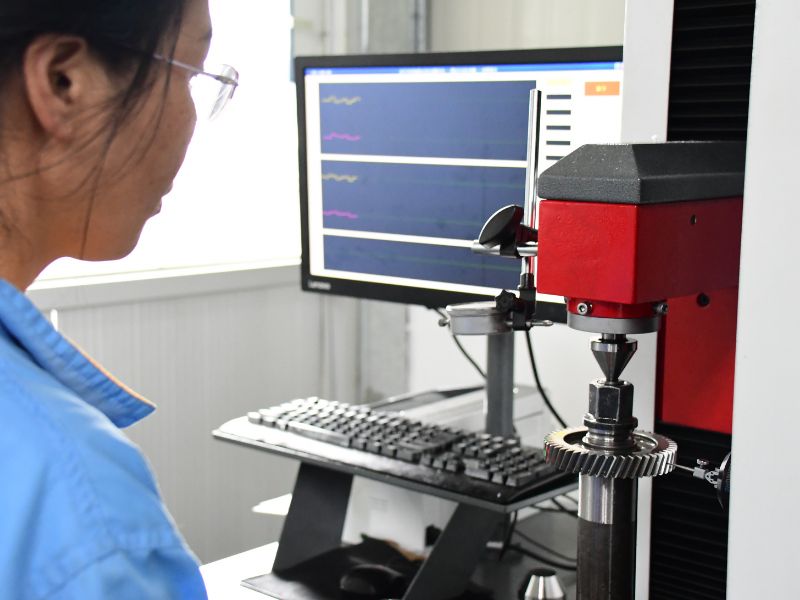
We cut the flange blanks and form the bands, then check every clamp against its flange pair on a profile projector. The contact line either matches or the set does not ship. You do not discover the mismatch on your assembly line.
02
TORQUE VALUES YOU CAN REPEAT
Every size ships with a documented torque limit, typically 17 N·m on M6 clamps. We test band stretch at that value before the run. High temperature threads get anti-seize guidance so the bolt comes apart at the next service instead of shearing.
03
GRADES PICKED FOR THE SERVICE LIFE
304, 316L and 321 do not interchange. We recommend the grade against your actual exposure and say plainly where each one quits. 321 costs more and takes longer. We tell you that before you commit, not after.
How V-Band Clamps Work
Placement
Each flange welds to its tube end. The band slips over the closed flange pair with the V profile sitting on both tapered faces.
Closure
The bolt or lever draws the band ends together until the band hugs the flange outer edge.
Wedge
The V profile rides down the tapered flange faces. Hoop tension converts into axial pull that presses the two flanges together.
Sealing
The flange faces meet metal-to-metal under compression. The clamp holds them there. No gasket, no sealant, no rubber to bake out.
Industries We Serve
Turbocharger Outlets and Downpipes
Standard 304 T-bolt V-bands torqued to 17 N·m on compressor and turbine flanges.
Intercooler and Charge Air Pipework
2 in to 3.5 in sets on 304 and 316L pipework for diesel platforms.
DPF and SCR Aftertreatment
V-bands on the can inlet and outlet flanges of commercial truck aftertreatment lines.
Marine Engine Wet Exhaust
316L bands and flange kits on riser and elbow joints.
Dust Collection and Fume Extraction
Quick-release V-bands where the removable sections open for cleaning.
Pneumatic and Dry Bulk Conveying
Double-bolt bands above 4 in on bulk solids and vacuum transfer lines.
Chemical Process Piping
316L sets on low-pressure process lines under chloride exposure.
Generator and Stationary Engine Exhaust
304 and 321 bands on flex bellows and silencer flanges.
Frequently Asked Questions
Can I run any V-band clamp on any V-band flange?
No. Flange families differ in profile angle and apex width. Two families can look the same and still seat a fraction of a millimeter off, which leaves the joint weeping at the split. Buy the clamp and flanges as one matched set, or bring the flange to the supplier and have the clamp checked against it.
Do V-band joints need a gasket?
Standard V-band flanges are precision-machined to seal metal-to-metal. Adding an unapproved gasket or silicone bead can alter the seating geometry and induce leaks. Clean the faces and torque to the documented value. If your application specifically requires a seal, only use gaskets engineered for that exact flange profile.
Why does a V-band joint that sealed fine start leaking months later?
Thermal cycling is the usual cause. Published tests on V-band joints show clamping force can drop by about 60 percent at 700°C skin temperature. The band relaxes as it heat cycles, vibration works the bolt, and the leak appears. Re-torque on the service schedule and replace any band with visible distortion.
You May Also Need
Stainless Steel Quick Release Clamps
Get in touch with
Ready to Source Stainless Parts?
If you already have the drawings, please send email to [email protected] directly for an instant quote.
Profab
Request a Quote