
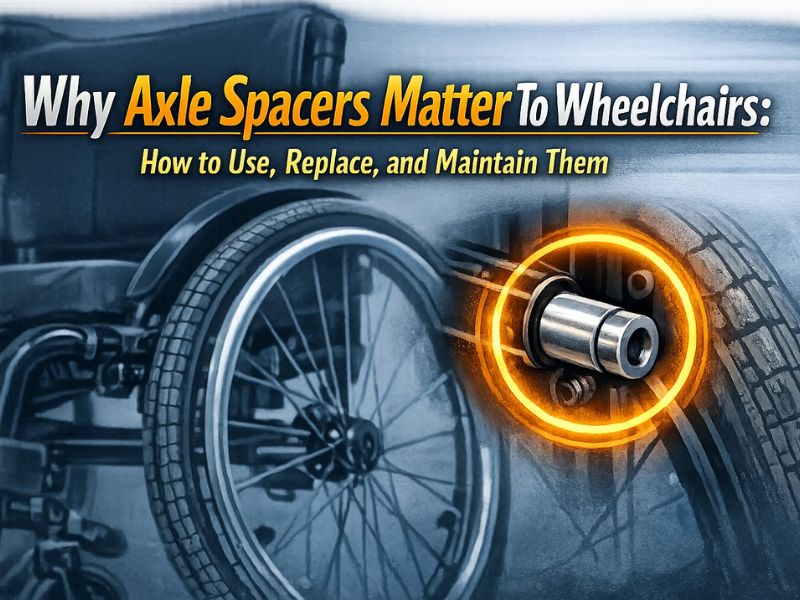
A wheelchair depends on a long list of small hardware components to track straight and roll smoothly, and the axle spacer is one of the easiest to overlook. It doesn't carry the wheelchair's weight the way a bearing or axle does, but getting its length wrong shows up immediately as wheel wobble, uneven rolling, or a chair that pulls to one side. In electric wheelchairs, a worn or incorrectly sized spacer can also load the drive motor unevenly, which shortens motor life along with bearing life.
What an Axle Spacer Actually Does
An axle spacer is a precision-length sleeve, usually installed between the wheel hub and the frame or between the bearing races inside the hub, that sets the axial clearance in the wheel assembly. That clearance, sometimes called endplay, is the small amount of space the bearing assembly needs to rotate freely without binding. Too little clearance and the bearing runs preloaded, generating friction and heat with every rotation. Too much clearance and the wheel wobbles side to side under load, which accelerates bearing wear at the same time it makes the chair harder to track straight. Fullbay's explainer covers the same preload-versus-endplay tradeoff in the context of heavy-duty truck wheel bearings, which use a different bearing design than the sealed cartridge bearings common in wheelchair casters, but the underlying principle carries over: the spacer is what holds that clearance at the value the bearing was designed for, rather than leaving it to whatever gap happens to result from stacking the surrounding parts.
Axle spacers are typically cylindrical sleeves, either hollow or solid, in stainless steel, aluminum alloy, or engineering plastic. Material choice comes down to load, corrosion exposure, and weight. For a wheelchair used outdoors or in wet conditions, stainless holds its dimensional accuracy over years of exposure in a way that plated steel and some plastics don't; a spacer that changes dimension from corrosion or moisture absorption stops controlling the clearance it was sized for.
Signs a Spacer Needs Replacing
Wheel wobble, unusual noise from the hub, vibration through the frame, and visible deformation of the spacer itself are the practical signs to check for. In electric wheelchairs, a spacer problem can also show up as reduced motor efficiency or a chair that tracks slightly off-center, because the drive wheel is no longer running true in its housing. Most spacer failures trace back to one of three causes: long-term friction wear at the spacer face, corrosion changing the spacer's effective length, or a spacer that was the wrong length from the original installation and has been quietly overloading the bearing on one side ever since.
When replacing a spacer, an OEM part matches the original design length and material. Aftermarket spacers can offer tighter tolerances or a more corrosion-resistant material, but the length still has to match what the specific hub and bearing stack requires. A spacer that's close but not exact reintroduces the same preload or endplay problem in the other direction.
Installation and Adjustment
Installation follows the same sequence for most wheelchair hubs: remove the axle, position the spacer against the correct bearing face or frame surface, and tighten the axle nut to the torque the hub manufacturer specifies. Overtightening is the most common installation error. It preloads the bearing beyond its design range even when the spacer itself is the correct length, and the result looks identical to a wobble problem from the wrong spacer until someone checks the torque. Stacking extra washers in place of a correctly sized spacer is a common improvised fix that creates uneven load distribution across the bearing face rather than solving the clearance problem cleanly.
Axle spacers are small parts, but the clearance they set is what determines whether the rest of the wheel assembly wears at its designed rate or fails early. Profab Machine manufactures stainless steel axle spacers machined to the exact length and tolerance your hub and bearing stack require. Contact Profab Machine to work through the right spacer specification for your wheelchair or mobility equipment application.
FAQ
Can axle spacers fix wheel alignment issues?
Yes. A properly sized axle spacer corrects the axial clearance that causes side-to-side wobble, which is often the real cause of what looks like a wheel alignment problem.
Are stainless axle spacers worth it for electric wheelchairs?
In most outdoor or wet-use cases, yes. Stainless holds its dimensional accuracy over years of exposure better than plated steel or some plastics, which keeps the bearing clearance at its designed value for longer.
How often should axle spacers be replaced?
There's no fixed interval. Replacement depends on usage, environment, and material. Check for wobble, noise, or visible deformation during routine maintenance, and replace if any of those are present.