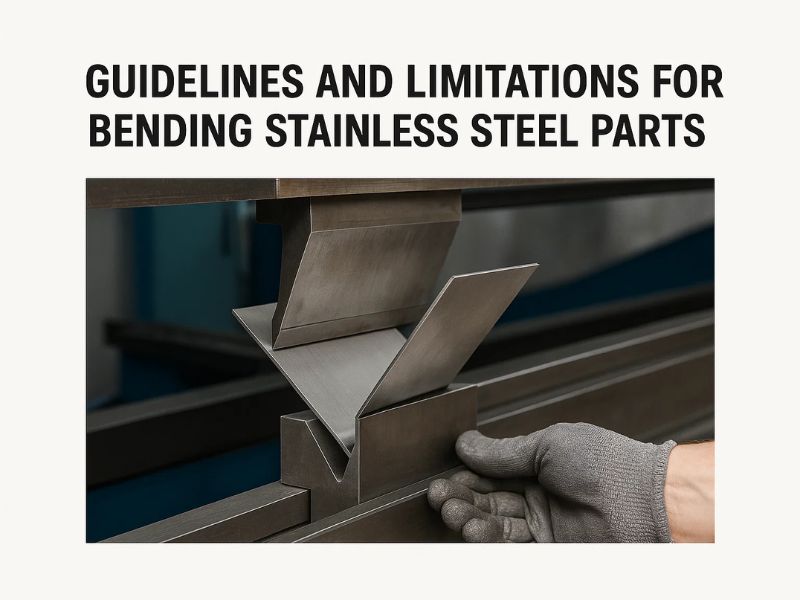
This article outlines the key guidelines and limitations for bending stainless steel parts, including material selection, bend radius requirements, thickness considerations, tooling choices, and common failure risks. Whether you're designing custom stainless steel components or evaluating fabrication capabilities, these practical insights will help you achieve reliable, repeatable bending results.
What Is Stainless Steel Bending?
Bending stainless steel parts is a common manufacturing process across automotive, industrial, and structural applications. Compared with carbon steel or aluminum, stainless steel presents unique challenges from its higher strength, work-hardening behavior, and lower thermal conductivity. Without the right process controls, cracking, springback, dimensional inaccuracy, and surface damage can all show up.
Material Properties Impacting Bending
Ductility and Strength
Ductility determines how much a metal can stretch or bend before it fails; strength determines how much force it takes to deform it. Higher-ductility grades allow tighter bends without cracking. Rolled forms of stainless steel are generally easier to bend than drawn forms.
Work Hardening
Bending stainless steel changes its internal structure through work hardening: the metal becomes harder and stronger at the bend but also less flexible. Overwork it and it can crack or spring back unpredictably. Annealing softens the metal back down when needed. 304 doesn't work-harden as aggressively as high-carbon steels, but the effect still needs to be accounted for in tooling and process planning.
Springback
Springback is the metal's tendency to partially return toward its original shape after the bending force is released, and stainless steel shows more of it than most metals, largely because of its rapid work-hardening rate. Typical springback for 304 runs in the range of a few degrees under standard tooling, worse at tighter bend-radius-to-thickness ratios and with air bending specifically, and less pronounced with bottoming or coining, which constrain the material more tightly during the bend. Compensating means overbending slightly past the target angle rather than bending exactly to spec.
Stainless Steel Bending Methods
Stainless steel is bent through sheet metal bending and tubing bending methods, each with several distinct techniques.
Sheet Metal Bending Methods
Sheet metal bending uses a press brake, applying force through a punch (upper tool) and die (lower tool) to form the sheet to the target angle.
1. Air Bending
The sheet is pressed into a V-shaped die without bottoming out fully, giving flexibility to produce different angles from the same tooling. It's accurate to roughly half a degree, suits small to medium batches well, and carries the most springback of the common methods.
2. Bottoming
The sheet is pressed fully against the die, giving tighter control over the final angle, roughly a quarter-degree accuracy, and noticeably less springback than air bending. Use it where exact, repeatable angles matter.
3. Coining
The most precise method: high force presses the metal fully into the die shape, nearly eliminating springback and producing very tight angle tolerances. Reserve coining for parts where precision is the priority, since the higher tonnage adds cost.
4. Roll Bending
The sheet passes through three or four rollers to gradually form a continuous curve, used for cylinders, cones, and large, gentle arcs rather than sharp angles.
5. Hot Bending
Local heating increases ductility before forming, reducing both the force needed and the crack risk. Step bending, using multiple small V-bends to approximate a large radius, is a related technique for cases where the minimum cold-forming bend radius can't be achieved.
Tubing Bending Methods
Tube and pipe bending is designed specifically to prevent the wall from collapsing, wrinkling, or kinking during the bend.
6. Rotary Bending
A spinning die forms the bend with tight, consistent control, capable of small-radius bends with minimal shape distortion. It needs careful setup and works best across a defined range of bend sizes.
7. Roll Bending (Tube)
The tube feeds through a series of rollers applying gradual pressure, well suited to architectural railings and large loops that don't need a tight radius.
8. Compression Bending
The tube is clamped at one end while a wiper block compresses it around a stationary bend die. It's faster and lower cost than other methods, but the cross-section is more prone to deforming, making it unsuitable for tight radii.
9. Heat Induction Bending
An induction coil applies localized heat immediately ahead of the bend point, softening the steel right before mechanical force pulls it into shape. Common in industrial, power generation, and petrochemical work.
10. Mandrel Bending
A specialized version of rotary draw bending that inserts a mandrel inside the tube to support the inner diameter, preventing collapse, flattening, and wrinkling on the inside radius.
Stainless Steel Bending Limits
Thickness and Bend Radius
Most press brakes handle stainless sheet under 3/16" comfortably, and for that range a bend radius close to the material thickness is achievable in standard air bending. As a practical starting point, plan for a minimum bend radius of roughly 1 to 2 times material thickness for stock in the 1–6mm range; going tighter than that raises real crack risk. The table below summarizes the practical guidance:
| Condition | Guidance | Notes |
|---|---|---|
| Sheet thickness < 3/16" | Bend radius ≈ 1× thickness achievable | Standard air bending |
| Bend radius-to-thickness ratio | Typically 1 to 2× | Tighter ratios raise crack risk; K-factor commonly assumed around 0.4 |
| Sheet thickness ≈ 1/8" | Gauge tooling often used instead | More common below 3/16" stock |
Minimum Bend Radius
Staying at or above the minimum bend radius for your material and grade is the single most reliable way to avoid cracking and weak spots. As a rule of thumb, the minimum bend radius roughly equals material thickness for standard grades; thicker stock needs a proportionally larger radius to stay within safe limits.
Tolerances
Modern CNC press brakes typically hold ±0.1mm on linear dimensions and ±1° on bend angles as standard practice, with high-precision setups reaching ±0.05mm and ±0.5°. Hole-to-bend and edge-to-bend spacing matters too: place holes too close to a bend line and the metal can tear or distort during forming. The table below gives minimum spacing by finish:
| Stainless Steel Type | Minimum Distance (mm) |
|---|---|
| 304 (No.1) | 0.8 |
| 304 (2B) | 2 |
| 304 (#400) | 4.2 |
| 430 (2B) | 1.7 |
Stainless Steel Bending Applications
Stainless steel bending is a core fabrication process across a wide range of industries.
Architecture and Construction: curved facades, handrails, guardrails, stairs, fences, and balustrades, both structural and decorative elements in modern buildings.
Automotive and Transportation: bent tubing for exhaust pipes and mufflers, chassis frames, mounting frames and structural reinforcements, and internal components like seat frames, safety belt hardware, and fuel lines, where strength and corrosion resistance both matter.
Medical and Pharmaceutical: components for medical instruments, surgical devices, implants, and prosthetics, plus medical tubing and precision brackets, where hygiene and biocompatibility are critical.
Food Processing and Catering: conveyor belting, chutes, tanks, and vats, where corrosion resistance and cleanability drive the material choice.
Industrial and Manufacturing: piping systems, industrial equipment, heat exchangers, and hydraulic components built for heavy-duty, long-service applications.
How to Bend Stainless Steel
Material Prep
Clean the surface before bending, removing dirt and oil with soap or a degreaser, and inspect for scratches or dents that could propagate into cracks under bending stress. Secure the sheet or rod firmly in the machine to prevent slipping during the bend. Thicker material or sharp-radius bends may call for localized heating to reduce force and crack risk.
Set up the press brake with the correct tooling and settings, align the sheet carefully to avoid marking it, and apply steady, controlled force through the bend. Check the finished part's angle and dimensions against spec before moving on.
- A pressure die holds the metal stationary during the bend
- Clamp dies rotate the tube around the bend die
- Mandrels support the tube's inner diameter
- Wiper dies prevent wrinkling on the inside of the bend
Post-Bend Treatment
After bending, restore the surface and relieve stress as needed: grind or polish out deep marks, sand blast or brush to clean off oxides and residue, and degrease to remove any remaining oil. Acid pickling or passivation restores corrosion resistance where the surface was disturbed. Electropolishing smooths the surface and removes embedded particles. Heavily stressed parts may need heat treatment or solution annealing to relieve internal stress and restore ductility.
Bending Challenges and Solutions
Springback Control
Several techniques address springback, often used in combination:
| Technique | Description |
|---|---|
| Overbending | Bend slightly past the target angle to compensate for springback |
| Bottoming | Press the sheet fully against the die to reduce springback |
| Coining | Apply high force at the bend line to nearly eliminate springback |
| Tooling Adjustments | Smaller punch tips and tighter dies reduce springback |
| Increased Force | Higher bending force helps the metal retain its formed shape |
| Active Angle Control | CNC press brakes that adjust in real time during the bend |
| Post-Forming Techniques | Stretching the part after bending to lock in its shape |
Preventing Cracks
- Use a mandrel or supporting pad to hold the metal in place during the bend
- Apply thick grease or MoS₂ paste to reduce friction and ease the bend
- Avoid chlorine-based grease, which can introduce stress and cracking
- Bend at a controlled rate, roughly 5 to 10 degrees per second, rather than forcing it quickly
Avoiding Surface Damage
A soft film on the die reduces scratching risk. Keep tooling clean and free of debris, and avoid letting the metal contact the die directly wherever a protective layer can be used instead.
Conclusion
Bending stainless steel reliably comes down to understanding material behavior, matching the bending method to the part geometry, and respecting the limits on bend radius, tolerance, and hole placement. Get those right and you get efficient production with consistent, defect-free parts.
Profab Machine provides custom stainless steel bending services built around these process controls.
FAQ
What is the best way to prevent cracks when bending stainless steel?
Bend across the grain direction, use a larger bend radius for thicker sheets, bend slowly, and inspect the material for surface defects before starting. Lubricating the metal also reduces friction-related cracking.
How do you choose the right bend radius for stainless steel?
Check the sheet thickness first, then use a bend radius equal to or greater than that thickness as a baseline. For material thicker than 3/16", plan for at least a 4mm radius.