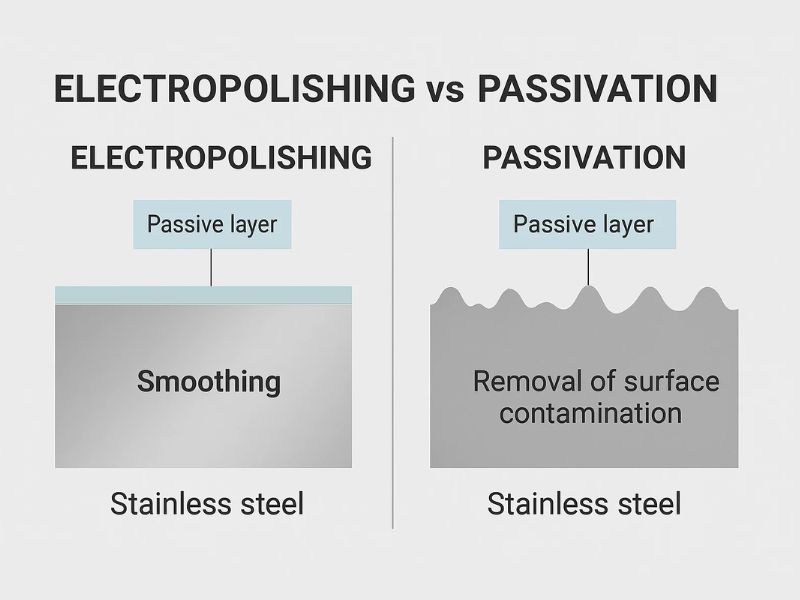
Electropolishing and passivation both protect stainless steel from corrosion, but they work through different mechanisms and solve different problems. Electropolishing is an electrochemical process that smooths and brightens the surface while removing a thin layer of material; passivation is a chemical treatment that removes free iron and strengthens the passive oxide layer without changing the surface finish. Choosing between them comes down to surface requirements, budget, and whether the part's history (welding, machining, forming) leaves contamination that only electropolishing can fully remove.
Electropolishing
Electropolishing reverses the electroplating process: the part is submerged in an acidic electrolyte and connected as the anode, and an applied current dissolves a thin, controlled layer of metal from the surface. This preferentially removes the peaks of surface roughness before the valleys, which is what produces the smooth, reflective finish electropolishing is known for. Because material is removed uniformly across the exposed surface, electropolishing also strips away the disturbed, iron-enriched layer that machining and grinding leave behind, exposing the chromium-rich base metal underneath.
Benefits:
- Reduces microscopic surface defects where bacteria and contaminants can lodge, which is why it's specified for hygienic and sterile applications.
- Removes burrs, cracks, and tool marks, making parts easier to clean and inspect.
- Produces a more uniform, chromium-rich passive layer than passivation alone, improving corrosion resistance.
- Works on complex geometries without the mechanical contact a polishing wheel would require.
Applications: medical device stents, surgical tools, and implants; aerospace components; electronics and semiconductor equipment; automotive and racing components where surface finish and fatigue resistance both matter.
Passivation
Passivation is a chemical treatment, not a material-removal process. After cleaning, parts go into an acid bath, typically nitric or citric acid, that dissolves free iron left on the surface from machining, grinding, or handling. Free iron doesn't form the protective chromium oxide layer stainless steel depends on, and left in place, it becomes a corrosion initiation point. Once the free iron is removed and the part is rinsed and dried, the exposed chromium reacts with atmospheric oxygen to form a thin, invisible chromium oxide layer, which continues to develop in strength over the following one to two days. The part's dimensions and surface texture are unchanged; passivation doesn't smooth or brighten anything, it removes what shouldn't be there.
Citric acid passivation is more environmentally benign and suits smaller-scale or mild operations; nitric acid remains standard in higher-volume industrial passivation lines.
Benefits:
- Meaningfully improves corrosion resistance, including in wet or salt-exposed environments.
- Removes surface iron and light contamination without altering part dimensions, which matters for tight-tolerance components.
- Produces a surface that's easy to clean and sanitize, supporting food and medical use.
Applications: mixing tanks, dairy and brewing equipment; cutting tools and storage containers; food processing machinery; medical device components where corrosion resistance matters but dimensional change doesn't.
Electropolishing vs. Passivation
Where Each One Works
Electropolishing works on essentially all stainless grades, including welded and brazed assemblies, since the material-removal process isn't dependent on the base metal's existing surface condition. Passivation is less reliable on welded joints and on lower-chromium steels, since it depends on the base metal already having enough chromium available at the surface to form a strong oxide layer, and heat-affected zones from welding can locally deplete that chromium.
Surface Finish
Electropolishing changes the surface meaningfully: it removes the damaged layer left by machining, and typical processes achieve a 25 to 40 percent reduction in surface roughness (Ra), with diminishing returns on parts that are already smooth. Passivation leaves the surface texture as-is; it cleans and protects without touching the geometry.
Corrosion Resistance
Both processes improve corrosion resistance, but not equally. Electropolishing produces a thinner, denser, more uniform oxide layer with less embedded surface contamination, which reduces pitting initiation sites and nickel release, both relevant for medical and food-contact parts. Passivation's oxide layer forms over a rougher, unaltered surface and is comparatively more prone to localized breakdown. In practice, the two are often used together: passivating after electropolishing gets the corrosion-resistance benefit of both processes rather than choosing one over the other.
Cost
Passivation is the cheaper option upfront. It requires simpler equipment and fewer processing steps, which is why it's common as a routine post-machining or post-welding step. Electropolishing requires a dedicated tank, power supply, and process control, which raises the per-part cost, especially at low volumes. Where parts justify it through longer service life and fewer replacements, electropolishing's higher upfront cost is often recovered over the part's lifespan; for straightforward corrosion protection on a budget, passivation remains the practical default.
Materials
Electropolishing works well on higher-alloy materials like Inconel and high-carbon stainless grades where the surface benefits most from full mechanical smoothing. Passivation is well suited to lower-carbon stainless grades where a clean, protective layer is the goal and appearance isn't a factor.
Choosing between electropolishing and passivation comes down to what the part actually needs: a smoother, more hygienic, more corrosion-resistant surface, or a straightforward, lower-cost corrosion treatment that leaves the part's dimensions untouched. Profab supports both as part of its surface finishing services, including electropolishing for parts that need it. Contact Profab Machine to work through the right surface treatment for your application.
FAQ
What metals can be electropolished or passivated?
Stainless steel, titanium, copper, and some nickel alloys can be treated with either process, though the results and suitability vary by alloy and application.
Does electropolishing change the size of the part?
Electropolishing removes a thin layer of material, typically well under 0.001 inches, which is enough to smooth sharp edges and minor surface imperfections without a meaningful dimensional change on most parts.
Can electropolishing and passivation be used together?
Yes, and it's a common practice. Electropolishing smooths the surface and removes the damaged surface layer; passivation afterward reinforces the protective oxide layer, giving better corrosion resistance than either process alone.
Is electropolishing safe for food and medical parts?
Yes. The smoother, more uniform surface it produces is easier to clean and sanitize, which is why it's widely specified for medical implants, surgical instruments, and food-contact equipment.