
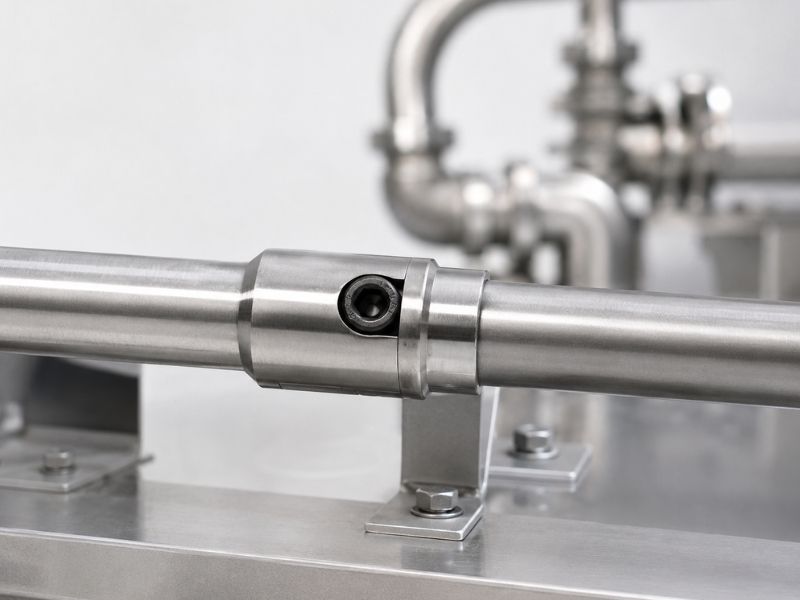
The clamp arrives, the installation crew tries to fit it around the pipe, and it either won't close or closes too loosely to grip. Nothing looks wrong with the clamp. The part number matches what was ordered. The problem is that the "inch" in the pipe specification and the "inch" in the clamp specification refer to two different things.
This happens routinely when someone selects a tube clamp based on nominal pipe size. The fix is simple once you understand the dimension that's actually being used. Getting there requires a short detour into why pipe sizing works the way it does.
Why Nominal Pipe Size Doesn't Match Any Physical Dimension
Nominal Pipe Size, or NPS, is a dimensionless reference number. It doesn't equal the pipe's OD, and for most common sizes it doesn't equal the pipe's ID either. The name is a legacy from when pipe standards were first established and has persisted through a century of revisions.
As noted in the ASME standard on nominal pipe size, NPS values were originally set to give the same inside diameter based on wall thicknesses standard at the time. However, as the set of available wall thicknesses evolved, the ID changed and NPS became only indirectly related to ID and OD.
The result is a mismatch that catches people every time:
| NPS (nominal) | Actual pipe OD |
|---|---|
| 1/2" | 0.840" (21.3 mm) |
| 3/4" | 1.050" (26.7 mm) |
| 1" | 1.315" (33.4 mm) |
| 1-1/2" | 1.900" (48.3 mm) |
| 2" | 2.375" (60.3 mm) |
| 3" | 3.500" (88.9 mm) |
| 4" | 4.500" (114.3 mm) |
As Merit Brass explains, an NPS 2" pipe has an OD of 2.375", while an NPS 6" pipe has an OD of 6.625", and an NPS 12" pipe has an OD of 12.75". None of those OD values match the nominal designation.
There is one exception: for NPS 14 and up, the NPS and OD values are equal. An NPS 14 pipe is actually 14 inches OD. This exception is its own source of confusion. People accustomed to working with large-diameter pipe, where nominal equals actual, sometimes apply the same assumption to smaller sizes where it doesn't hold.
How Tube Is Sized Differently
Tubing uses a different convention. A tube is specified by its actual OD and actual wall thickness. There is no "nominal" layer between the label and the dimension.
A 1-inch tube has an OD of exactly 1.000 inch. A 25mm tube has an OD of exactly 25mm. A 2-inch tube has a true OD of 2.000 in, while a 2-inch NPS pipe has an OD of 2.375 in. That difference matters when substituting products or sourcing components. Fittings, clamps, and supports designed for tubing will not fit NPS pipe of the same labeled size.
This is the gap that creates the wrong-clamp problem:
| Labeled size | Tube actual OD | Pipe (NPS) actual OD | Gap |
|---|---|---|---|
| 1/2" | 0.500" (12.7 mm) | 0.840" (21.3 mm) | 0.340" |
| 3/4" | 0.750" (19.1 mm) | 1.050" (26.7 mm) | 0.300" |
| 1" | 1.000" (25.4 mm) | 1.315" (33.4 mm) | 0.315" |
| 1-1/2" | 1.500" (38.1 mm) | 1.900" (48.3 mm) | 0.400" |
| 2" | 2.000" (50.8 mm) | 2.375" (60.3 mm) | 0.375" |
Order a 1-inch stainless steel OD tube clamp for a 1-inch NPS pipe and the clamp is 0.315 inches too small. It won't close around the pipe at all. Order a clamp sized for 1-inch NPS pipe and install it on a 1-inch tube, and the clamp has 0.315 inches of extra diameter. It sits loose, can't grip, and will slide or rotate under any load.
The Metric Version: DN Is the Same Problem
The confusion isn't limited to imperial systems. European metric pipe uses Diameter Nominal, or DN, and it has the same characteristic: the DN number doesn't equal any actual pipe dimension.
As Gems Sensors documents, DN is the metric counterpart to NPS defined by ISO standards. Like NPS, DN is also dimensionless and does not equal the pipe's actual diameter in millimeters. A common DN 20 pipe has an outside diameter of 26.67 mm, not 20 mm.
The DN-to-OD conversion:
| DN (nominal) | Actual pipe OD |
|---|---|
| DN 15 | 21.3 mm |
| DN 20 | 26.7 mm |
| DN 25 | 33.4 mm |
| DN 40 | 48.3 mm |
| DN 50 | 60.3 mm |
| DN 80 | 88.9 mm |
| DN 100 | 114.3 mm |
Metric tube, like imperial tube, is specified by actual OD. A 25mm tube has an OD of 25mm. A DN 25 pipe has an OD of 33.4mm. Both might be described as "25" in a purchase order but they won't fit the same clamp.
Where the Mistake Enters the Order
The wrong-clamp order usually originates at one of three points.
The drawing says "1-inch pipe" without specifying OD. The purchasing team interprets "1-inch" as 1.000 inches and orders a clamp for a 1.000-inch OD tube. The system uses NPS 1 pipe with an actual OD of 1.315 inches. The clamp arrives and doesn't fit.
An old bill of materials lists a clamp by a nominal size description. The original engineer knew that "NPS 1 pipe clamp" meant a clamp sized for a 1.315-inch OD. The person re-ordering years later searches for "1-inch pipe clamp" and selects a clamp in the 1.000-inch OD range. Same outcome.
The system uses tubing in one section and pipe in another. A fabrication that transitions between instrumentation tubing and process pipe may have both 1-inch tube (1.000" OD) and 1-inch NPS pipe (1.315" OD) within a few feet of each other. Ordering clamps by labeled size without verifying OD at each location puts the wrong clamp in the wrong position.
The Correct Way to Specify a Tube Clamp
The specification for any tube clamp should state the actual OD of the tube or pipe it will be installed on, not the nominal size.
For tubing: Measure the OD with calipers or take it directly from the tube drawing. State the actual OD in millimeters or decimal inches. Specify "tube OD = 25.4mm" not "1-inch tube."
For pipe: Look up the NPS-to-OD conversion for the pipe's nominal size. A 2-inch NPS pipe has an OD of 60.3mm. Specify the clamp for 60.3mm OD, not for "2-inch pipe."
For existing installations: If there's no drawing and no markings, measure. Wrap a cloth tape around the pipe circumference and divide by π to get the OD, or use external calipers directly if there's access. Don't guess from a nominal label stamped on the pipe.
Once the actual OD is confirmed, clamp selection becomes straightforward. The clamp's working diameter range must bracket the measured OD with the OD falling in the usable middle of the range, not at either extreme. For the full selection process covering wall thickness, liner material, and mounting configuration, see the companion guide on OD and wall thickness.
Conclusion
NPS, DN, and tube OD each describe pipe or tube size differently, and the gap between them is exactly where the wrong clamp gets ordered. Specify the actual measured OD, not the nominal label, and the clamp will fit the first time.
Profab Machine manufactures stainless steel OD tube clamps in 304 and 316L, sized to actual tube OD in metric and imperial dimensions. When ordering, specify the actual outside diameter of the tube or pipe measured at the installation point, not the nominal size designation.