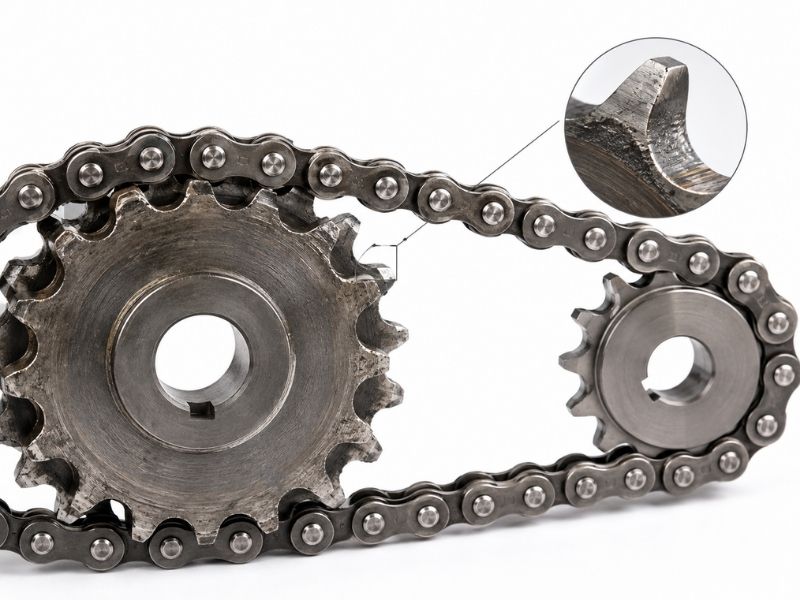
Sprockets can wear faster than chains when the tooth surface sees more contact cycles, lower hardness, poor lubrication, or a worn chain that no longer matches the original pitch. The small drive sprocket is usually the first part to show visible tooth wear because each tooth engages the chain more often than a tooth on the larger driven sprocket.
That does not mean the chain is innocent. In many drives, chain elongation starts the damage. Wear at the pin and bushing increases the effective pitch of the chain, then the elongated chain rides higher on the sprocket teeth and loads the tooth flanks in the wrong place. By the time you see hooked teeth, sharp tips, or worn pockets, the chain and sprocket have already worn into each other as a pair.
For maintenance, the practical rule still holds: if the chain is past its elongation limit or the sprocket tooth profile is visibly worn, inspect both parts before replacing only one. A new chain on a worn sprocket often loses life quickly because it has to run on a tooth profile shaped by the old chain.
Why the Small Sprocket Wears Faster Than the Chain Set Suggests
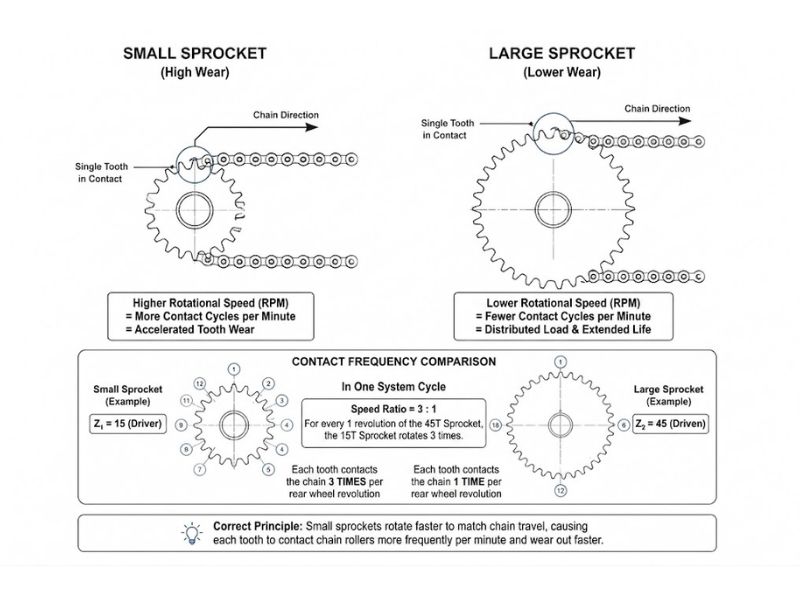
The simplest reason is contact frequency. In a 15-tooth drive sprocket and 45-tooth driven sprocket arrangement, the ratio is 3:1. For one revolution of the large sprocket, the small sprocket turns three times. Each tooth on the small sprocket therefore engages the chain three times while each tooth on the large sprocket engages once.
The chain distributes those contacts across many links. A 100-link chain does not ask one link to carry every engagement. The small sprocket has far fewer teeth sharing the same transmitted load, so each tooth flank accumulates contact cycles faster. Under high torque, poor lubrication, or abrasive contamination, that difference becomes visible as hooked teeth on the small sprocket before the rear or driven sprocket looks severely worn.
This is also why increasing the tooth count on the small sprocket can improve service life. More teeth reduce the articulation angle at each engagement and spread the load over more tooth contacts. You still need the correct chain speed, center distance, and ratio, but a very small driver is rarely kind to chain and sprocket life.
Chain Elongation Is Usually the Wear Multiplier
A roller chain does not stretch like a rubber belt. The plates are not plastically elongating under normal service. The pitch grows because the pin and bushing wear at the bearing surfaces. As clearance increases at every joint, the roller centers sit farther apart over a measured length.
Once that happens, the chain stops seating at the original pitch circle. It rides higher on the sprocket teeth and starts loading the flanks above the intended seating zone. Roller chain wear guidance commonly treats about 1.5% to 2% elongation as the range where the chain starts riding up the sprocket teeth and accelerated wear can begin.
That wear pattern creates the classic pocketed or hooked tooth profile. The sprocket is no longer shaped for a new chain with correct pitch. It is shaped for the old elongated chain. Install a new chain on that tooth profile and the rollers do not seat cleanly. You get noise, uneven load sharing, rapid roller wear, and in severe cases chain jump under load.
How Sprocket Hardness Controls Wear Life
Tooth hardness decides whether repeated roller contact stays as slow polishing wear or turns into fast profile loss. Heavy-duty carbon steel and alloy steel sprockets often use flame hardening, induction hardening, carburizing, or through-hardening to improve tooth wear resistance. Machine Design's sprocket engineering reference points out that sprockets should be replaced when wear extends through hardened tooth areas, because the softer underlying material then wears much faster.
Surface hardness alone is not enough information. You also need to know the hardening method and effective case depth. A shallow hardened layer can test well at the surface but disappear quickly under abrasive service. A deeper case gives the tooth more usable wear allowance before the soft core is exposed.
For carburized or induction-hardened teeth, the working question is not just "What is the HRC?" The better question is: what surface hardness, what case depth, what steel grade, and what hardened tooth area? If a drawing calls out hardness but ignores case depth and hardening pattern, two suppliers can deliver parts that look equivalent on paper but perform very differently in the drive.
Why Stainless Steel Sprockets Need a Different Wear Expectation
Stainless steel sprockets solve a different problem from hardened carbon steel sprockets. In food processing, washdown equipment, marine machinery, and chemical conveyors, corrosion can destroy a carbon steel drive even if the tooth hardness is excellent. Stainless keeps the drive usable where rust, chloride exposure, cleaning chemicals, or product contamination matter more than maximum dry-wear life.
The trade-off is hardness. Austenitic stainless grades such as 304 and 316L are not heat-treatable to the 45 to 60 HRC tooth hardness range used for many heavy-duty hardened steel sprockets. Their annealed hardness is much lower. That means 304 and 316L stainless steel sprockets will usually wear faster than hardened alloy steel sprockets under the same load, speed, lubrication, and contamination conditions.
The material choice is still correct when corrosion is the main failure mode. In a wet food conveyor, a harder carbon steel sprocket may corrode at the bore, keyway, and tooth root long before a 316L sprocket loses its tooth profile. In a coastal or chloride environment, 316L is often the practical baseline because the molybdenum content improves pitting resistance compared with 304.
Martensitic stainless grades such as 440C can reach much higher hardness after heat treatment, often near bearing-grade hardness. They are useful when wear resistance matters and the corrosion exposure is mild enough for a hardenable stainless grade. Do not treat 440C as a simple upgrade over 316L in washdown or chloride service. Its wear resistance is better, but its corrosion behavior is not the same as 316L.
For stainless drives, the usual life-improvement moves are mechanical rather than promotional. Increase the sprocket tooth count where the ratio allows it. Keep alignment tight. Control chain slack. Use compatible stainless chain when galvanic corrosion or product-zone contamination is a concern. Confirm the chain standard, pitch, roller diameter, and tooth gap before ordering replacement parts. Profab's guide on matching a stainless steel sprocket to your chain covers those dimensional checks in detail.
When to Replace Sprockets Before They Damage a New Chain
Replace the sprocket when the tooth profile has changed enough that a new chain will not seat on the original pitch geometry. Hooked teeth are the obvious sign. The loaded face becomes asymmetric because the drive normally pulls in one direction, so the tooth starts to lean into a curved profile rather than staying symmetrical.
Worn seating pockets are just as important. These polished or scooped zones often sit higher on the tooth flank than the original seating area. They show that an elongated chain has been running at a larger effective pitch diameter. A new chain will not match those pockets.
Sharp tooth tips indicate advanced profile loss. Tooth tips should not become thin, pointed, or knife-like. If the tip has deformed or the flank has lost its hardened surface, replacement is no longer optional maintenance. The tooth is carrying load in the wrong geometry.
Side wear points to alignment error rather than normal pitch wear. If one side of the tooth is polished or thinned, check shaft parallelism, sprocket axial alignment, hub seating, bearing condition, and chain guide position before fitting new parts. Replacing the sprocket without correcting alignment only resets the clock on the same failure.
How to Slow Sprocket and Chain Wear
Start with chain elongation measurement. For industrial roller chain, measure over multiple pitches under light tension and compare the length against the original pitch count. Do not rely only on slack adjustment. You can take up slack and still have a chain with worn pin-bushing joints.
Keep lubrication focused on the pin-bushing interface. Oil on the outside of the plates looks reassuring, but the wear that lengthens the chain happens inside the joint. Lubricant must reach the bearing surfaces, and the viscosity has to suit speed and temperature. In wet or washdown service, choose a lubricant and cleaning practice that do not leave the joint dry after every sanitation cycle.
Control alignment early. A chain drive can tolerate some abuse, but side loading turns a normal wear problem into a tooth-face and plate-edge wear problem. A straightedge, laser alignment tool, or dial setup costs less time than repeated chain and sprocket replacement.
For stainless applications, specify the failure mode before choosing the material. Use 304 where the environment is mild and cost control matters. Use 316L where chloride exposure, washdown chemistry, or food-contact corrosion risk drives the decision. Consider 440C or another hardenable stainless only when the corrosion environment is moderate and tooth wear is the limiting problem.
Conclusion
Sprockets wear faster than chains when individual teeth see concentrated contact cycles and when tooth hardness, case depth, lubrication, alignment, or chain elongation push the contact outside the intended geometry. The small sprocket shows this first because it has fewer teeth doing more repeated work.
The chain still drives much of the failure. Once pin and bushing wear increases pitch, the chain starts cutting a new tooth path into the sprocket. That is why replacing only the visibly failed part often gives poor service life. Chain and sprocket wear is a paired system, not two isolated components.
Profab Machine manufactures 304 and 316L stainless steel sprockets for food processing, marine, washdown, and corrosive industrial service. If your drive needs both corrosion resistance and longer tooth life, the useful discussion starts with chain standard, load, speed, environment, lubrication, and the actual tooth wear pattern.