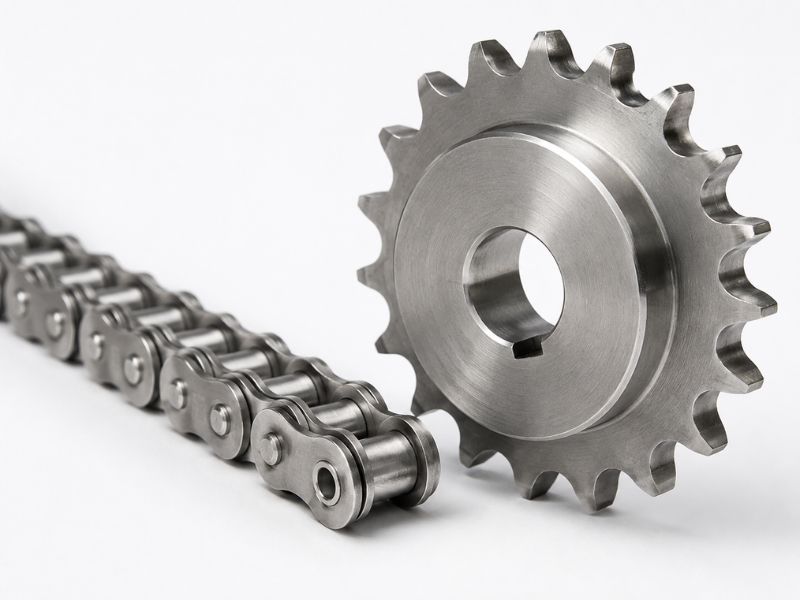
This guide covers every dimension that needs to match, why each one matters, and the specific considerations that apply when you're running stainless steel sprockets and chain rather than carbon steel.
Step 1: Identify Your Chain Standard Before Anything Else
Before you measure anything, establish which standard your chain was manufactured to. The two dominant standards are ANSI B29.1 (common in North America and Asia) and ISO 606 / DIN 8187 (common in Europe). Chains designed to these standards use different tooth profiles and different roller diameters even when the pitch appears identical, as AIMS Industrial's roller chain guide documents.
A standard ANSI #40 sprocket is cut for a 7.92mm roller riding in a 7.95mm gap (see the roller diameter table above). An ISO 08B chain has an 8.51mm roller, 0.59mm larger than the gap the sprocket was designed for. The chain threads on, but engagement is off enough to accelerate wear on both components.
The chain standard is usually stamped or printed on the chain itself, or on the original packaging. If the marking has worn off, measure the roller diameter and compare it against the ANSI or ISO dimension tables to confirm which standard applies.
ANSI chain designations use a two-digit number where the first digit indicates pitch in eighths of an inch (#40 = 4/8" = 0.5" pitch). The suffix indicates chain type: no suffix for standard, H for heavy series (thicker plates, same pitch and roller diameter), and 2 or 3 for double or triple strand.
ISO/DIN chain designations use a different number format: 08B-1 means 8/16" pitch, B series, single strand. The roller diameter and inner width differ from ANSI at the same nominal pitch.
Do not assume that matching pitch numbers means the chains are interchangeable. Confirm the standard before ordering sprockets.
Step 2: Match Pitch Exactly
Once you've confirmed the standard, pitch is the first dimension to match. The sprocket tooth pitch must equal the chain pitch exactly. No rounding, no "close enough."
Common ANSI pitches and their sprocket numbers:
| ANSI Chain | Pitch | Roller Diameter |
|---|---|---|
| #25 | 6.35mm (1/4") | 3.30mm |
| #35 | 9.525mm (3/8") | 5.08mm |
| #40 | 12.7mm (1/2") | 7.92mm |
| #50 | 15.875mm (5/8") | 10.16mm |
| #60 | 19.05mm (3/4") | 11.91mm |
| #80 | 25.4mm (1") | 15.88mm |
Common ISO/BS pitches for reference:
| ISO Chain | Pitch | Roller Diameter |
|---|---|---|
| 06B-1 | 9.525mm | 6.35mm |
| 08B-1 | 12.7mm | 8.51mm |
| 10B-1 | 15.875mm | 10.16mm |
| 12B-1 | 19.05mm | 12.07mm |
| 16B-1 | 25.4mm | 15.88mm |
Note that #50 ANSI and 10B-1 ISO share both pitch and roller diameter, one of the few cases where the chains are genuinely interchangeable. For all other sizes, confirm roller diameter against the specific chain before assuming cross-standard compatibility.
Step 3: Confirm Roller Diameter and Tooth Gap
The sprocket tooth gap must accommodate the chain roller diameter with the correct clearance. Too tight and the chain won't seat properly. Too loose and the chain contacts only the tips of the teeth rather than seating in the root, which concentrates wear and can cause hopping under load.
Sprocket manufacturers cut the tooth gap to the standard dimension for each chain size. If you're matching a catalog sprocket to a catalog chain of the same standard and size, the roller-to-tooth fit is handled by the standard. Where this matters is when:
- You're replacing a sprocket worn by a chain of unknown standard
- You're matching imported equipment to locally sourced chain
- You have a custom or non-standard chain
In these cases, measure the roller diameter with calipers and compare to the tooth gap specification of the sprocket you're considering. The roller should seat cleanly in the root of the tooth without forcing.
Step 4: Determine Tooth Count for Your Speed Ratio and Service Life
Tooth count on the driven and driving sprockets sets your speed ratio. It also has a significant effect on chain and sprocket service life that most selection guides treat as secondary but shouldn't.
Speed ratio: Divide the driven sprocket tooth count by the driving sprocket tooth count. A 40-tooth driven sprocket with a 20-tooth driving sprocket gives a 2:1 reduction. The driven shaft turns at half the speed of the driving shaft.
Minimum tooth count: Running a small sprocket with fewer than about 17 teeth increases the angle at which each chain link articulates as it engages the tooth. This articulation angle increases wear at the pin and bushing interface and produces more noise and vibration. For continuous-duty applications, 17 to 19 teeth is the practical minimum on the driving sprocket. For low-speed or intermittent duty, you can go lower.
Odd tooth count: Using an odd number of teeth on the sprocket relative to the number of chain links distributes wear more evenly across all teeth rather than concentrating it on the same teeth that contact the same chain links on every revolution. When replacing a worn sprocket, consider an odd tooth count if the current sprocket is even, and vice versa.
More teeth, smoother operation: A higher tooth count reduces the polygon effect, which is the slight speed variation that occurs as the chain engages discrete teeth rather than a smooth surface. At high chain speeds, a higher tooth count on both sprockets reduces vibration and noise. The practical limit is sprocket diameter and space constraints.
Step 5: Match the Bore and Shaft Connection
The sprocket bore must match your shaft diameter, and the connection method must suit the torque and reversing loads the drive will see.
Bore types:
- Finished bore: Drilled and reamed to a specific diameter, often with a keyway and set screw tapped holes. The sprocket mounts directly on the shaft. Simple and inexpensive. Suitable for moderate torque in one direction.
- Pilot bore: Supplied with a small starter bore that the user machines to the final diameter and keyway specification. Used where the exact shaft size isn't known at order time or where custom dimensions are required.
- Taper bore (QD/taper lock): Uses a split taper bushing that clamps to the shaft when the bolts are tightened. Easy to install and remove, handles reversing loads well, self-centering. Standard choice for industrial conveyors and drives that need easy sprocket replacement.
For stainless steel sprockets in food processing or pharmaceutical environments, finished bore with a keyway is common because the clean geometry is easier to inspect and clean than a taper lock hub with multiple crevices. Taper lock hubs are generally carbon steel and can be replaced with stainless equivalents if the environment demands full stainless construction.
Stainless Steel Sprockets and Chain: What Changes
Stainless steel chain follows the same ANSI and ISO/BS pitch standards as carbon steel chain. An ANSI #50SS chain has the same 15.875mm pitch, the same roller diameter, and the same overall geometry as a carbon steel #50 chain. It runs on the same sprocket. The dimensions don't change.
What changes is the load rating. Stainless steel roller chain typically carries about 70 to 80% of the minimum tensile strength of equivalent carbon steel chain at the same size, because austenitic stainless grades (304, 316) have lower yield strength than heat-treated carbon steel. When replacing a carbon steel chain and sprocket set with stainless, verify that the application load falls within the stainless chain's rated capacity before assuming a direct substitution is valid.
Grade selection for sprockets:
304 stainless handles most food processing, washdown, and light corrosive environments. 316 stainless provides better resistance to chloride environments. The 2 to 3% molybdenum content raises the threshold for pitting corrosion that 304 lacks. For sprockets running in saltwater spray, CIP cleaning with chlorinated sanitizers, or environments with concentrated chloride exposure, 316 is the appropriate specification.
Running stainless chain on carbon steel sprockets:
Stainless chain can run on carbon steel sprockets. The dimensions are compatible if the chain and sprocket are the same standard and size. The combination is sometimes used when only the chain requires stainless (for food contact compliance, for example) and the sprocket is enclosed or otherwise not in the product zone. For full corrosion resistance throughout the drive, match stainless chain to stainless steel sprockets of the same grade.
Lubrication in stainless chain drives:
Standard petroleum-based chain lubricants are not appropriate for food zones. Food-grade chain lubricant certified to NSF H1 is required for any chain that is in or near the product zone. Some applications use dry-film or PTFE-based lubricants that don't attract particulate. Stainless chain doesn't eliminate the need for lubrication. It changes the lubricant specification.
Replacing Worn Sprockets: When to Replace Chain Too
A new chain on a worn sprocket wears the chain rapidly and often skips. A worn chain on a new sprocket does the same. When one component is replaced, evaluate whether the other has enough remaining life to justify running together.
Sprocket wear shows as hooked or asymmetric teeth where one face of the tooth is worn more than the other. This is caused by chain running in one direction pulling the chain links to one side of the tooth. If the tooth profile looks curved rather than symmetric when viewed from the side, the sprocket should be replaced.
Chain wear is measured by chain elongation. A chain gauge or simple caliper measurement over a set number of links shows whether the chain has stretched beyond the point where a new sprocket can compensate. The generally accepted replacement threshold is about 1.5% to 2% elongation, tightening toward the low end for drives with fewer sprocket teeth and precision applications. Beyond roughly 3% elongation, chain jump and accelerated sprocket wear become likely regardless of application. Beyond these limits, a new sprocket won't correctly engage the worn pitch.
The practical rule: if replacing a sprocket after significant running time, replace the chain at the same time. If the chain is being replaced due to a single link failure but the rest of the chain is within elongation limits, assess the sprocket tooth profile before deciding whether it also needs replacement.
Conclusion
Matching a sprocket to a chain comes down to five checks: confirm the standard, match pitch exactly, verify roller-to-tooth clearance, choose the right tooth count for speed and service life, and match the bore to the shaft. Stainless steel changes the load rating and lubrication requirement, not the dimensional matching.
Profab Machine manufactures stainless steel sprockets in 304 and 316L to ANSI and ISO standards, with finished bore, pilot bore, and custom bore configurations available.