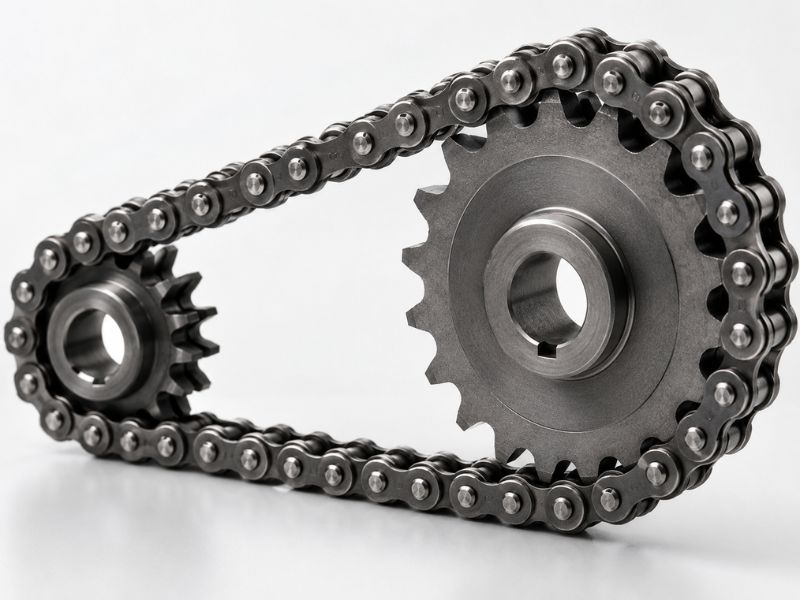
A chain and sprocket system transmits rotational power from one shaft to another by mechanically linking them with a loop of chain. The chain's links engage the teeth of one sprocket, carry the drive force across the distance between shafts, and transfer it to a second sprocket on the output side. The system is simple, widely manufactured, and handles load conditions that would destroy a belt drive in the same installation.
Understanding how the system works, what it's good at, and where its limitations are determines whether you're selecting the right transmission type for a given machine.
Chain and Sprocket Definition: The Core Components
Three components define the system.
The drive sprocket sits on the input shaft, connected to the power source. It rotates at the speed of the engine, motor, or prime mover driving the machine.
The driven sprocket sits on the output shaft. It may be larger or smaller than the drive sprocket, depending on the required speed ratio and torque multiplication.
The chain is a series of rigid links connected by pins and rollers. The rollers seat into the spaces between the teeth on each sprocket. When the drive sprocket turns, its teeth push against the chain rollers, the chain transmits that force across the distance to the driven sprocket, and the driven sprocket rotates.
The key characteristic of this engagement is that it is positive. The chain cannot slip on the sprocket the way a belt can slip on a pulley. Every revolution of the drive sprocket produces a precisely predictable rotation of the driven sprocket, determined entirely by the tooth count ratio between the two.
Speed ratio = driven sprocket teeth ÷ drive sprocket teeth
A 12-tooth drive sprocket paired with a 48-tooth driven sprocket produces a 4:1 reduction. The output shaft turns at one quarter the input speed, and the output torque (before friction losses) is four times the input torque.
How Chain and Sprocket Systems Work: The Polygon Effect
The engagement mechanism creates an effect that belt drives don't have: the polygon effect.
A sprocket is not a round wheel. It's a polygon — a shape with a finite number of flat sides, one per tooth gap. As the chain wraps around the sprocket, the effective pitch radius of the drive changes slightly with each link that enters and exits engagement. This chordal action causes a small cyclic variation in chain speed, even when the sprocket turns at perfectly constant rotational velocity.
The polygon effect increases with fewer teeth and decreases with more. A sprocket with 17 teeth has measurably more speed variation per revolution than one with 40 teeth running the same chain. At high chain speeds, this variation produces vibration and noise. It's the fundamental reason that minimum tooth counts of 17 to 19 are standard practice for drive sprockets in continuous-duty applications — not arbitrary rules, but engineering limits for acceptable dynamic performance.
Understanding this matters when comparing chain drives to belt drives. A flat belt or V-belt running over a round pulley doesn't have a polygon effect. In high-speed, low-torque, vibration-sensitive applications, a synchronous belt system may outperform a chain drive even though the chain system has better torque capacity. Each transmission type has its domain.
Types of Chain
Not all chains are roller chains. The chain type determines which sprocket profile is required.
Roller chain is the most common type for power transmission. The chain consists of alternating inner and outer link plates, with hardened steel rollers that rotate freely on the pins. The rollers reduce the friction and wear at the tooth engagement point. Standard roller chains follow ANSI B29.1 (North American) or ISO 606 / DIN 8188 (European A-series, dimensionally compatible with ANSI) dimensional standards. A separate European B-series (DIN 8187) uses different pitches and is not interchangeable with ANSI or DIN 8188 chain. As covered in detail in our guide to matching sprockets to chain, the pitch and roller diameter must match the sprocket exactly.
Silent chain (also called inverted tooth chain) uses toothed link plates that engage directly into sprocket tooth grooves, without rollers. The engagement is smoother and quieter at high speeds, making silent chain the choice for automotive timing systems and high-speed machine tool drives. The sprocket profile for silent chain differs from roller chain and the two are not interchangeable.
Conveyor chain is designed for material transport rather than power transmission. The links include attachments, extended pins, or carriers that support the product being moved. Conveyor chain runs at low speeds and carries the load on the chain itself rather than through a tensioned loop.
Leaf chain uses interlaced link plates without rollers, designed for lifting applications — forklift mast chains and counterweight systems. Not a power transmission chain in the conventional sense.
Types of Sprocket
Sprocket classification follows the chain type and the mounting configuration.
Simplex sprockets run a single-strand chain. The most common configuration in industrial and automotive applications.
Duplex and triplex sprockets run two or three parallel chains on a single sprocket body, increasing load capacity proportionally without increasing sprocket diameter. Used where the required torque exceeds what a single-strand chain can carry at the sprocket size the installation allows.
Idler sprockets don't connect to a shaft — they guide the chain to prevent sag on long spans, take up slack, or redirect the chain path around an obstruction. They can be used to maintain tension without a dedicated tensioner mechanism.
Taper lock sprockets mount on the shaft via a split taper bushing that grips when the fastening bolts are tightened. They're easy to install and remove without special tools, which makes them standard for industrial conveyor and drive sprockets that are regularly removed for maintenance.
Timing sprockets run with toothed belts, not chains. The name similarity causes some confusion — a timing chain uses roller chain and a roller chain sprocket, while a timing belt uses a toothed belt and a timing sprocket with a different tooth profile.
What Are Motorcycle Sprockets?
Motorcycle sprockets are the clearest everyday example of a chain and sprocket system in action.
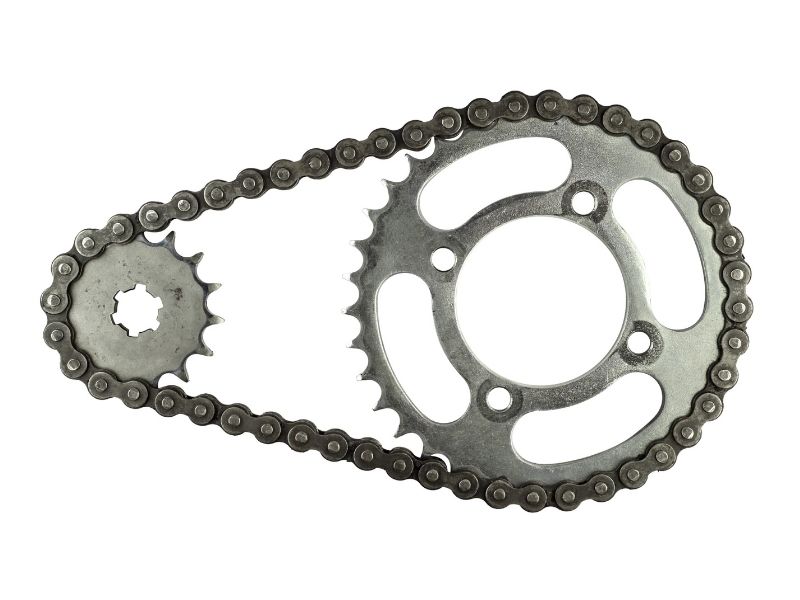
A motorcycle chain drive connects the engine output shaft (via the gearbox) to the rear wheel using two sprockets and a loop of roller chain. The front sprocket (countershaft sprocket or drive sprocket) is small — typically 14 to 18 teeth. The rear sprocket is large — typically 40 to 52 teeth. This ratio determines the overall final drive reduction on top of whatever the gearbox provides.
The reason the rear sprocket is so much larger than the front is torque multiplication. A smaller front sprocket driving a larger rear sprocket multiplies torque at the rear wheel at the cost of wheel speed relative to engine speed. For a motorcycle, high torque at the rear wheel produces acceleration. Changing the sprocket ratio is one of the most common modifications motorcyclists make to tune acceleration vs. top speed — a larger rear sprocket improves low-speed torque and acceleration, a smaller rear sprocket raises top speed at the cost of acceleration.
Motorcycle sprockets are typically made from steel (rear) and steel or aluminium (front). Aluminium rear sprockets are lighter but wear faster than steel against the same chain. Stainless steel motorcycle sprockets are used in environments where corrosion is the primary concern, such as on classic bikes in wet climates or coastal environments, where the alternative is repainting and re-treating a corroding steel sprocket every season.
Chain and Sprocket Uses
Chain and sprocket systems appear wherever the transmission requirement involves high torque, a fixed speed ratio, and a requirement for the drive to work across a gap between shafts that can't be bridged by gears.
In industrial machinery: conveyor drives, bucket elevators, paper mill roll drives, printing press line shafts, agricultural combine drives, irrigation pump drives, and machine tool change-gear systems.
In vehicles: motorcycle final drives, go-kart and karting applications, agricultural tractor PTO systems, and older industrial vehicle final drives before enclosed hypoid gearing became standard.
In material handling: forklift chain drives, overhead conveyor trolleys, chain hoists, and pallet conveyor systems.
In food processing: stainless steel chain and stainless sprocket drives on conveyor lines, washdown environments, and bottling and canning machinery where the chain drive must resist cleaning chemicals applied daily.
Advantages and Disadvantages of Chain and Sprocket Systems
Advantages
No slip. The fixed engagement between chain rollers and sprocket teeth means the speed ratio between input and output shafts never changes with load. This is the critical advantage over belt drives. A V-belt drive slips under overload. A chain drive doesn't — it either transmits the load or the chain or sprocket fails, but it doesn't slip and change the speed ratio in between.
High torque capacity. Chain drives handle much higher torque than belt drives at equivalent center distances and sprocket sizes. This is why bicycles, motorcycles, and heavy industrial conveyors use chain — the torque requirement exceeds what a practical belt system can carry.
Long center distances. A chain drive can span a large distance between shafts without the sag and tension management problems that affect belt drives at long spans. Adding an idler sprocket controls sag on particularly long runs.
Operates in wet and dirty conditions. Chain drives function in environments where belt drives would slip or degrade — mud, oil mist, water spray. A properly lubricated roller chain maintains its performance in contaminated environments that would require a sealed system for belt drives.
Multiple shafts from one chain. A single chain can drive multiple sprockets on parallel shafts, which is more complex with belt systems.
Disadvantages
Requires lubrication. Roller chain running dry wears rapidly at the pin-bushing interface. A dry chain will also wear the sprocket teeth asymmetrically. Proper lubrication is the most important maintenance factor in chain drive longevity. Food processing, pharmaceutical, and clean-room applications require either food-grade lubricant (NSF H1) or specialty self-lubricating chain, which increases both cost and procurement complexity.
Polygon effect at high speed. As discussed above, the polygon effect limits chain drives at high rotational speeds. Above approximately 500 to 800 RPM at the smaller sprocket, vibration from the polygon effect becomes significant. High-speed drives above this range typically require a silent chain or a belt transmission instead.
Noise. Metal-to-metal engagement is inherently noisier than a belt running over a pulley. In applications where noise is a design constraint — consumer products, office environments, precision instruments — belt drives or gear drives are preferred.
Wear elongation. As the pin-bushing interface wears, the effective pitch length of each link increases slightly. This "chain stretch" causes the chain to ride higher on the sprocket teeth over time, accelerating tooth wear. Monitoring chain elongation and replacing the chain before it reaches the replacement threshold protects the sprockets. See why sprockets wear faster than chains for the full wear mechanism.
Corrosion sensitivity. Standard carbon steel roller chain and sprockets corrode in wet or chemical environments. This adds lubrication, coating, or material upgrade requirements in applications where a simple steel-and-grease solution would corrode quickly.
Where Stainless Steel Chain and Sprockets Apply
Standard carbon steel sprockets and chains are adequate for enclosed, dry, lubricated industrial applications. Stainless becomes necessary when the operating environment introduces corrosion risk that carbon steel can't handle within the maintenance interval the application allows.
Food and beverage processing lines run washdown cycles using sodium hydroxide at 0.5–2% concentration at 60–80°C daily. Carbon steel sprockets corrode and shed rust into the product zone within one season. Stainless steel sprockets in 304 or 316L resist this chemistry and meet the material requirements for food-contact hardware.
Marine applications expose chain drives to salt spray continuously. A carbon steel chain in this environment corrodes at the pin-bushing interface within one season. Stainless chain maintains dimensional stability across multiple seasons, reducing the replacement cycle and the risk of unexpected chain failure.
Pharmaceutical production, semiconductor fab, and chemical processing environments each have specific chemical exposures that rule out carbon steel without coatings. In these environments, 316L stainless is the specification because the molybdenum content raises resistance to chloride pitting that 304 alone doesn't provide.
One trade-off to note: stainless roller chain has lower tensile strength than equivalent carbon steel chain at the same pitch. The reduction is typically 20–30% in minimum breaking strength. When substituting stainless for carbon steel in an existing drive, verify the load case against the stainless chain's rated capacity before assuming a direct substitution is valid.
Conclusion
A chain and sprocket system earns its place wherever slip isn't acceptable and torque or distance rules out gears. Get the standard, pitch, and tooth count right, and switch to stainless only where the corrosion environment actually demands it.
Profab Machine manufactures precision 304 and 316L stainless steel sprockets in ANSI and ISO standards. Available in simplex and duplex configurations with finished bore, pilot bore, and taper lock options, our sprockets are built for demanding food processing, marine, and chemical applications.