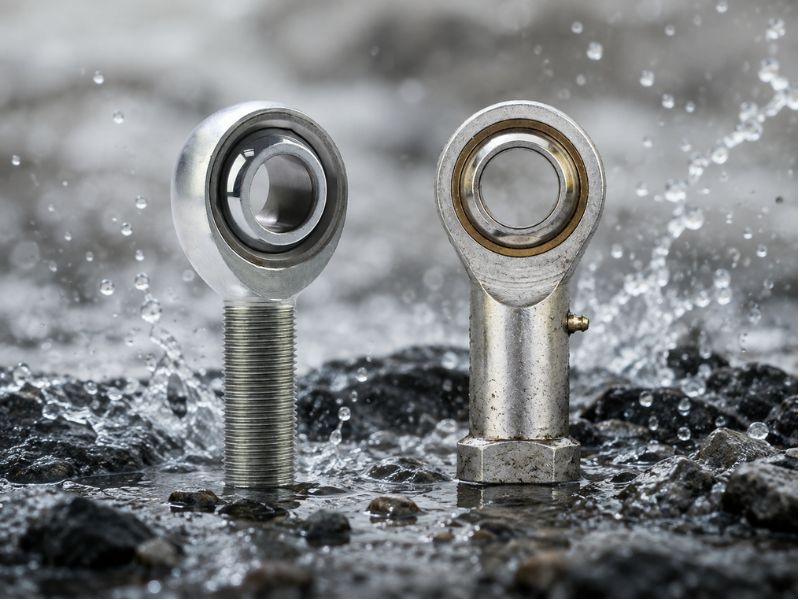
The standard forum answer to "PTFE or greasable?" splits along predictable lines. PTFE advocates say it's maintenance-free and sealed. Greasable advocates say you can push contamination out. Both answers are partially right and both miss the specific failure mechanism that water crossings introduce.
Water crossings aren't just "moisture." They combine water ingress, silt and fine particulate, temperature changes that create differential pressure inside the joint, and the physical pressure of moving through a water obstacle. Understanding what each joint type does with that combination determines which one you want in your build.
What Happens Inside a PTFE Joint After Submersion
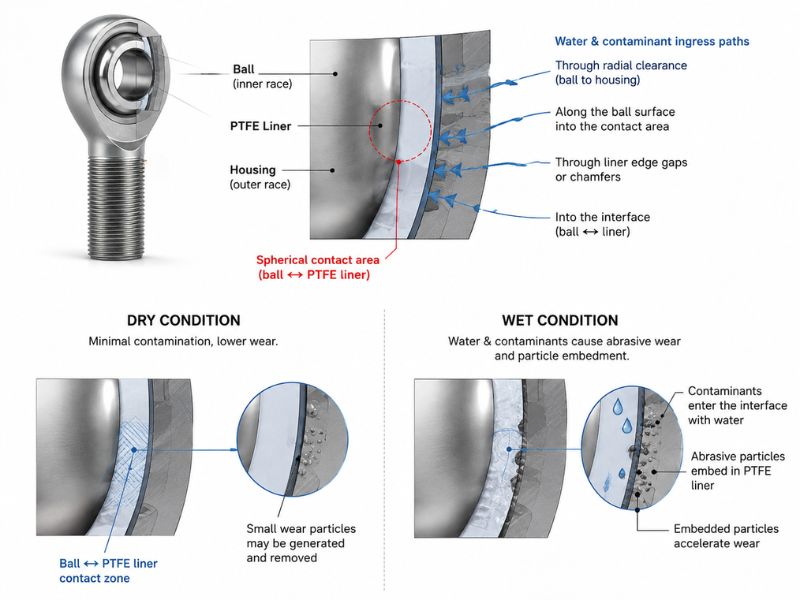
A PTFE-lined heim joint is not hermetically sealed. The liner sits between the ball and the housing, and there are gaps at the edge of the liner where it meets the housing bore. In normal dry or dusty conditions, those gaps are small enough that contamination ingress is minimal. In a water crossing, pressure differential and capillary action pull water into the joint at those gaps.
Once water is inside, it sits against the PTFE liner. PTFE itself doesn't absorb water and doesn't corrode, which is why the marketing on self-lubricating joints calls them weatherproof. But the ball and housing are steel, and water sitting at the liner-to-ball interface corrodes the ball surface. The rust particles that form don't leave the joint. They stay inside and become embedded in the soft PTFE surface.
This is the mechanism that matters: embedded rust and silt particles in the PTFE liner turn it into a grinding compound. The liner that was supposed to reduce wear is now actively abrading the ball surface. The joint feels fine when you check it by hand. It's articulating freely. But the contact surface is degrading with every movement, and the internal clearance is growing faster than it would from PTFE wear alone.
Adding grease to a PTFE-lined joint after a water crossing makes this worse, not better. Grease in a PTFE joint attracts and traps fine particles at the contact surface. As one long-running thread on irate4x4 puts it: "Grease attracts dirt and makes a nice grinding paste." You're creating an abrasive compound inside the joint housing.
What Happens Inside a Greasable Joint After Submersion
A greasable heim joint has a zerk fitting that allows fresh grease to be pumped into the bearing cavity. During a water crossing, water enters around the lip seal if present, or through the bearing gap if not. The joint ends up with a water-grease emulsion inside.
Water-contaminated grease loses its film strength. The bearing surfaces are no longer separated by a coherent lubricant film. If you don't address this and just keep driving, the joint runs in degraded condition until the grease dries out or oxidizes further, which accelerates wear at the contact surface.
The critical difference from PTFE is what you can do about it. A greasable joint can be purged. Pump fresh grease through the zerk until clean grease is coming out the opposite side of the housing. The contaminated grease gets pushed out and replaced. The bearing surfaces are back in contact with clean lubricant. If you do this after every water crossing, the joint's internal condition resets rather than accumulating degradation.
The greasable joint's advantage in water crossing use isn't that it keeps water out better. It doesn't. It's that you have a recovery mechanism. The PTFE joint has no recovery mechanism. Whatever got in stays in.
The Pressure Washer Problem
Here's the situation that damages joints faster than any water crossing: the post-trip pressure wash.
A 3,000 PSI pressure washer directed at a heim joint forces water past seals and into bearing gaps at far higher pressure than any river crossing creates. The crossing was at low differential pressure. The pressure washer is at high differential pressure, aimed directly at the seal interface.
After a water crossing, rinse the vehicle with low-pressure water or a garden hose. Keep high-pressure jets away from heim joints, u-joints, and wheel bearings. This applies to both PTFE and greasable joints. For greasable joints, pump fresh grease through the zerks after rinsing, before storage. For PTFE joints, inspect for play and replace on schedule rather than trying to recover.
Stainless Steel Changes the Failure Sequence
The analysis above assumes standard carbon steel or chrome steel ball surfaces. Stainless steel heim joints change the failure sequence for water crossing use specifically.
In a carbon steel greasable joint, water inside the housing immediately begins corroding the ball and housing bore. The corrosion itself reduces the effectiveness of the grease film on the next run even if you purged and recharged the joint. In a stainless joint, the ball surface resists this corrosion. The water can sit inside the joint overnight without initiating rust at the contact surface. When you purge with fresh grease the next day, you're working from a clean baseline rather than a rusted one.
For PTFE-lined stainless joints, the grinding paste problem described above still applies. The silt and particulate contamination is still there regardless of ball material. But the rust particle contribution is eliminated. The degradation rate is slower because you've removed one of the two abrasive components from the mix.
This is why stainless makes more practical sense for builds that see regular water crossings than the load capacity trade-off alone would suggest. The corrosion contribution to internal abrasion is significant enough in wet environments that preventing it extends service life beyond what the nominal rating difference between stainless and chrome steel implies.
Which Type Actually Fails First: The Honest Answer
Under identical conditions with identical maintenance:
PTFE-lined joints fail first in sustained mud and water use. The inability to purge contamination means degradation accumulates with each crossing. The joint will articulate freely much longer than it should because the play develops internally before it's perceptible by hand. By the time you feel slop, significant liner and ball surface damage has already occurred.
Greasable joints fail first when maintenance doesn't happen. A greasable joint that runs two trail seasons without a post-crossing purge is carrying contaminated grease from the first season. The maintenance advantage only exists if you use it.
The honest question isn't which joint type lasts longer in theory. It's which type matches your actual maintenance behavior. If you will purge grease after every water crossing, greasable joints will outlast PTFE in wet use. If you won't, because the trip ends late, because the zerk is buried in the linkage, because you forget, PTFE joints will last longer in practice because they have one fewer failure mode you can introduce.
Boots as a Third Option
Rod end boots, sometimes called Seals-It washers or heim joint boots, slip over the housing and seal the gap between the housing face and the bolt or stud. They don't change the joint type but they change the contamination equation substantially.
A PTFE joint with a properly fitted boot that seals the housing face gaps gets significantly less contamination ingress during a water crossing. The boot doesn't make it airtight, but it reduces the differential pressure path that water uses to enter. Combined with stainless construction, a booted PTFE joint in water crossing use outperforms an unbooted greasable joint on most trails.
The limitation: boots restrict articulation range. At large angular offsets, the boot can contact the stud or the adjacent component and either tear or prevent full articulation. For high misalignment applications, boots may not be compatible with the required angular travel.
Conclusion
Water crossings turn contamination into the deciding factor: PTFE joints trap whatever gets in permanently, while greasable joints can be purged clean if you actually do it. Add a boot to either type and use stainless construction, and the honest answer becomes less about which design is superior and more about which one matches your real maintenance habits.
Profab Machine makes stainless steel heim joints in PTFE-lined and greasable configurations, in 304 and 316L, for off-road and marine builds where water exposure is part of the operating environment.