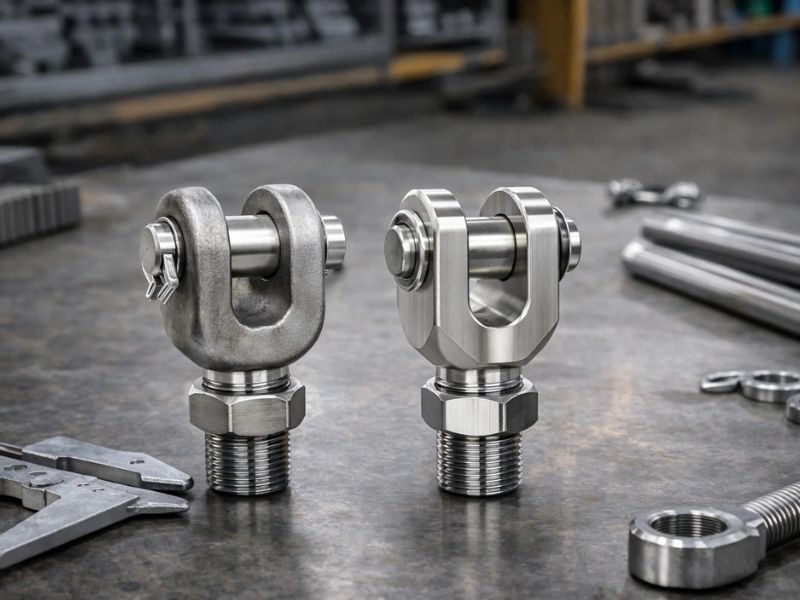
Ask which process makes a "stronger" clevis rod end and you'll get a different answer depending on who's selling what. The honest answer is that strength isn't really the variable in most cases. The variable is grain flow, and whether your application puts enough cyclic load on the pin bore to make that difference worth paying for.
Why Grain Flow Is the Real Difference
A clevis rod end starts as either a piece of round bar or a forging blank. Machine it from bar stock and the final shape gets cut out of material whose internal grain structure runs in one direction, set when the bar was rolled at the mill. Wherever the finished part's contour departs from that original bar axis, most obviously around the clevis fork and the pin bore, the machining process severs grain lines instead of following them.
Forging works the other way. The blank gets worked under pressure into roughly the final shape before final machining, so the grain deforms and flows around the part's contour instead of getting cut across it. Around a radius or a fork transition, a forged part keeps continuous grain flow where a machined part has grain ends terminating at the surface.
This matters specifically at fatigue crack initiation points, and a clevis pin bore under cyclic side-load is exactly that kind of point. A 2023 peer-reviewed fatigue study on hot-forged steel confirmed that samples with grain flow oriented in the main load direction consistently outperformed samples cut from rolled bar on rotational flexing fatigue tests. The forging advantage wasn't uniform across every test condition, and the paper didn't claim a single fixed percentage. The improvement is real but ranges with load type and grain orientation, which is a more honest way to describe it than a single clean number.
None of this means a machined clevis pin is fatigue-prone. It means the failure mode under high-cycle, high-load service tends to originate differently, and forging is one legitimate way to push that failure point further out when the application genuinely lives in that regime.
What Forging Actually Fixes, and What It Doesn't
Forging's second real advantage is defect consolidation. Bar stock can carry small internal voids or inclusions left over from the casting and rolling process. The pressure of forging closes a lot of that porosity as the material deforms, which is a genuine metallurgical benefit and one of the reasons forged parts are the default in aerospace and safety-critical automotive linkages.
What forging doesn't do is deliver a finished part. An as-forged surface is rough, dimensionally loose compared to a drawing, and still needs secondary machining on the bore, the threads, and any mating face that has to hold a tolerance. A forged clevis blank isn't a substitute for machining. It's a different starting material that still ends up on a CNC machine for the features that actually need to fit something.
Machining 316 Stainless Is Harder Than the Tolerance Spec Suggests
The other side of this comparison is what machining stainless actually costs in shop time, and it's a real constraint whether the blank came from bar stock or a forging. Austenitic grades like 316 carry a machinability rating in the range of roughly 35 to 45 percent relative to the 100 percent baseline set by 1212 free-machining steel, according to the Nickel Institute's technical reference on machining stainless. That's a wide, honest range because the number depends on tool geometry, coolant, and cut parameters, not a single fixed figure.
The reason sits in the metallurgy. 316 work-hardens fast under a cutting edge, its thermal conductivity is low enough that heat concentrates at the tool tip instead of dissipating into the chip, and its ductility means it tends to smear rather than shear cleanly. All three push toward shorter tool life, lower feed rates, and more careful process control than a comparable carbon steel job. That's true whether you're finishing a forged blank or cutting a part from solid bar, and it's the reason precision stainless machining is its own specialty rather than a carbon-steel process run slower.
Why Forging Only Pays Off at Volume
A forging die is a real, dedicated tooling cost, and it only pays for itself once it's amortized across enough parts. Custom die design and machining for a closed-die forging commonly runs into five figures depending on part complexity, and that cost gets spread over the production run, so the per-part tooling adder is steep on a short run and small on a long one.
For a one-off run, a prototype quantity, or a part that changes revision every year or two, that math rarely closes. Forging earns its cost on parts that run in the thousands with a fixed, stable geometry, which describes a lot of the automotive and heavy-equipment world and very little of custom or low-volume industrial hardware.
When Machined Stainless Is the Better Call
None of this is an argument against forging where it belongs. It's an argument for matching the process to the application instead of defaulting to whichever one sounds more impressive in a spec sheet.
Machined stainless is the better call when the run is custom or low-volume, when the bore and thread tolerances need to hold tighter than an as-forged part delivers without secondary work anyway, or when the part's geometry changes often enough that a die would sit idle between runs. It's also the simpler path when corrosion resistance, not cyclic fatigue life, is the reason stainless was specified in the first place, which describes most rod end applications outside of continuous heavy-cycle service.
Profab Machine machines stainless steel clevis rod ends from 316 and 17-4 stainless bar on CNC equipment built for the tolerances and surface finish this material actually needs, without a die investment or a minimum order tied to amortizing one. For applications that genuinely call for a forged blank, that's a service we can source and coordinate rather than one we run in-house, and we'll say so plainly rather than blur the line.
If your application runs high-cycle, high-side-load service and you're not sure which side of that line it falls on, that's worth a conversation before you spec the part either way.