Stainless steel tubing runs through everything from automotive exhaust systems to petrochemical process lines, but it doesn't all come from the same production route. Welded and seamless tubing start from different raw stock and end up with different mechanical properties, different lead times, and different price points. Picking the wrong one either overpays for pressure capacity you don't need or under-specs a system that will eventually fail at the seam.
This guide walks through how each type is made, where the real performance differences come from, and which applications actually require seamless construction versus where welded tubing is the better buy.
Understanding Manufacturing Methods
Seamless Tube Production
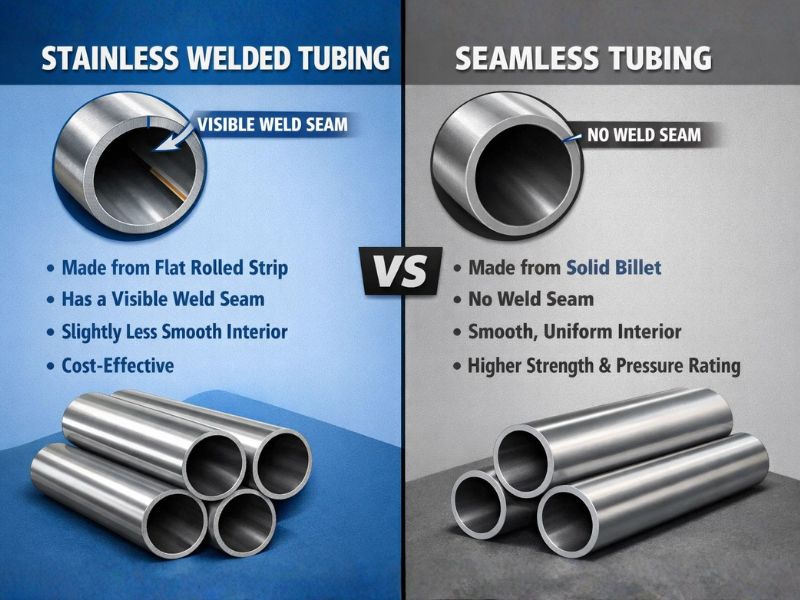
Seamless tube starts as a solid steel billet, heated and pierced by a mandrel that drives through the center to create a thick-walled hollow shell. Mandrel milling then elongates that shell, with rollers reducing wall thickness while increasing length; hot extrusion is an alternative route for some sizes, forcing heated billet through a shaped die to form the profile directly. Cold drawing through precision dies sets the final dimensions and surface finish, and pilgering, a reciprocating-die process, can tighten tolerances further where they're needed. Every one of these steps adds time, which is the main reason seamless tubing costs more and takes longer to produce than welded.
Welded Tubing Manufacturing
Welded tubing starts as flat coiled strip, which unwinds into forming rolls that gradually curve it into a tube shape before the edges are joined. High-frequency induction welding is the most common method: electrical current heats the strip edges and pressure fuses them together in a continuous, high-speed process. Electric resistance welding (ERW) works similarly, passing current through the material itself to generate the fusing heat, while laser welding produces the narrowest, most consistent seam of the three. After welding, the weld bead is reduced by cold rolling or forging, and a final drawing pass improves surface finish, tightens dimensional tolerance, and relieves residual stress from the weld.
What the Process Difference Means in Practice
Welded production runs continuously at high speed and scales easily for volume, while seamless production is a slower, multi-step batch process with real capacity constraints. That shows up directly in lead time: welded tubing often ships within days to a couple of weeks, while seamless can run four to eight weeks depending on size and grade. Welded methods also handle thin-wall, large-diameter configurations more easily, while seamless production is better suited to heavy-wall tubing. As a rough rule, welded tubing runs meaningfully cheaper than an equivalent seamless spec, though the exact gap depends heavily on size, grade, and order volume.
Performance: Welded vs Seamless
1. Pressure Capacity
Seamless tubing generally carries a higher allowable working pressure than welded tubing of the same size and wall thickness, but the reason isn't "uniform wall thickness" in the abstract, it's the weld joint efficiency factor that pressure design codes apply to welded construction. Under ASME B31.3, seamless pipe is assigned a joint quality factor of 1.0, while as-welded ERW or EFW pipe without full radiographic examination is typically assigned 0.85. Since allowable pressure scales directly with that factor, welded tubing at the same wall thickness carries roughly 15% less rated pressure than seamless, a gap that narrows or disappears if the welded tube is fully radiographed and the factor is raised back toward 1.0.
2. Corrosion Resistance
Seamless tubing's homogeneous grain structure resists chemical attack evenly across the whole cross-section, with no seam to act as a weak point. The heat-affected zone next to a weld can see localized changes to the metallurgical structure, including carbide precipitation in unstabilized grades, and any residual surface irregularity at the seam, even after bead reduction, gives corrosive media and residue somewhere to collect. In practice this matters most in continuous immersion or high-chloride service; for general atmospheric or low-corrosivity use, the difference is rarely the deciding factor.
3. Structural Integrity and Fatigue
Seamless tubing's continuous grain structure distributes stress evenly and handles cyclic loading better than a welded joint, which can develop fatigue cracks over repeated stress cycles even when the weld passed inspection at installation. Thermal cycling adds another variable, since the weld zone and base metal can expand at slightly different rates, introducing extra localized stress. This is why nuclear, aerospace, and other high-consequence-of-failure applications specify seamless as a baseline requirement rather than an optional upgrade.
4. Dimensional Tolerance and Surface Finish
Welded tubing actually has the edge here: the rolling and sizing process gives tighter outside-diameter control and more consistent wall thickness than seamless production typically achieves, and cold-drawn welded tube often has a smoother finish than seamless, which can carry faint spiral marks from the piercing and rolling process. Welded tubing is also available in longer continuous lengths, since seamless production has practical length limits tied to the piercing and drawing equipment.
5. Size and Shape Flexibility
Large-diameter, thin-wall tubing favors welded construction; the forming process handles that geometry easily where seamless struggles. Heavy-wall tubing runs the other way, favoring the rotary piercing process. Welded production also covers a wider practical diameter range and takes to square, rectangular, and custom profiles far more easily than seamless, which needs shape-specific tooling for anything other than round.
6. Testing and Quality Assurance
Seamless tubing has no weld to inspect, which removes an entire category of quality control: no weld procedure qualification, no ongoing weld-parameter monitoring. Welded tubing needs the opposite, with non-destructive testing (ultrasonic, radiographic, or eddy current) applied to verify seam integrity, plus continuous monitoring of weld parameters during production. Both types go through hydrostatic testing to prove pressure integrity, with test pressures set by the governing product standard. Certification documentation reflects the same split: welded tube certs include weld procedure qualification records, while seamless certs focus on material and dimensional conformance.
7. Cost Analysis
The cost gap between the two comes almost entirely from production complexity. Seamless tube requires multiple heating, piercing, and drawing operations on dedicated equipment with real throughput limits, while welded tube runs continuously off coil stock at much higher line speeds. That difference compounds with order size: welded tubing's cost advantage is largest on standard sizes ordered in volume, and narrows on small, specialty, or heavy-wall orders where seamless capacity constraints matter less. For applications where either type meets the engineering requirement, the practical decision usually comes down to whether the project can absorb seamless lead times and premium, or whether welded's faster availability and lower cost make it the better fit.
Industry Applications: Where Each Type Excels
Critical High-Pressure and High-Temperature Applications
Oil and gas drilling systems, which regularly run at working pressures well above what welded tubing is rated for, specify seamless as standard. Petrochemical reactor vessels and high-pressure process piping follow the same logic, and nuclear power plants use seamless tubing exclusively, since the combination of radiation exposure and high system pressure leaves no margin for a weld-related failure mode. Boiler tubes and chemical-plant heat exchangers add a thermal dimension: seamless construction avoids the weld heat-affected zone that can lose strength at sustained high temperature, which is why seamless stainless tubes remain the default above roughly 600°F.
Automotive and General-Purpose Applications
Exhaust systems, manifolds, headers, and tailpipes run well below tubing pressure ratings and see moderate temperatures, so welded stainless is the standard here on cost and availability alone. Grade 409 covers cost-sensitive exhaust runs, and 321's titanium stabilization earns it a place in premium exhaust systems exposed to sustained heat. The same logic applies to architectural handrails, HVAC systems, furniture, and general plumbing, where pressures are low and welded tubing's smoother finish is actually an advantage for appearance.
Specialized Industries: Medical, Marine, and Food Processing
Medical device manufacturing and implantable components generally specify seamless for reliability and precision, and pharmaceutical clean-in-place systems favor seamless construction to avoid any weld-adjacent surface irregularity that could trap contamination. Marine environments push toward seamless too, since sustained salt spray attacks a weld seam more aggressively than the surrounding base metal. Food-grade tubing under ASTM A270 can be met by either type, with the choice coming down to the specific sanitary system design rather than a blanket rule — see Profab's stainless tubing for available sizes and grades.
Material Grades and Standards
Common Stainless Grades
Grade 304 covers most general-purpose and architectural work. Grade 304L drops carbon below 0.03% to prevent carbide precipitation during welding, which is why welded construction commonly specifies the "L" grade. Grade 316 adds 2 to 3 percent molybdenum for meaningfully better corrosion resistance in marine and chemical service, at a real cost premium over 304, and 316L combines that low-carbon weldability benefit with the molybdenum addition, which is why medical and pharmaceutical tubing usually specifies it. Grade 321's titanium stabilization protects against intergranular corrosion at high temperature, covering the exhaust and high-heat applications 304 and 316 aren't suited for, and Grade 409 is the economical ferritic option for automotive exhaust where cost matters more than absolute corrosion resistance.
ASTM Standards
ASTM A269 covers general-purpose stainless tubing, both welded and seamless, under a single set of mechanical property requirements. ASTM A213 is seamless-only, written specifically for boiler, superheater, and heat-exchanger tubes in high-temperature service. ASTM A554 covers welded mechanical tubing in round, square, and rectangular profiles; despite sometimes being grouped with the pipe standards, it's a welded-only specification. ASTM A312, by contrast, covers both seamless and welded stainless pipe under the same mechanical requirements, with the joint quality factor discussed above being what actually differentiates their pressure ratings in service, not a difference in base material strength. This standards comparison breaks down the scope of each in more detail. Grade 304 tubing under these standards carries a minimum tensile strength around 75,000 PSI regardless of whether it's seamless or welded.
Installation Considerations
Joining and Fabrication
Weld seam orientation matters during installation of welded tubing: positioning the seam away from the point of maximum bending stress, and keeping it on the neutral axis when the tube will be bent, both reduce the risk of seam failure during forming. Beyond that, fusion welding, orbital welding, and compression fittings all work the same way on both tubing types, and standard tube benders, cutters, and welders handle both without specialized equipment. Bending radius is governed by wall thickness rather than by whether the tube is seamless or welded.
Conclusion
The choice between welded and seamless stainless tubing comes down to the operating pressure, temperature, and failure consequences of the application, not a general preference for one process over the other. Seamless earns its premium in high-pressure, high-temperature, and high-consequence service where the joint quality factor and heat-affected-zone limitations of a weld aren't acceptable trade-offs. Welded tubing is the better buy everywhere else, offering faster lead times, tighter dimensional control, and a real cost advantage for the large majority of general industrial, automotive, and architectural applications.
For guidance on specifying the right stainless tubing for your project, Profab Machine can help match the grade and construction method to your actual operating conditions.
Profab also supplies stainless steel tube clamps for mounting and securing tubing runs.
FAQ
When do engineers specifically choose seamless tubing over welded?
Seamless tubing is preferred for high-pressure systems, fatigue-critical applications, and safety-sensitive industries such as hydraulics, oil and gas, and certain chemical processes, where the weld joint quality factor or heat-affected zone of a welded tube would compromise the design margin.
Which type is easier to source with short lead times?
Welded stainless tubing is generally easier to source, available in a wider range of sizes, and offers shorter lead times than seamless tubing, since it runs continuously off coil stock rather than through a multi-step batch process.