
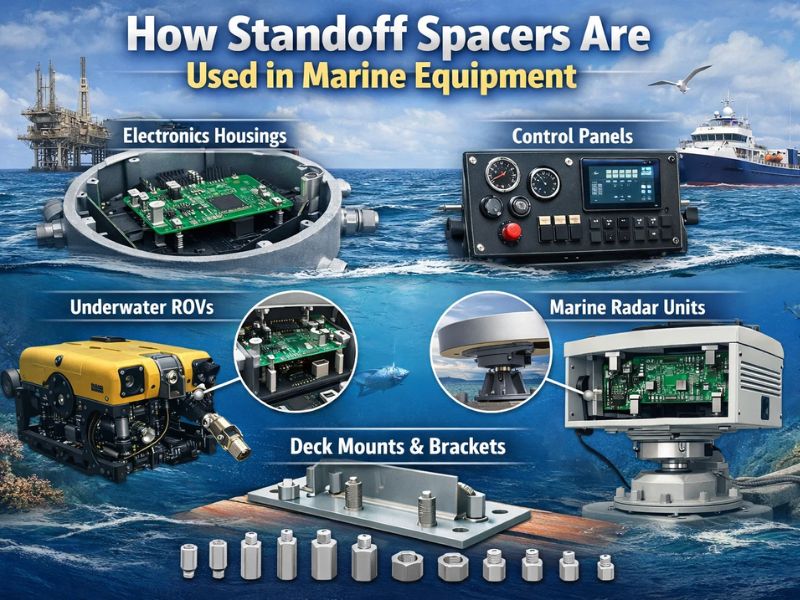
Standoff spacers do a small but essential job in marine electronics: they create a precise, fixed gap between a circuit board and its mounting surface. That gap does three things at once, it keeps conductive traces and components clear of a grounded metal enclosure, it lets air circulate underneath the board for cooling, and, when the standoff is threaded, it locks the assembly in place against constant vibration and motion. Get the spacer wrong and you don't just lose the mounting, you lose the electrical isolation and thermal clearance that go with it.
Where Standoff Spacers Do the Work
Engine Control Modules and Power Distribution Boards
Engine bay electronics see continuous vibration for as long as the engine runs, which rules out anything but a threaded standoff with a mechanical lock. Electronic control modules mounted directly above or near the engine need standoffs sized to the fastener, typically M5 or M6 for this duty, paired with lock washers or a thread-locking compound rated for the engine bay's operating temperature.
Power distribution boards carrying significant current need physical isolation from a grounded enclosure. Direct contact between a live bus bar and a grounded housing is a short-circuit and fire risk, so the standoff's job here is holding a consistent, adequate isolation gap, not just mechanical support.
Power electronics, switching regulators, and rectifiers generate real heat in a confined space. Taller standoffs create a larger air gap under the board, which improves convective cooling compared to a board mounted flush against a panel.
Marine Lighting Systems and Junction Boxes
LED driver boards in navigation and deck lighting fixtures benefit from standing off the fixture base, since condensation forms readily in sealed housings that cycle through temperature swings; elevating the board keeps it out of any moisture that collects at the base. Junction box components (relays, terminal blocks, breakers) need the same separation to avoid short circuits from condensation or box flexing under load.
Navigation lights at the masthead and stern see direct salt spray and UV exposure continuously. 316 stainless steel standoffs are the standard specification here for their corrosion resistance in that environment. Submersible or underwater lighting is a different case: potted, sealed assemblies with standoff penetrations need galvanically compatible standoff material (316 stainless or bronze, not a metal that will corrode against the enclosure's other fittings) and a proper potting compound around every connection.
Communication Equipment and Antenna Mounting
VHF radio chassis mounting needs both structural support and a solid electrical ground path for RF performance, which stainless standoffs provide reliably even under vibration and corrosion exposure. AIS transponders add a wrinkle: the antenna connection needs grounding for lightning protection, while the power supply circuit needs isolation to prevent ground loops, so a single installation sometimes needs standoffs serving both functions in different locations on the same board.
Satellite communication domes and exposed antenna amplifiers add weatherproofing to the list of requirements. Sealed, gasketed standoff assemblies with O-rings at each mounting point keep water out of equipment that has no other enclosure protection once it's mounted on a flying bridge or hardtop.
Bilge Pump Controls and Float Switch Systems
Controller electronics in bilge compartments need enough standoff height to keep circuitry clear of any water that reaches the compartment, with ventilation designed to let moisture escape without letting water in. Bilge water carries oils, fuel residue, and other contaminants that damage electronics quickly on contact, so the margin matters more here than in a dry compartment. Float switches and level sensors that operate partially submerged need standoffs and fasteners rated for continuous wet service, which 316 stainless handles without the corrosion concerns a lesser grade would introduce.
Pump-induced vibration is a separate consideration from engine vibration, generally lower frequency but still enough to back out an improperly locked fastener over time. Coarse-thread standoffs with lock washers, and rubber isolation washers where vibration transmission itself is a concern, address this the same way they do near the engine.
Material Selection for Marine Durability
Why 316 Stainless Dominates Marine Standoff Applications
316 stainless steel's 2 to 3 percent molybdenum content is what separates it from 304 in chloride-heavy environments: it meaningfully improves resistance to the pitting and crevice corrosion that saltwater exposure drives. The passive oxide layer that gives stainless its corrosion resistance also self-repairs when scratched, provided the environment allows it to reform, which is what makes 316 the practical default for standoffs that will see continuous or repeated saltwater exposure rather than an occasional splash.
Corrosion testing to ASTM B117 is the standard method for evaluating hardware corrosion resistance, though the standard itself doesn't fix a pass/fail duration, that's set by whatever spec is being tested against. For marine-grade hardware, exposure requirements are commonly specified in the hundreds of hours rather than tens. What that testing consistently shows is the same pattern reported across marine hardware literature generally: 316 substantially outperforms 304 once chloride exposure is sustained rather than incidental.
Alternative Materials Worth Knowing
Brass conducts electricity considerably better than stainless steel, which matters where a standoff is doing RF grounding duty rather than just mechanical support. Naval brass (roughly 60% copper, 40% zinc, with a small tin addition) resists the dezincification that plain brass suffers in saltwater, where the zinc leaches out and leaves a weak, porous copper structure behind.
Silicon bronze combines corrosion resistance close to 316 stainless with good electrical conductivity, making it a reasonable middle ground where both properties matter.
6061-T6 aluminum gives a meaningfully better strength-to-weight ratio than steel, which matters on weight-sensitive above-deck installations like racing or performance sailboats, at the cost of lower absolute strength and less corrosion resistance in continuous saltwater contact.
Nylon and other plastics absorb moisture over time, which causes dimensional swelling and can loosen a standoff that was originally torqued correctly. UV exposure degrades most plastics on exposed deck installations over months rather than years, causing chalking, cracking, or yellowing depending on the polymer. Where electrical insulation rather than mechanical support is the goal, ceramic, fiberglass-reinforced phenolic, or PEEK standoffs hold up far better in continuous marine exposure than nylon or polycarbonate.
Conclusion
Standoff spacer selection in marine equipment comes down to matching the material and construction to what the standoff actually has to do in that location, whether that's isolation, grounding, cooling clearance, or vibration resistance, not just picking a size that fits the board. 316 stainless covers most exposed marine locations; the alternative materials above earn their place only where a specific property (conductivity, weight, or insulation) matters more than corrosion resistance alone.
Profab Machine manufactures stainless steel standoff spacers in a range of sizes and thread configurations, with custom manufacturing available from your drawings. Contact Profab Machine to work through the right specification for your installation.
FAQ
What is the best material for standoff spacers in a saltwater environment?
316 stainless steel is the standard choice for its pitting and crevice corrosion resistance in chloride exposure. For non-load-bearing electrical isolation duty, nylon or ABS spacers are also used since they're immune to saltwater corrosion by nature, though they carry their own moisture-absorption and UV-degradation limits over time.
How do spacers help with heat management in marine power systems?
Marine compartments are often cramped and poorly ventilated. Standoffs lift components like inverters or charge controllers off the mounting surface, opening a clear air gap behind the unit that improves convective heat dissipation and extends the component's service life.