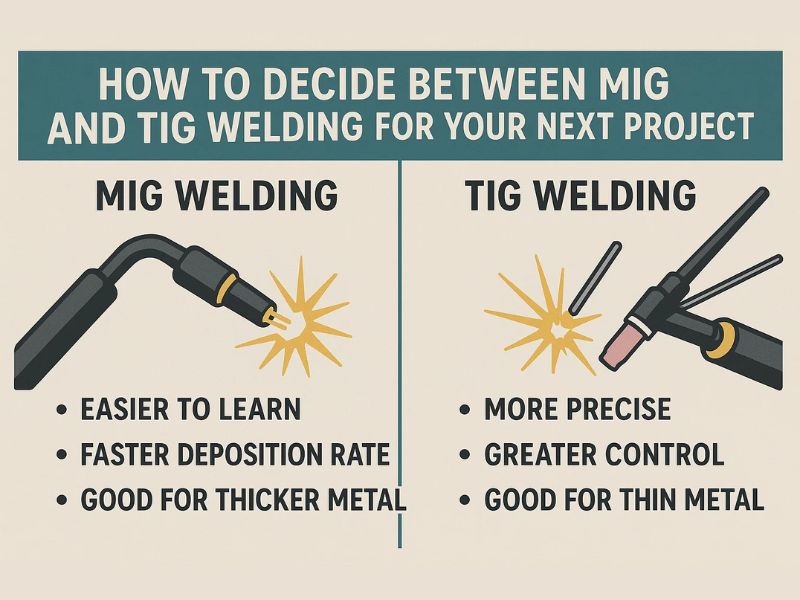
The choice between MIG and TIG welding for stainless steel is an engineering and economic decision. You're balancing production speed against precision, initial cost against long-term weld quality, and the need to protect stainless steel's corrosion resistance from excess heat input. MIG is well suited to high-volume, structural fabrication on thicker materials. TIG is the preferred, and often mandatory, choice for critical, high-purity, or highly visible work.
What Is MIG Welding
MIG equipment is straightforward: a power source, wire feed unit, welding gun, and shielding gas supply. The wire electrode is consumable, melting into the weld as filler. Most stainless steel MIG welding uses Direct Current Electrode Positive (DCEP) polarity, which keeps the arc stable and promotes adequate penetration.
How MIG Works
A wire electrode feeds automatically through the gun as you guide it along the seam, melting and fusing the joint. Because the operator only has to control gun movement rather than also feeding filler manually, MIG is comparatively easy to learn and well suited to large projects and thicker materials.
What Is TIG Welding
TIG equipment includes a power source, a torch with a non-consumable tungsten electrode, and shielding gas; filler rod, where used, is a separate consumable. TIG welders typically offer both AC and DC output, but stainless steel welding normally uses DC electrode negative (DCEN) polarity, which concentrates heat at the workpiece for proper penetration. Water-cooled torches are common or required for sustained TIG work to prevent overheating.
How TIG Works
The operator controls the torch with one hand and feeds filler rod with the other, a dual-hand operation that gives much finer control over the weld than MIG allows. That control is what makes TIG the right choice for thin materials and work that needs a clean, precise finish, at the cost of a steeper learning curve.
MIG vs TIG Welding
Skill and Learning Curve
TIG demands real coordination and manual dexterity, one hand on the torch and the other feeding filler rod, and mastering it takes extensive practice. MIG is widely considered easier to learn, sometimes called the "hot glue gun" of welding for how quickly a beginner can produce a usable bead with its semi-automatic wire feed.
Weld Strength and Penetration
TIG's narrow, focused arc produces deep, precise fusion and a generally lower defect rate, which is why it's considered superior for joint integrity in critical applications. MIG can still produce strong, durable welds, particularly with proper joint preparation like a V-groove, but its broader arc typically gives shallower penetration than TIG at comparable settings. Where weld integrity is the overriding requirement, TIG's control advantage makes it the default.
Speed and Efficiency
MIG is substantially faster. TIG's manual filler-feeding and meticulous technique keep deposition rates low, typically 1 to 2 kilograms per hour, which rules it out for long continuous welds or high-volume production. MIG's continuous wire feed runs at 3 to 8 kilograms per hour, several times faster than TIG, making it the clear choice for high-volume manufacturing and long weld runs.
Weld Quality and Finish
TIG welds are widely regarded as stronger and cleaner than MIG welds on stainless steel, with a narrower heat-affected zone and fewer defects. MIG welds are strong enough for most structural work but typically show a broader heat-affected zone and a rougher finish by comparison. Where appearance and weld integrity both matter, TIG is the standard choice.
Material Thickness
- TIG only: for very thin materials (0.5–1.5 mm), TIG is the only viable option. MIG's heat input at this thickness easily causes burn-through, leading to rework or scrap.
- TIG preferred: for typical housings (1.5–3 mm), TIG remains preferred for its heat control and lower distortion risk.
- Either process: for 3–6 mm material, both processes work; the choice comes down to speed versus aesthetics.
- MIG preferred: for structural components 6 mm and thicker, MIG's speed and deposition rate allow full penetration in a single pass, where TIG would need multiple passes and more total heat input.
Visual Aesthetics and Post-Processing
TIG is the clear choice where finished appearance matters: clean, uniform, low-spatter welds with the signature "stack of dimes" profile that typically need only light polishing to remove minor heat tint. MIG welds on stainless steel tend to look rougher, with more spatter and more discoloration from higher heat input, which often means grinding, chemical cleaning, and repassivation to restore both appearance and corrosion resistance, adding time and cost, and potentially affecting tight dimensional tolerances.
Applications
Aerospace and Critical High-Purity Applications
For aerospace work, TIG is the dominant, often mandated process. Flawless welds, minimal defects, and tight control of the heat-affected zone aren't optional for components like engine parts, and TIG's ability to repair minor defects rather than scrap an expensive part adds a real economic advantage on top of the quality case.
Structural and Industrial Fabrication
For frameworks, pressure vessels, and heavy machinery, MIG is the preferred process because speed and deposition rate matter more than surface finish, especially when welds end up hidden or coated anyway. Pulsed MIG splits the difference, offering better weld quality than standard MIG for mid-volume runs that still need a cleaner finish.
Food and Beverage, Medical, and Sanitary Welding
TIG is the standard for sanitary welding in food, beverage, and medical equipment. Its precise heat control avoids the chromium carbide precipitation that would otherwise compromise corrosion resistance at the weld, and its clean, low-spatter finish avoids the surface irregularities that trap contamination in equipment exposed to harsh cleaning chemicals and constant sanitation requirements.
Architectural and Aesthetic Projects
For railings, countertops, and sculptural work where the finished look is the whole point, TIG's clean, spatter-free weld with the "stacked dimes" appearance is worth the extra time it takes to produce.
Conclusion
The choice between MIG and TIG for stainless steel comes down to weighing MIG's throughput against TIG's precision and finish quality. Use TIG for critical, sanitary, thin-material, or visually demanding work; use MIG for high-volume structural fabrication where speed matters more than finish. Most shops end up needing both.
At Profab Machine, our certified welders work in both processes and match the technique to the stainless grade and application, so your project gets the integrity, aesthetics, and durability it actually needs. Contact Profab Machine for a quote on your next stainless welding project.
FAQ
What is the main difference between TIG welding and MIG welding?
TIG uses a tungsten electrode and gives you more control for precise, clean welds. MIG uses a continuously fed wire and runs faster for larger projects. The choice comes down to whether speed or precision matters more for the job.
Which process is better for welding stainless steel?
It depends on the application. TIG gives a cleaner, stronger weld with better corrosion-resistance preservation. MIG works faster and is more practical for large or less visible structural joints.
Which welding method is easier for beginners?
MIG is generally easier to learn since the wire feeds automatically and the operator only guides the gun. TIG takes more practice because it requires controlling the torch and feeding filler rod at the same time.