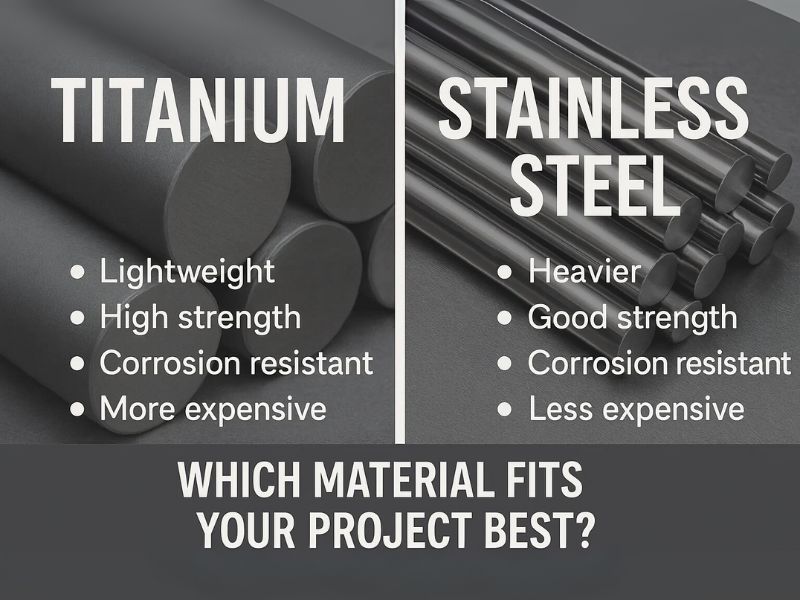
Titanium and stainless steel both show up in demanding engineering applications, but they solve different problems. Titanium wins on strength-to-weight ratio and corrosion resistance in the harshest environments; stainless steel wins on cost, machinability, and weldability for everything short of that. Here's how they actually compare across composition, mechanical properties, corrosion behavior, and cost, so you can match the material to what your project actually needs rather than defaulting to whichever sounds more advanced.
Titanium vs Stainless Steel: Quick Guide
Choosing Titanium
Titanium is the right call when weight and corrosion resistance both matter more than cost. It shows up in aircraft structures and medical implants because it's biocompatible, resists corrosion in saltwater and aggressive chemicals, and delivers a strength-to-weight ratio steel can't match. The tradeoff is price and machinability, titanium costs significantly more and is harder to fabricate.
Choosing Stainless Steel
Stainless steel is the practical default when you want to control cost without sacrificing durability. It welds and machines without specialized equipment, and grades like 304 and 316 resist corrosion well enough for the overwhelming majority of food processing, construction, and automotive applications.
Project Scenarios
| Project Type | Best Material | Reason |
|---|---|---|
| Jet engine parts | Titanium | Needs strength and light weight |
| Medical implants | Titanium | Biocompatibility and durability |
| Food equipment | Stainless Steel | Cost-effective and corrosion resistant |
| Marine hardware | Stainless Steel 316 | Strong corrosion resistance at reasonable cost |
| Outdoor products | Stainless Steel | Sufficient durability at lower cost |
| Extreme saltwater/chemical exposure | Titanium | Superior corrosion resistance where 316 eventually pits |
Material Properties
Composition
Titanium alloys like Ti-6Al-4V are mostly titanium with small additions of aluminum and vanadium. Stainless steel grades like 304 and 316 are iron-based, with chromium and nickel driving the corrosion resistance.
| Material | Ti | Al | V | Sn | Fe | C | O | N |
|---|---|---|---|---|---|---|---|---|
| Ti-6Al-4V | 90% | 6% | 4% | – | <0.25% | <0.10% | <0.20% | <0.03% |
| Ti-5Al-2.5Sn | 90% | 5% | – | 2.50% | <0.25% | <0.10% | <0.20% | <0.03% |
| Ti-3Al-2.5V | 94.50% | 3% | 2.50% | – | <0.25% | <0.10% | <0.20% | <0.03% |
| Material | Cr | Ni | Mn | P | S |
|---|---|---|---|---|---|
| 304 Stainless Steel | 18.0-20.0% | 8.0-10.5% | 2.00% | 0.05% | 0.03% |
| 316 Stainless Steel | 16.0-18.0% | 10.0-14.0% | 2.00% | 0.05% | 0.03% |
Physical Properties
Titanium alloys melt at a higher temperature than 304 stainless, weigh nearly half as much, and conduct heat more slowly, which matters for parts that need to resist thermal fatigue.
| Property | Titanium (Ti-6Al-4V) | Stainless Steel (304) |
|---|---|---|
| Melting Point (°C) | 1,668 | 1,400–1,450 |
| Thermal Conductivity (W/m·K) | 6.7–22 | 16.2 |
| Density (g/cm³) | 4.43–4.51 | 7.93–7.98 |
Appearance
Titanium has a gray, matte, satin-like finish from its natural oxide layer, especially in commercially pure grades; anodizing changes its color by controlling that oxide layer's thickness. Stainless steel is bright and silvery and polishes to a mirror finish, which is why it's the default for visible, decorative applications.
Environmental Impact
Titanium production via the conventional Kroll process is energy-intensive with a correspondingly high carbon footprint; recycled titanium meaningfully reduces that footprint since it skips the primary extraction step. Stainless steel 316L powder runs around 1.95 kg CO2e per kg, a smaller footprint than titanium produced conventionally, though the comparison depends heavily on production method and grade for both materials.
Strength and Hardness
Tensile Strength
Titanium alloys run roughly 900 to 1,200 MPa tensile strength; stainless steel spans a wider range, roughly 600 MPa up to over 1,100 MPa depending on grade and condition. Titanium's advantage isn't raw tensile strength so much as tensile strength relative to weight.
Hardness Ratings
Ti-6Al-4V (Grade 5) typically measures around 330 to 370 HV on the Vickers scale in its standard annealed condition, comparable to mid-range stainless steel grades rather than dramatically harder. Precipitation-hardened stainless grades like 17-4PH reach roughly 40 HRC, while 304L and 316L sit closer to 15 HRC in the annealed state.
| Material | Approximate Hardness |
|---|---|
| Titanium Grade 5 (Ti-6Al-4V), annealed | ~330–370 HV (Vickers) |
| Stainless Steel 17-4PH | ~40 HRC |
| Stainless Steel 304L / 316L | ~15 HRC |
Impact Resistance and Applications
Titanium alloys including commercially pure titanium and TC10 are used in oil and chemical processing equipment exposed to HCl, H2S, and hot aqueous environments, conditions where they resist both cracking and corrosion. Stainless steel handles impact and cyclic stress well in its own domain too: orthodontic archwires made from stainless steel tolerate repeated flexing without failure, which is part of why the grade remains standard for that application.
Weight Comparison
Titanium's density (about 4.5 g/cm³) is close to half that of stainless steel (about 8.0 g/cm³), which is the whole basis for its strength-to-weight advantage in aerospace and performance applications.
| Material | Density (g/cm³) |
|---|---|
| Titanium (Ti-6Al-4V) | 4.43 |
| Stainless Steel (304) | 8.00 |
Where weight is the deciding factor, aerospace structures, race car components, high-end bicycles, titanium's advantage is worth the cost premium. Where weight isn't the constraint, buildings, bridges, chemical tanks, stainless steel's extra mass is irrelevant and its lower cost wins.
- Aerospace: titanium reduces structural weight directly
- Automotive: titanium helps where weight matters, but cost usually rules it out except in performance applications
- Construction: stainless steel's mass and cost profile fit large structures
- Medical: stainless steel covers most tools; titanium covers implants
- Chemical processing: heavy stainless steel tanks handle most corrosive service safely and economically
Corrosion Resistance
Titanium Performance
Titanium forms a tenacious, self-healing oxide layer that holds up in seawater and aggressive chemical environments where stainless steel eventually pits.
Stainless Steel Performance
Stainless steel's corrosion resistance depends heavily on grade:
- Austenitic grades (304, 316) resist acids and saltwater well, with 316's molybdenum content giving it a meaningful edge over 304 in chloride exposure
- Ferritic grades (430, 444) resist corrosion but offer less formability
- Martensitic grades deliver high strength with only moderate corrosion resistance
Harsh Environments
In continuous saltwater or aggressive chemical exposure, titanium's oxide layer holds up longer than any stainless grade, while 316/316L perform well but can develop pitting or crevice corrosion over extended service. For marine hardware or chemical tanks specifically, titanium's advantage grows with exposure severity and service life requirements; for shorter service life or less aggressive exposure, 316 stainless remains the more economical choice.
Maintenance
- Clean surfaces regularly to remove accumulated dirt and chemical residue
- Avoid direct contact with carbon steel, which can trigger galvanic corrosion against both titanium and stainless
- Passivate stainless steel after fabrication to restore its protective oxide layer
Cost and Value
Titanium costs substantially more than stainless steel, and the gap varies by grade and form. Commercially pure Grade 2 sheet typically runs in the range of $10–18 per kilogram, with higher-strength Grade 5 running $20–45 per kilogram depending on certification and finish. Stainless steel, by comparison, typically runs $4–7 per kilogram for common grades. These figures move with market conditions and should be confirmed against current supplier quotes before budgeting a project.
Pros and Cons
Titanium Advantages
- Biocompatible and widely used in medical implants
- High strength-to-weight ratio
- Osseointegrates with bone, a key reason for implant use
- Excellent wear and corrosion resistance
- Responds well to surface treatments for specialized performance
Titanium Drawbacks
Titanium is expensive to extract and process, requires specialized tooling and welding equipment, and takes longer to machine than stainless steel, all of which add cost and lead time to any project.
Stainless Steel Advantages
- Strong and resistant to deformation
- Chromium content provides reliable corrosion resistance across most environments
- Machines and welds without specialized equipment
- Long service life with minimal maintenance
Stainless Steel Drawbacks
Stainless steel can develop pitting corrosion in sustained salty or acidic exposure, a failure mode titanium largely avoids even at elevated temperature. For general-purpose use, 304 and 316 remain cost-effective and reliable; they simply can't match titanium's strength-to-weight ratio or corrosion resistance ceiling in the most demanding environments.
Conclusion
Titanium and stainless steel aren't competing for the same jobs. Pick titanium where weight and extreme corrosion resistance justify a real cost premium, aerospace, implants, or continuous exposure to seawater and aggressive chemicals. Pick stainless steel everywhere else: it machines and welds easily, costs a fraction of titanium, and handles the corrosion demands of food processing, construction, marine hardware, and general industrial equipment without difficulty.
If you want expert help matching the material to your application, Profab Machine can walk through the tradeoffs for your specific project.
FAQ
What makes titanium better for medical implants?
Titanium doesn't react with body tissue and osseointegrates with bone, producing strong, biocompatible implants that last for years. That's why it's the standard for bone and dental implants.
Can you weld titanium and stainless steel easily?
Stainless steel welds with standard equipment and techniques. Titanium requires specialized tools, shielding, and skill to avoid contamination, which adds cost and time to the process.
Which material resists saltwater best?
Titanium resists saltwater better than any stainless grade over the long term. Stainless steel 316 performs well in marine service but can eventually develop pitting corrosion.
Is stainless steel a better choice for food and kitchen equipment?
Yes. Stainless steel resists staining and corrosion, cleans easily, and costs far less than titanium, making it the practical standard for food processing and kitchen equipment.