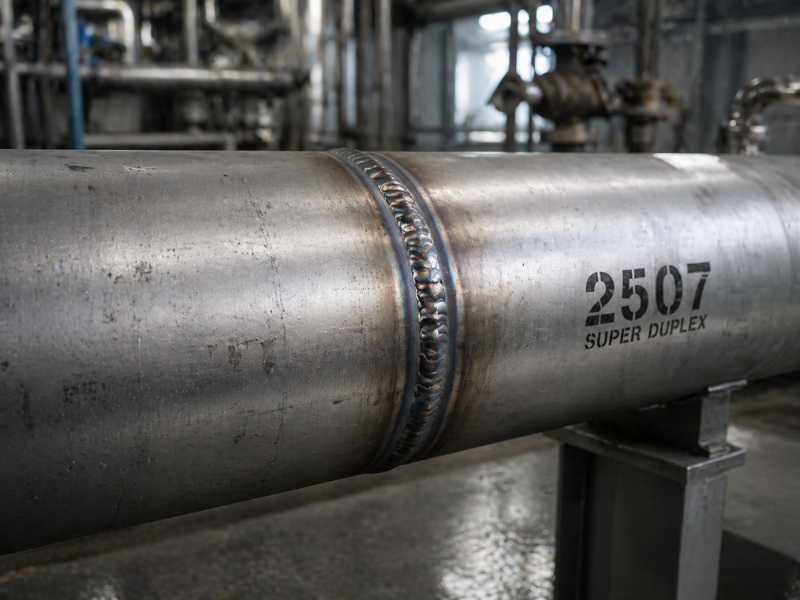
A 2507 super duplex fitting passes every visual check and dye penetrant test. The weld looks clean. Two months later, after service in a seawater cooling system, a crack runs through the heat-affected zone. The failure mode is brittle fracture. The root cause is sigma phase, formed during a multipass weld where nobody measured the interpass temperature.
This situation is more common than it should be. It happens when fabricators treat 2507 as if it were simply a stronger, more expensive 316L. They use familiar settings, trust the alloy content to cover the gaps, and assume the process has some forgiveness built in. It does not.
What Makes 2507 Different from Every Other Grade You’ve Welded
2507, also known as UNS S32750, is a super duplex stainless steel. Its microstructure is dual phase, roughly 50% ferrite and 50% austenite. That balance gives it a pitting resistance equivalent number (PREN) of 40 or higher, well above the approximately 35 typical of standard 2205 duplex and around 25 for 316L.
The alloy package is the reason: 25% chromium, 7% nickel, 4% molybdenum, and 0.27% nitrogen. Those elements give 2507 strong resistance to chloride pitting, crevice corrosion, and stress corrosion cracking in aggressive environments. The problem is that the same elements, especially chromium and molybdenum, also make sigma phase precipitation happen faster than it does in lower-alloyed grades.
With 2205, the welding window is already tighter than it is for austenitic stainless steels. With 2507, it tightens again. The extra thermal sensitivity is not a small adjustment. It changes how the job has to be controlled.
The table below compares the main welding limits for three grades that many shops work with:
| Parameter | 316L Austenitic | 2205 Duplex | 2507 Super Duplex |
|---|---|---|---|
| Max Interpass Temperature | 150°C | 150°C | 100°C |
| Heat Input Range (GTAW) | Flexible | 0.5–2.5 kJ/mm | 0.5–1.5 kJ/mm |
| Filler Metal | ER316L | ER2209 | ER2594 |
| Back Purge Required? | Recommended | Required | Mandatory |
| Shielding Gas | Pure Ar | Ar + 2% N₂ | Ar + 2% N₂ |
| PREN of Weld Metal | ~25 | ~35 | ≥40 |
| Sigma Phase Risk | Low | Moderate | High |
The Sigma Phase Problem: Why Slow Cooling Breaks Welds
Sigma phase is an intermetallic compound made up of iron, chromium, and molybdenum. It precipitates from the ferrite phase when 2507 stays too long in the temperature range of approximately 600°C to 1000°C. The precipitation peak is around 850°C.
At that point, chromium and molybdenum move into sigma phase. The nearby material is left depleted, so it loses corrosion resistance and toughness at the same time. Even a small volume fraction of sigma in the weld HAZ can cause a sharp drop in Charpy impact energy, sometimes from over 100 J down to below 20 J.
The risk is highest in two welding situations.
Multipass welds with inadequate cooling: Every new pass reheats the one before it. If the workpiece has not cooled below 100°C before the next pass starts, the accumulated thermal exposure drives the HAZ further into the sigma formation range.
Slow post-weld cooling: Thick sections and poorly ventilated work areas can keep the weld pool and HAZ hot for too long as they pass through the danger range. For heavy sections, forced cooling with air or water is not an extra precaution. It is part of the welding process.
A point many fabricators underestimate is the speed of the reaction. Sigma phase in 2507 does not need a long high-temperature soak. It can start forming within minutes at 850°C. Slow cooling is not a cushion. It gives sigma phase the time it needs.
Once sigma phase is present, grinding will not remove the problem. Neither will stress relief or any low-temperature treatment. The only real correction is full solution annealing at approximately 1050–1100°C, followed by immediate water quenching. For most finished welded assemblies, that is not realistic. Prevention is the only practical answer.
Sigma phase formation in 2507: key facts
- Temperature range: 600°C to 1000°C (peak precipitation at ~850°C)
- Can begin forming within minutes at peak temperature
- Effect: severe loss of toughness and corrosion resistance in HAZ and weld metal
- Prevention: rapid cooling through this range, strict interpass temperature limit
Heat Input and Interpass Temperature: The Two Numbers That Run the Job
For 2507 GTAW, the practical heat input range is 0.5–1.5 kJ/mm. For SMAW, the range is wider but still controlled. Most fabrication standards specify 0.5–2.0 kJ/mm, and the lower limit matters just as much as it does for GTAW.
Too low: The cooling rate becomes too fast. Ferrite formation takes over in the HAZ, and the ferrite-heavy structure loses toughness and pitting resistance. In tight joint preparations, incomplete fusion also becomes more likely.
Too high: Ferrite grains grow coarse. Nitrogen volatilizes from the weld pool. Cooling through the sigma range slows down. The ferrite/austenite balance, which is the basis of 2507’s performance, moves out of control in the other direction.
There is no safer side to miss on. Both extremes can produce a defective weld. The job is to stay inside the qualified procedure window and confirm that every pass stays there.
The interpass temperature limit for 2507 is 100°C. This is not guidance. It is the upper limit. In actual shop work, many experienced fabricators use 80°C as their working maximum to leave room for variation.
Measuring Temperature Correctly
Temperature-indicating crayons (Tempilstiks) can help with rough checks, but contact thermometers or thermal cameras give more dependable readings. Measure on the base material next to the weld, not on the surface of the last bead. The HAZ around the weld is the area that matters.
On thick multipass welds, interpass temperature often takes longer to drop than people expect. Judging by a gloved hand is one of the easiest ways to violate the procedure in a shop. Measuring takes ten seconds. Repairing or replacing a failed weld costs far more.
Filler Metal and Shielding Gas: The Over-Alloying Strategy
The correct filler metal for 2507 is ER2594. Not ER2209. Not ER316L. Not whatever duplex wire is left over from the last job.
ER2594 is intentionally over-alloyed: approximately 25% chromium, 9% nickel, 4% molybdenum, and 0.25% nitrogen. That extra alloying is there to compensate for what happens during welding. Nitrogen volatilizes from the weld pool, and the cooling HAZ tends to form more ferrite than the target 50/50 balance. The higher nickel and nitrogen content in ER2594 helps drive austenite reformation back toward the correct ratio in the finished weld metal.
A matching grade filler such as ER2507 can work in tightly controlled laboratory conditions, but it gives less room for process variation in production. For fabrication work, ER2594 is the standard choice.
Shielding Gas and Back Purge
For GTAW on 2507, the shielding gas should be 98% Ar with 2% N₂. Pure argon is not enough. Without added nitrogen, the weld pool loses nitrogen, and austenite formation in the HAZ is suppressed even when the filler metal is correct.
Back purge on root passes is mandatory. Use Ar + 2–5% N₂ as the purge gas. More than 5% N₂ can cause arc instability and porosity. Less than 2% does not supply enough nitrogen to the root side of the pool.
The purge has to be established before arc start and maintained until the root pass cools below 100°C. If there is a purge leak or the purge is shut off too early during welding, the root pass should be rejected. This is not something to sort out later by looking at the finished weld.
Gas specification for 2507 GTAW:
- Shielding: 98% Ar + 2% N₂
- Back purge: Ar + 2–5% N₂
- Gas purity: ≥99.995% Ar base for both
- Purge timing: establish before arc start, maintain until root pass cools below 100°C
Verifying the Weld: What Visual and PT Won’t Tell You
For 316L or carbon steel, visual inspection and dye penetrant testing cover many of the main weld quality concerns. For 2507, they say very little about the failure mode that matters most.
Sigma phase cannot be seen on the surface. It gives no visual warning. A weld can look perfect, meet dimensional checks, and still be compromised as soon as it enters chloride service.
These are the tests that matter for 2507 welds.
Ferrite measurement: Target range is 35–65% ferrite using a calibrated Ferritescope or WRC-1992 diagram calculation based on actual weld metal composition. Readings below 35% indicate excess austenite, with elevated stress corrosion cracking susceptibility. Readings above 65% indicate over-ferritic structure with reduced toughness and impact resistance.
ASTM A923 Method C: The ferric chloride corrosion test per ASTM A923 is the standard method for detecting detrimental intermetallic phases in duplex stainless steel welds. Method C subjects weld specimens to a ferric chloride solution for a defined duration. Weight loss above the acceptance threshold confirms sigma or chi phase presence. This test is required by most engineering standards for critical service applications of duplex and super duplex welds.
Charpy V-notch impact testing: Required for critical applications, particularly offshore platforms, subsea equipment, and cryogenic service. The test measures actual toughness in the weld and HAZ. If sigma phase has formed, the impact energy will fail the acceptance criterion. This failure will not show up in visual inspection, PT, or dimensional measurement.
Post-weld pickling and passivation: Even a correctly welded 2507 joint with a sound microstructure will underperform if heat tint remains on the surface. The high-temperature oxidation zone beside the weld bead is chromium-depleted. Acid pickling removes that layer and restores the passive oxide film. For components going into chloride service, including seawater systems and chemical processing, pickling is not cosmetic. It is functional. Passivation with nitric acid or citric acid solution follows to confirm full surface recovery.
Maintaining the correct ferrite/austenite balance is the central challenge in welding duplex grades. Super duplex grades make that challenge much harder because intermetallic phases precipitate faster.
The Most Common Procedural Gaps, and Why They Matter
In certification audits and field failure investigations, three gaps show up again and again in 2507 welding specifications.
No interpass temperature stated in the WPS: “Control as required” or “per welder judgment” is not a measurable requirement. If the procedure does not state a 100°C maximum, it cannot be enforced or audited consistently.
Purge gas composition not specified: Argon-only back purge is sometimes listed where nitrogen-mixed purge is required. That omission is technically wrong, and it leaves the root pass exposed to nitrogen loss no matter how carefully the other parameters are controlled.
Filler metal grade not restricted: A WPS qualified with ER2594 may allow ER2209 substitution under some procedure qualification interpretations. That substitution is not acceptable for 2507 production welds and should be clearly prohibited in the written procedure.
These procedure problems can get through pre-job review unnoticed. They usually become obvious only after a field failure starts a root cause investigation. When that happens, the welding procedure document is one of the first things examined.
A defensible 2507 welding program starts with all three requirements written directly into the WPS: a stated interpass limit, nitrogen-mixed purge gas composition, and grade-restricted filler metal.
Profab Machine supplies different grades of stainless steel components across marine, oil and gas, and industrial markets. We provide 2507 and other super duplex components, including flanges, structural connectors, custom machined fittings, and OEM assemblies.