Go through the FSAE.com forum archives and the same question comes up every season from new teams: why do most cars use spherical bearings pressed into the A-arm tube ends instead of threaded rod ends, when rod ends are cheaper and adjustable?
It's a load path problem, not a preference. Once that clicks, the rest of the spec decisions, 2-piece vs 3-piece, metal-to-metal vs PTFE, stainless vs standard bearing steel, follow the same logic.
Why Spherical Bearings Replace Rod Ends at A-Arm Joints
A threaded rod end transmits load through the shank thread into the housing. Fine when the load runs purely axial along the rod's centerline. An A-arm joint rarely sees purely axial load. Suspension geometry puts bending moments through the joint as the wheel moves through travel, as the chassis flexes, and as cornering loads shift the load vector relative to the arm's axis.
A rod end's threaded shank carries a stress concentration right where the thread meets the unthreaded shank. Put a bending moment through that point and the shank fails at the thread root, often with little warning. FSAE design guides flag this constantly as one of the most common and most avoidable suspension failures: never put bending load through a rod end's threaded shank.
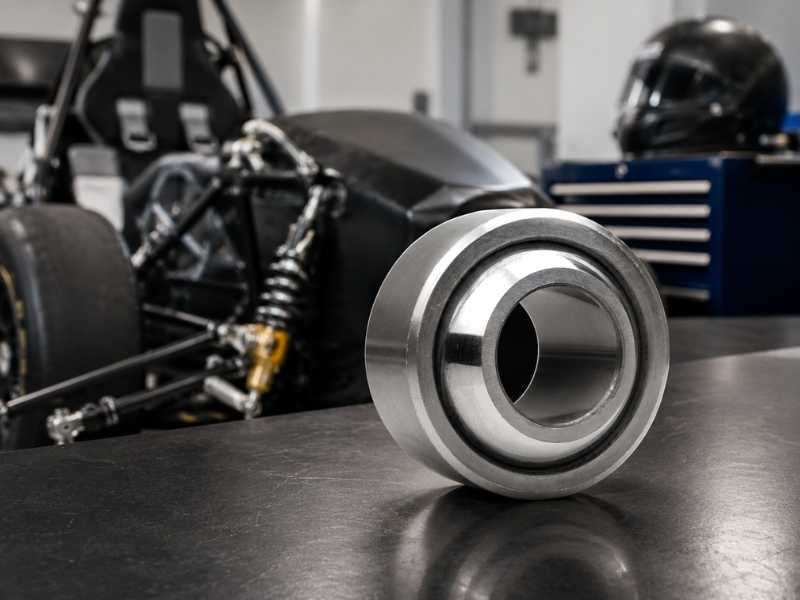
A spherical plain bearing pressed directly into the A-arm tube skips this problem entirely. Load goes from the pin, through the ball, into the outer ring, into the tube itself. No threaded shank anywhere in the path. The tube wall, not a thread root, becomes the limiting structural element, and tube walls handle off-axis loading far better than a 1/4-28 or 5/16-24 thread ever will.
That's why teams switching from rod ends to encapsulated spherical bearings at A-arm joints report fewer failures, even when those bearings cost less than the rod ends they replaced.
2-Piece vs 3-Piece Construction
Spherical plain bearings come in two basic constructions, and the difference matters more here than in industrial linkage work. Motorsport joints see higher peak loads relative to bearing size, plus tighter packaging constraints.
Spherical plain bearings are better classified by construction type and liner system than by a simple 2-piece vs. 3-piece label. For FSAE suspension joints, the more useful question is whether the bearing is a swaged, split-ball, load-slot, or high-misalignment design, and whether its dynamic and static load ratings match the actual load case and housing fit.
Metal-to-Metal vs PTFE-Lined for Suspension Joints
While industrial applications often use metal-to-metal bearings for shock loads, motorsport suspension joints overwhelmingly standardize on self-lubricating, PTFE-lined bearings. This is especially true in FSAE. Metal-to-metal bearings require manual grease lubrication. In open-wheel racing, this grease acts as a magnet for track debris, rubber pickup, and abrasive dust. The mixture turns into a grinding paste that destroys the bearing within hours.
More importantly, metal-to-metal bearings suffer from high and inconsistent breakaway torque. Because suspension movements are slow and oscillating, the bearing cannot develop a hydrodynamic oil film. This introduces stiction and hysteresis into the suspension geometry, which degrades tire grip and corrupts sensor data. To handle peak cornering and braking loads without liner creep, motorsport teams specify aerospace-grade (MIL-SPEC) PTFE fabric liners. These tightly woven liners handle massive dynamic loads, keep friction low, and remain entirely maintenance-free.
Stainless vs Standard Bearing Steel: When It Actually Matters
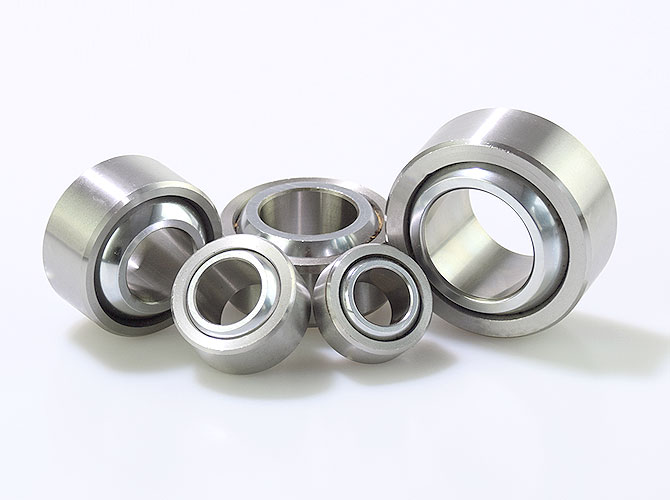
Standard motorsport bearings use through-hardened carbon bearing steel to achieve maximum load ratings. However, stainless steel becomes mandatory under two specific conditions: wet-weather racing and galvanic corrosion prevention. For example, teams need stainless steel when pressing bearings directly into carbon fiber suspension tubes. General industrial stainless grades, like 304 or 316L, lack the yield strength required for motorsport. They will deform plastically under severe braking and cornering loads. While hardened 440C offers higher hardness, it sacrifices critical corrosion margins and impact toughness.
The standard solution in premium racing components is 17-4PH precipitation-hardening stainless steel. Heat-treated to the H900 condition, 17-4PH delivers structural yield strength that rivals high-tensile carbon alloy steels. At the same time, it maintains superior corrosion resistance. When installing these high-strength components, remember that tight stainless fits gall easily. Always apply a thin film of MoS2 paste to the outer ring OD before pressing. This prevents surface tearing and ensures accurate final clearance.
Installation: The Stake Tool Question
FSAE teams machining their own A-arm tube ends and pressing bearings in by hand run into a specific problem. A press fit calculated for a CNC-bored tube often ends up closer to a slip fit once the bore comes from a manual mill with a boring bar, because achievable roundness and surface finish don't match a production housing.
A loose bearing works itself out under load. Sometimes the ball pops free of the outer ring entirely. The fix used across most FSAE programs: a retaining shoulder machined or welded into the tube on the side facing primary load direction, combined with whatever press fit you can get (even looser than spec) plus a retaining compound to take up the remaining clearance.
For stainless tube and stainless bearing outer rings, apply a thin film of anti-seize or MoS₂ paste to the outer ring OD before pressing. Stainless-on-stainless press fits gall, and a galled surface has less real contact area than the nominal interference suggests. That compounds the slip-fit problem teams already face from manual boring tolerances. ISO 12240-1 sets the dimensional baseline these fits are measured against, even when the actual achieved tolerance in a student shop falls short of it.
Service Life: What to Expect and What Shortens It
Teams running mid-range bearings report needing replacement after roughly 50-100 hours of running time, which for most programs covers a full competition season including testing. The bearings that wear fastest sit at joints with the highest combination of load and oscillation frequency, typically the outboard A-arm joints carrying direct wheel loads.
Play showing up before that hour count usually traces to one of three things: a 2-piece bearing with a poor staking job, a press fit that ended up looser than intended from manual machining, or a bearing running beyond its angular range because suspension geometry pushes misalignment past the rated angle during full wheel travel. Checking actual angular travel against the bearing's rated angle at the design stage, not just at static ride height, catches that last issue before it turns into a mid-season failure.
Profab Machine manufactures precision stainless steel spherical bearings in high-strength 17-4PH. We offer aerospace-spec motorsport series with bore sizes from 1/4 inch to 1 inch. We also manufacture matched stainless steel rod ends for joints that require a threaded connection. Custom outer ring and bore tolerances are available to match your specific A-arm sleeve dimensions.