
The question comes up on every linkage or actuator design at some point. Both a spherical bearing and a rod end contain a ball-and-socket contact surface. Both tolerate angular misalignment. On paper they look interchangeable. In practice, specifying one when you need the other shortens service life significantly and sometimes causes outright failure.
The decision comes down to three things: how the load enters the component, what the surrounding structure looks like, and how much angular motion the joint actually sees in service.
What They Actually Are
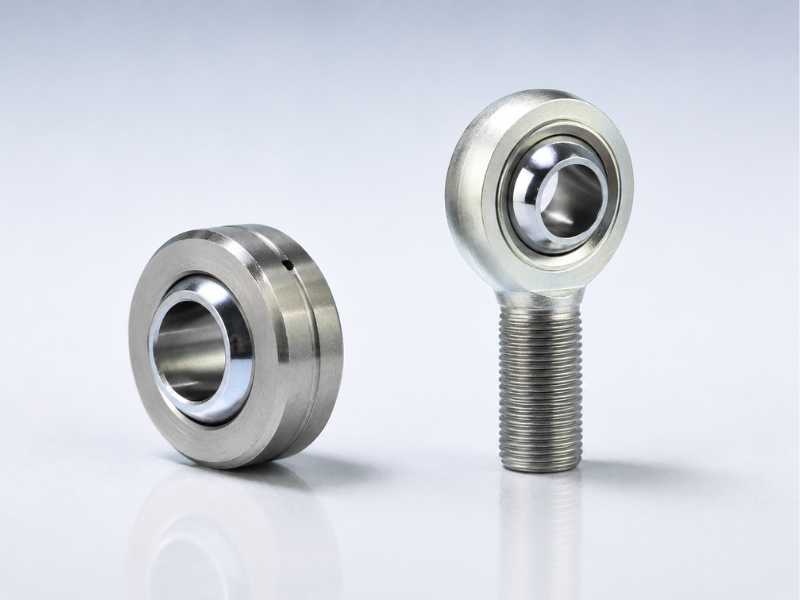
A rod end (also called a heim joint or rose joint) is a self-contained assembly. The spherical ball sits inside a housing that’s integrated with a threaded shank. You thread the shank directly into a rod or actuator arm. The joint mounts at the end of a member and transmits force along the rod axis.
A spherical plain bearing, sometimes called a spherical bearing in catalog language, is a bearing element only. It has an inner ring and an outer ring with a spherical contact surface between them. It gets pressed or bolted into a separate housing. The shaft or pin passes through the inner bore. There is no threaded shank. The load path runs through the housing, not through a threaded connection.
That structural difference is what drives most of the selection logic.
Use a Rod End When the Load Is Primarily Axial Along the Rod
Rod ends are designed to transmit tensile and compressive loads along their own axis. The threaded shank is the load introduction point. If your application involves a push-pull rod, a control linkage, a steering arm, or any situation where force travels through a slender rod into a pivot point, a rod end is the natural fit.
The angular compensation is a secondary benefit. It accommodates shaft misalignment and allows some oscillation at the joint, but the core function is axial load transmission. If you try to use a spherical plain bearing in this role without a proper housing, you end up building a complicated assembly that a rod end would handle more cleanly with fewer parts.
Typical rod end applications: cylinder clevises, control rods in agricultural machinery, steering linkages, actuator connections on solar tracking systems.
Use a Spherical Bearing When the Load Passes Through a Pin
A spherical plain bearing is typically used where a pin or shaft passes through the inner ring, and the bearing is mounted inside a housing or bracket. Although these bearings are commonly selected for radial loading, they can also accommodate combined radial and axial loads while compensating for angular misalignment.
This configuration is common in pivot pins, heavy equipment linkages, rocker arms, oscillating levers, and structural joints where the bearing is supported by a dedicated housing rather than attached to a threaded shank.
The housing carries the outer ring. The inner ring carries the shaft. Radial forces transfer from shaft to inner ring to outer ring to housing. The spherical contact between the rings absorbs angular misalignment without edge loading.
This is the correct configuration for pivot pins in heavy equipment, oscillating levers, rocker arms, and any joint where the load comes in perpendicular to the bore axis rather than along a rod. The housing can be a pillow block, a fabricated bracket, or a purpose-machined bore in the machine frame.
Trying to use a rod end in this load path means threading the shank into something that was never designed to take radial load through a thread. The shank bends. The thread fretting follows.
Angular Motion Range Is a Real Differentiator
Rod ends in standard stainless construction typically offer misalignment angles of 10° to 15°. Some extended-angle versions reach 25°. Beyond that, the ball contacts the housing bore edge and you lose the angular compensation entirely.
Spherical plain bearings in the GEC series accommodate angular misalignment while maintaining a high radial load capacity.
Depending on bore size and manufacturer design, angular movement is typically in the range of approximately 6° to 15°.
Where significant oscillating motion is combined with high radial loading, a spherical plain bearing installed in a rigid housing often provides a more robust solution than a rod end.
Radial Load Capacity Favors Spherical Bearings
For the same bore size, a spherical plain bearing pressed into a solid housing will generally carry a higher radial dynamic load than a rod end of the same thread size. The rod end housing wall is constrained by the overall shank geometry. The spherical bearing outer ring can be made thicker and housed in a more rigid structure.
If you are sizing for high radial loads and the geometry allows a housing bore rather than a threaded shank, a spherical plain bearing gives you more load capacity per unit of bore diameter.
⚠️ Common mistake: Selecting a rod end by thread size (M16, M20) without checking the dynamic radial load rating (C value). Two rod ends from different manufacturers at the same thread size can differ by 30 to 50% in C value depending on ball diameter and housing design. Always pull the load rating table, not just the thread spec.
Corrosion Environment Affects Both, But Differently
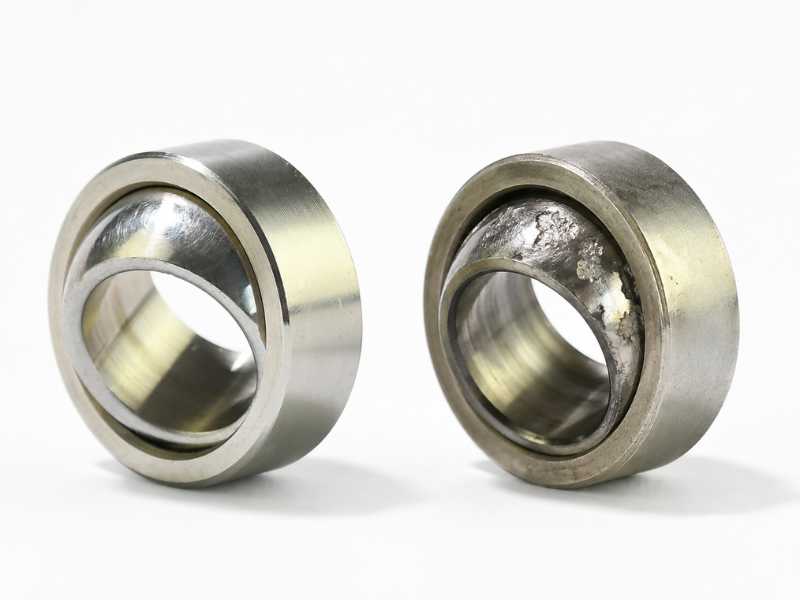
In 316L stainless, both rod ends and spherical plain bearings resist chloride corrosion well. The material selection logic is the same for both: 304 for dry or mildly corrosive environments, 316L for food processing, marine, and chemical exposure.
Where they differ is in the PTFE liner behavior under CIP conditions. Self-lubricating rod ends with PTFE liners are affected by sustained exposure to hot caustic cleaning solutions above 80°C. The liner swells slightly and loses dimensional stability. Spherical plain bearings in the same PTFE-lined construction have the same vulnerability, but because the outer ring is housed in a rigid bore, that inward-facing expansion directly reduces internal radial play, often leading to a sharp increase in operating torque or outright joint binding. The rod end housing, being less constrained, allows the liner distortion to manifest differently, but both configurations will suffer rapid wear once the liner’s dimensional stability is compromised.
For aggressive CIP environments above 70°C, a PTFE liner is a risky choice. It often fails too early. A metal-to-metal spherical plain bearing is a much more durable alternative. For this setup, you should use a hardened stainless steel ball made of 17-4PH or 440C. Pair it with a 316L stainless housing. Finally, apply a food-grade lubricant externally to prevent galling. This combination handles hot caustic washes far better than any self-lubricating liner.
Assembly and Adjustment Access
Rod ends win on installation simplicity. Thread them in, lock with a jam nut, done. They are also adjustable in service. You can lengthen or shorten the rod by turning the end in or out before locking. This makes them the standard choice for control linkages where length adjustment is part of setup.
Spherical plain bearings require a housing bore, a press-fit or retained fit, and a separate shaft or pin with retention hardware. Installation is more involved. There is no built-in length adjustment. If your design needs field-adjustable linkage lengths, rod ends are the practical choice.
Mounting Geometry Summary
If the joint connects the end of a rod or actuator to a fixed pivot, and the primary load is tension or compression along that rod: use a rod end.
If the joint is a pivot in a bracket, housing, or heavy lever, and the load is radial through a pin or shaft: use a spherical plain bearing.
If the application involves both radial load and the need for easy length adjustment, the answer is usually a clevis-and-pin arrangement paired with a rod end at the opposing attachment point.
If your load path or housing geometry sits between the two options, the selection can be worked through against your actual operating conditions.