
When a spherical bearing assembly starts making noise or develops perceptible play, the instinct is to call it worn out and replace it. That’s often the right call. But if you replace the bearing without understanding why it failed, the replacement will fail the same way on the same schedule.
Noise and play are symptoms. The root cause sits upstream in the design, the installation, the maintenance interval, or the material selection. This post covers the most common sources of each symptom and what they tell you about what went wrong.
Knocking or Clunking Under Load Reversal
This is the most diagnostic sound a spherical bearing assembly produces. You hear a distinct knock each time the load direction reverses. It happens when internal radial play has grown large enough that the ball shifts position at the moment of load reversal rather than rolling smoothly through it.
The knock comes from the ball making hard contact with the housing bore after traveling across the now-enlarged clearance gap. In a well-fitted bearing with minimal internal play, load reversal is silent because the ball never has room to accelerate across a gap.
The cause is almost always one of two things: wear at the spherical contact surface from extended service, or an assembly that was never preloaded correctly to begin with. In oscillating applications, spherical bearings should be selected with a C/P ratio that accounts for the dynamic load cycle, not just the peak static load. If the bearing was undersized from the start, clearance grows faster than the design assumed and you reach the knock threshold early in service life.
Replacing the bearing solves the noise. Reviewing the load rating and preload spec prevents the next one from failing the same way.
Squealing or Dry Scrubbing Sound
A high-pitched squeal or a dry scrubbing sound during rotation or oscillation almost always means inadequate lubrication at the spherical contact surface. In grease-lubricated spherical bearings, this happens when the relubrication interval has been exceeded and the grease film breaks down under load and heat. The metal-to-metal contact that follows generates both heat and noise.
In PTFE-lined self-lubricating bearings, squealing is less common but not impossible. It typically appears when the PTFE liner has been chemically degraded by an incompatible cleaning agent, or when the liner has worn through in a localized area and metal-to-metal contact is occurring at that spot while the rest of the surface still has liner coverage.
If the squeal appears suddenly after a cleaning cycle in food processing or pharmaceutical equipment, suspect liner attack before anything else. Hot caustic solutions above 70°C will degrade PTFE over time. The liner becomes brittle, cracks, and then fragments under load. Those fragments act as abrasives and accelerate the wear they were supposed to prevent.
The practical check: if lubricating a grease-type bearing silences the squeal immediately, the bearing may still be serviceable. If the sound persists after lubrication, or if the bearing is a PTFE type that requires no lubrication, the contact surface is mechanically damaged and replacement is the correct action.
Intermittent Click or Tick at a Specific Point in Rotation
A click that occurs at the same angular position on every cycle is a localized defect signal. In a spherical bearing, this usually means a pit, spall, or inclusion on the ball surface or the inner race that the contact zone passes over on each revolution.
Pitting at a specific location is characteristic of corrosion that developed while the bearing was stationary. If a stainless steel bearing sits unused in a humid or chloride-bearing environment without protective lubrication, corrosion initiates at the contact zone where the ball rests against the race. The load from the ball’s own weight and any external preload concentrates stress at that point. When the machine starts up again, that pitted area generates a repeating click.
This failure mode is common in seasonal equipment. You see it in agricultural machinery and marine hardware. It also happens in outdoor actuators that sit idle for months. You can fix this at the design stage. Use a 316L stainless housing to resist environment corrosion. However, do not use 316L for the internal sliding components. It is too soft and will gall instantly under load. Instead, choose a hardened stainless steel ball made of 17-4PH or 440C. Finally, apply a protective lubricant to the contact zone before storage.
⚠️ Warning: A localized click that grows louder or becomes a continuous rattle over days of operation indicates rapid spall propagation. Do not run the machine to failure. The debris generated by an advancing spall damages the housing bore and the shaft, turning a bearing replacement into a more expensive machined-surface repair.
Continuous Rattle at Low Load
A rattle that appears at low load and disappears under higher load is a classic sign of excessive internal clearance without the benefit of external preload. The ball is loose in the housing. It rattles when load is insufficient to hold it against one side of the contact zone.
This can happen when a new bearing is installed with a housing bore that is oversized, either from a machining error or from a bore that has worn out from previous bearing removals. It can also happen when a bearing is selected from a series with a looser internal clearance specification than the application requires.
Spherical plain bearings are available in normal clearance (C0) and reduced clearance grades. High-speed oscillating applications and precision machinery generally need reduced clearance. If a bearing was specified at normal clearance in an application that needs tighter internal geometry, rattling at low load is the predictable result.
Shimming or re-machining the housing bore to restore the correct interference fit is the right correction. Replacing the bearing without addressing the bore size just resets the clock on the same failure.
Play That Appears Along One Axis Only
If you check play by hand and find it only in one direction, the bearing itself may not be the problem. Unidirectional play usually means a housing or shaft fit issue rather than internal bearing wear.
A housing bore that is out-of-round will hold the outer ring firmly in one axis while allowing movement in the perpendicular axis. A shaft that is undersized for the inner bore will allow the inner ring to shift axially or radially relative to the shaft rather than rotating with it. In both cases the bearing can be in good condition while the assembly shows play that feels exactly like a worn bearing.
The diagnostic step is to remove the bearing and measure the housing bore and shaft diameter directly. A correctly fitted spherical bearing outer ring should require a press or hydraulic tool to install. If it drops in by hand, the bore is oversize. The shaft should be a close running or transition fit to the inner bore. If there is perceptible shake between shaft and inner ring with the bearing out of the assembly, the shaft is undersize.
Play Combined with Heat at the Housing
Play at the bearing combined with elevated housing temperature during operation points to fretting wear at the housing bore interface rather than wear at the spherical contact surface. The outer ring is micro-slipping in the bore. The friction from that slip generates heat at the housing. The wear debris from that slip expands the bore, which increases the slip amplitude, which accelerates the wear.
This failure mode runs fast once it starts. A housing that feels warm to the touch after an hour of operation should be investigated immediately. By the time the bore has worn enough to allow visible play of the outer ring, the housing itself may be beyond salvage.
The cause is almost always insufficient interference fit at installation. For oscillating applications with dynamic radial loads, you must secure the outer ring tightly. Do not use an H7 bore because it allows too much clearance. Instead, machine the housing bore to an M7 or N7 tolerance per ISO standards. This ensures a proper interference fit. If the original specification used a looser fit, the bearing will fret. Even a premium bearing cannot survive a loose housing bore.
When Noise Appears After Relubrication
New noise after relubrication is a specific and often misread signal. The most common cause is introducing the wrong lubricant for the application temperature or load. A grease that is too soft will churn and be expelled from the contact zone under load. Once the grease is out, noise follows. A grease that is too stiff at low temperature will not distribute across the contact surface and the bearing runs dry until it warms up.
The second cause is over-greasing. Packing a spherical bearing housing completely full of grease raises the churning resistance and generates heat. The elevated temperature softens the grease further and can cause it to migrate out of the contact zone entirely. Spherical bearings should be lubricated to fill approximately 30 to 50 percent of the available void space, not packed solid.
If the bearing was previously quiet and becomes noisy immediately after a grease service, the lubricant specification or the volume applied is the first place to look, not the bearing condition.
Summary: What the Symptom Tells You
Knock under load reversal points to internal clearance growth from wear or undersizing. Squeal points to dry contact from lubricant breakdown or liner degradation. A repeating click at a fixed angular position points to a localized surface defect from corrosion or spalling. Continuous rattle at low load points to excessive clearance from bore oversize or wrong clearance grade. Unidirectional play points to fit problems at the housing or shaft rather than the bearing itself. Heat combined with play points to fretting at the housing bore from insufficient interference fit.
Each of those root causes is addressable at the design or maintenance stage. Catching the signal early enough to act on the cause rather than just the symptom is where the maintenance value actually sits.
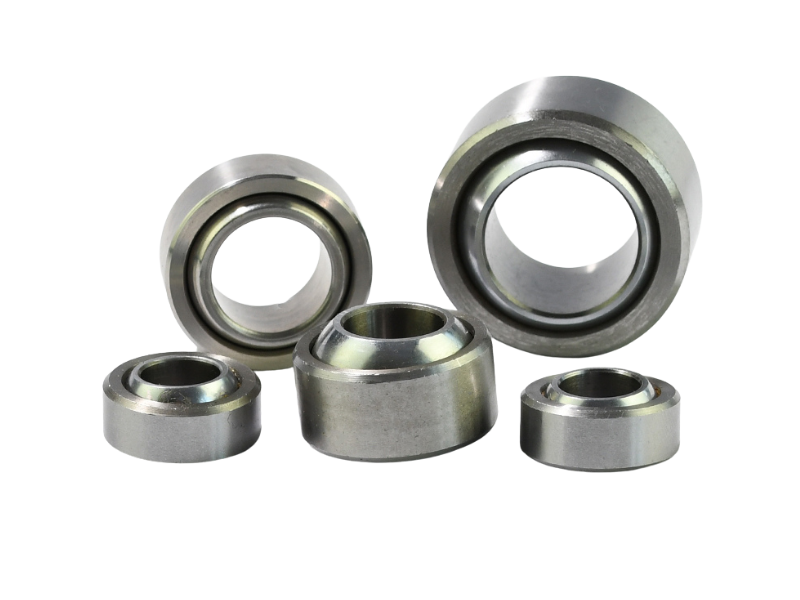
Profab Machine manufactures stainless steel spherical bearings in 304, 316L and 17-4PH, 5 mm to 100 mm bore. If you are troubleshooting noise or play in an existing assembly, the symptom pattern usually points to a specific spec correction rather than just a like-for-like replacement.
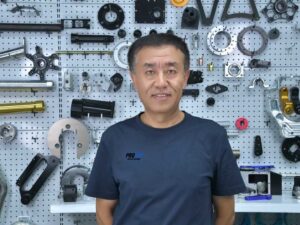
Ray Wang is an engineer at our company with more than 20 years of experience in stainless steel applications and automotive parts. Over the years, he has built deep expertise in precision machining, material behavior, and practical engineering solutions. His hands-on background and strong focus on quality help ensure every project meets demanding performance and reliability standards.
Ray Wang is an engineer at our company with more than 20 years of experience in stainless steel applications and automotive parts. Over the years, he has built deep expertise in precision machining, material behavior, and practical engineering solutions. His hands-on background and strong focus on quality help ensure every project meets demanding performance and reliability standards.