The 30-Knot Question Nobody Asks at the Marina
You are running 30 knots across an unfamiliar bay. A submerged stump appears under your hull. Your propeller hits it. In the next 50 milliseconds, one of two things happens. Your aluminum blade folds, absorbs the energy, and you limp home on a wounded prop. Or your stainless steel blade barely flinches, and the impact load travels up the shaft, through the bearings, and into the lower unit. One outcome costs you 200 dollars. The other costs you 3,000.
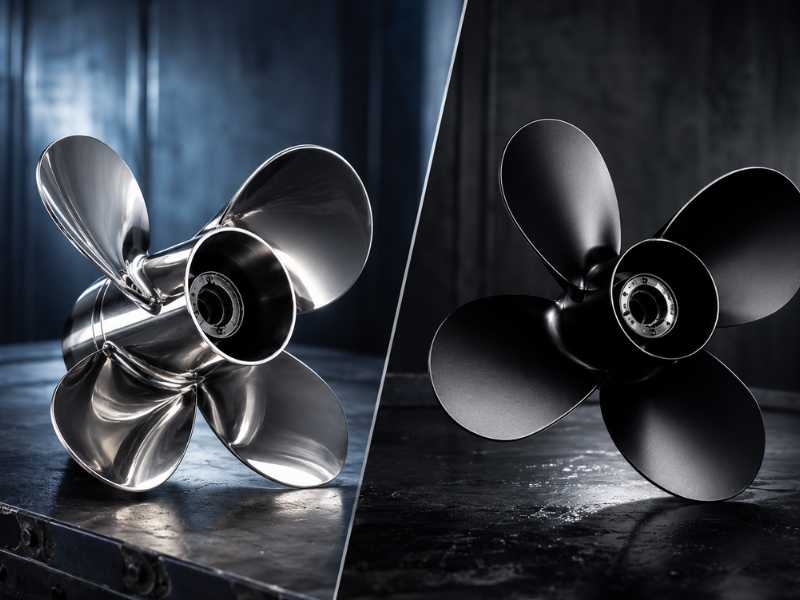
This is the actual engineering question behind the stainless steel vs aluminum propeller debate. Forum threads talk about top speed and service life. Marketing pages list specs about durability. But the design choice that matters most is which part of your drivetrain you have selected to fail first. Because something will fail eventually, and the material of your prop decides what it is.
The Material Mechanics Behind Prop Behavior
To understand why this tradeoff exists, you need to look at what happens to each material under load. Marine-grade aluminum alloys used in cast props sit around 270 to 310 MPa tensile strength. The 17-4 PH and similar stainless steel grades used in performance props run 1000 to 1300 MPa after aging. Mercury Marine has published data showing stainless steel takes roughly five times the stress of aluminum before yielding. That number matters less for normal cruising and more for the moment of impact.
Why SS Blades Can Be Thinner
Higher yield strength lets a designer remove material without losing structural integrity. SS blades on the same diameter prop run noticeably thinner than aluminum equivalents. Thinner trailing edges mean less form drag, cleaner water release, and reduced cavitation tendency at the tips. This is where the 5 to 10 percent top speed gain comes from. It is not magic. It is geometry that aluminum cannot support without flexing.
Blade Flex and Power Transfer
Aluminum has a Young's modulus around 69 GPa. Stainless steel runs about 200 GPa. When you load up an aluminum blade at wide open throttle, it bends. Not dramatically, but measurably. That bend changes the effective pitch of the blade, which means part of your engine torque is spent deforming the prop instead of moving water. Stainless steel blade flex is close to zero in normal operation. The pitch you bought is the pitch you get at every RPM. This is why an SS prop feels more responsive and why hole shot improves when you swap a tired aluminum prop for a fresh stainless one.
The Sacrificial Failure Mode That Aluminum Owners Rely On
Now to the part that performance articles tend to skip. Aluminum props are not just cheaper. They are designed to fail in a specific way. When you strike a rock or log, the aluminum blade absorbs energy through plastic deformation. The blade bends, sometimes tears, and dissipates the impact as heat and permanent strain. This is the same principle as a crumple zone in a car. The component fails in a controlled way to protect more expensive components behind it.
Behind your prop sits the propshaft, the propshaft seal, the bearing carrier, the gear set, and the lower unit housing. Replacing a lower unit on a mid-size outboard runs anywhere from 2,500 to 7,000 dollars depending on the engine. Replacing an aluminum prop runs 150 to 300. The aluminum prop is, in engineering terms, a mechanical fuse.
Stainless steel does not fuse. The yield strength is so high relative to typical impact loads that the blade transmits most of the energy straight through to the next weakest link. To mitigate this rigid transfer of energy, modern propeller manufacturers rely on modular, sacrificial hub systems—such as Mercury’s Flo-Torq or Yamaha’s SDS. These plastic or rubber inserts are designed to slip or shear under sudden torque spikes, acting as a secondary mechanical fuse.
However, this protection is not absolute. In low-speed, high-mass impacts where the torque spike is insufficient to shear the hub, or in severe high-speed strikes that exceed the hub's absorption capacity, the unyielding rigidity of a stainless steel blade transfers significant levered stress straight through to the propshaft, the splines, or the lower unit gears. A hard strike can shear shafts, crack gear teeth, or distort the bearing carrier. The prop survives. The drivetrain may not. This is the prop strike damage scenario that owners discover weeks later, not at the moment of impact.
⚠️ WARNING: If you hit a hard underwater object at planing speed with a stainless steel prop, do not assume you escaped damage just because the blades look intact. Inspect the propshaft for runout, check for water in the gearcase oil, and look for metal particles on the magnetic drain plug. Hidden lower unit damage from prop strike events often appears later as gear whine, seal failure, or progressive bearing noise.
The Decision Framework Real Boaters Use
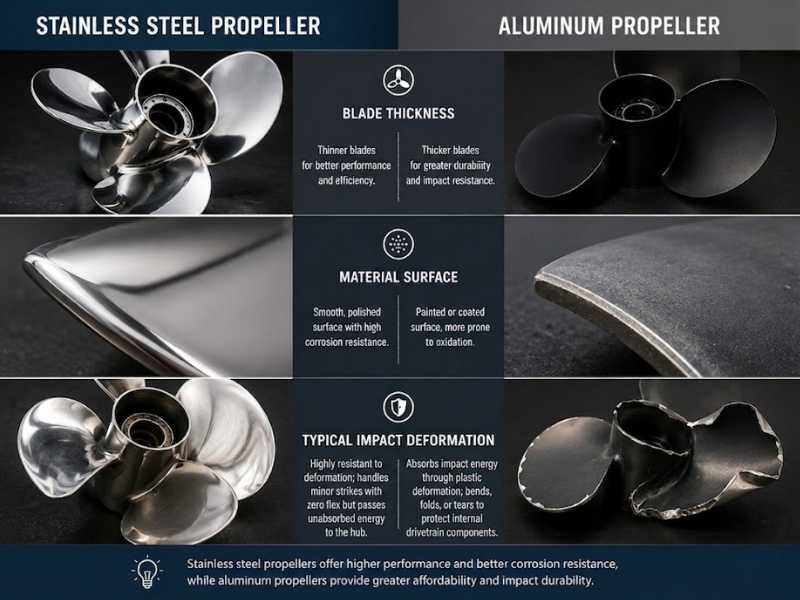
Once you frame the choice as a fuse selection problem, the use cases become clear. The question is not which prop is better. The question is which failure mode costs you less in your operating environment. This is the prop material selection guide that actually maps to real boating conditions.
When Aluminum Is the Correct Engineering Choice
If you run shallow water with stumps, rocks, oyster beds, or unmarked sandbars, aluminum is doing real work for you. Every season you will probably take at least one strike. Aluminum lets that strike consume itself. The same logic applies if you trailer your boat to unfamiliar lakes and rivers. You do not know where the obstructions are. A 200 dollar prop is cheap insurance against a 4,000 dollar lower unit rebuild. Lower horsepower engines below 90 HP also benefit from aluminum because the top speed gain from SS is small at those power levels, and the lighter rotating mass slightly improves acceleration off idle.
When Stainless Steel Earns Its Price
Deep open water with a clean bottom changes the calculation. Offshore boats, big lake cruisers, and tournament fishing rigs rarely strike anything. The probability of impact is low enough that the sacrificial failure mode is not protecting you from anything statistically meaningful. Meanwhile, you spend hundreds of hours at sustained high RPM where blade flex, drag, and cavitation hurt your performance. SS pays back through fuel economy at cruise, faster top end, and marine prop durability that runs two to three times longer than aluminum. Higher horsepower engines above 150 HP also load aluminum blades to the point where flex becomes a real efficiency loss. At 250 HP, an aluminum prop is leaving measurable speed and fuel on the table. For these boats, an SS prop is the right outboard performance upgrade rather than a luxury.
The Hybrid Strategy
Experienced boaters who run mixed conditions often own two props. An aluminum spare lives in the boat for shallow exploration and unfamiliar water. The stainless prop goes on for the offshore run or the long cruise where conditions are known. This is not indecision. It is correct engineering practice for a system with two very different operating profiles.
Cavitation, Ventilation, and the Geometry Argument
Cavitation is one of the more misunderstood topics in prop selection. It is the formation of vapor bubbles on the low pressure side of the blade when local pressure drops below the vapor pressure of water. When those bubbles collapse against the blade surface, they erode the metal. The underlying fluid mechanics of propeller cavitation are covered in more depth by maritime engineering references.
A cavitation propeller story usually involves an aluminum prop that has been hammered for a few seasons. SS resists cavitation erosion better because the surface is harder and the passive oxide layer reforms quickly. Aluminum cavitation damage shows up as pitting on the blade back, sometimes severe enough to make the prop unbalanced within a few seasons. The thinner blade profile of SS also reduces the local pressure drop that triggers cavitation in the first place. So stainless does not just survive cavitation better, it tends to cause less of it.
The Cost Math Over a Five Year Window
A quality aluminum prop costs 150 to 300 dollars. A comparable stainless steel prop runs 500 to 1,200. That is the upfront 3 to 4 times multiplier. Over five years of moderate use, an aluminum prop typically needs replacement once or twice from cumulative cavitation pitting and minor strikes. SS often runs the full five years on the same prop with periodic reconditioning. The total cost of ownership gap narrows considerably, especially if you factor in the fuel savings from reduced blade flex.
The math flips the other way if you take a single hard strike on a stainless steel prop and damage the lower unit. One bad day in shallow water can erase a decade of efficiency gains. This is why the operating environment matters more than the spec sheet in any honest outboard propeller material comparison.
What to Look for in a Quality SS Prop
If you decide stainless is right for your application, the manufacturing quality of the prop matters as much as the material grade. Investment cast 17-4 PH stainless with proper solution treatment and aging delivers the strength numbers manufacturers advertise. Sand cast or improperly heat treated props can fall well short. Hub bonding, blade balance, and pitch consistency across all blades are precision machining concerns that separate a good prop from a vibration generator. Reference standards like the American Bureau of Shipping rules give you a sense of what professional grade marine hardware should meet.
Look for props with verified pitch tolerance under 0.5 degrees blade to blade, dynamic and static balance meeting ISO 484 Class S or Class 1 tolerances, and documented material certification. These are not exotic requirements. They are the baseline for any precision marine component you trust at 5,000 RPM.
Picking the Right Prop for Your Boat
The honest answer to the stainless steel vs aluminum propeller question is that neither material is universally better. They are different engineering solutions to different operating conditions. If you run shallow, trailer often, or want cheap insurance against impact damage, aluminum is the correct choice and there is no shame in running it. If you run deep, push high horsepower, and need every percent of efficiency at cruise speed, stainless earns its price several times over.
The decision is not about prestige or top speed bragging rights. It is about which failure mode you have prepared to handle. Once you frame it that way, your operating environment and budget will tell you which prop belongs on the back of your boat.
Understanding these critical failure modes and mechanical limits is what separates standard hardware from marine-grade engineering. Profab Machine delivers custom CNC-machined stainless steel propeller hardware, shaft components, and marine linkages. We ensure your drivetrain components hold up to the realities of 30-knot impacts and years of corrosive saltwater service.