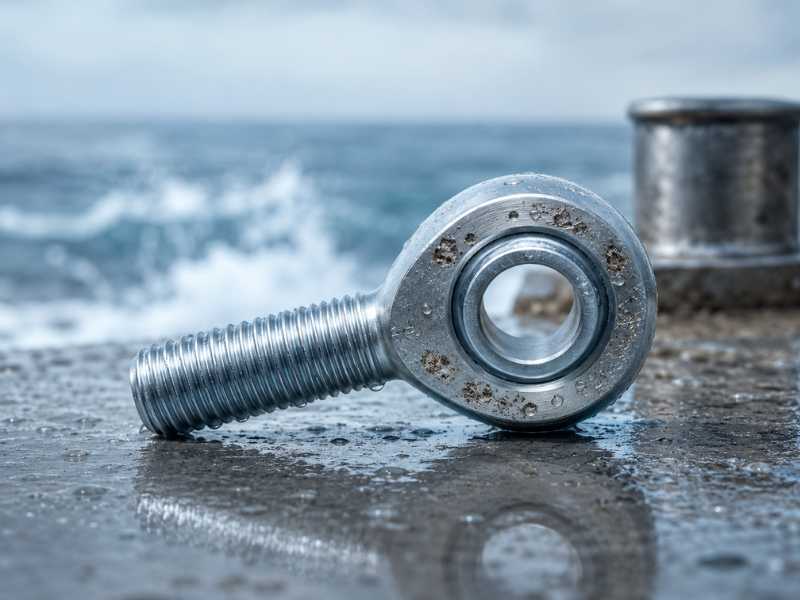
A rod end specified in 316 stainless steel and installed in a saltwater environment can still pit within a single season. The grade selection was correct in principle, but two variables that determine whether pitting initiates were not addressed: geometry and surface condition. Both are specific to rod end assemblies and both are routinely ignored in specifications that stop at material grade.
This article covers how pitting initiates on stainless steel, why rod end geometry accelerates it at predictable locations, how to use PREN as a grade selection tool beyond the 316-versus-304 binary, and what surface treatment decisions actually shift the outcome.
The Pitting Mechanism on Stainless Steel
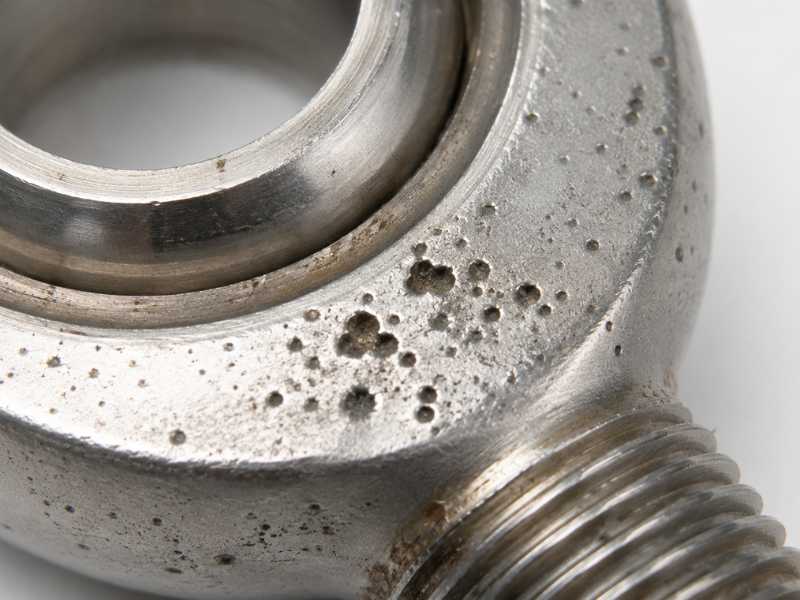
Stainless steel resists corrosion through a passive chromium oxide layer, a few nanometers thick, that forms spontaneously on the surface in the presence of oxygen. The layer is self-repairing under most conditions. In chloride environments, chloride ions compete with oxygen at surface sites where the passive film is thin or locally disrupted. When chloride wins that competition at a specific point, the film breaks down locally, the bare metal beneath dissolves, and a pit initiates.
The pit geometry accelerates its own growth. The interior of an active pit is oxygen-depleted and acidic, conditions that prevent passive film reformation. Chloride ions migrate into the pit to maintain charge balance, further increasing the local chloride concentration. The surrounding surface remains passive and acts as a cathode, driving anodic dissolution at the pit. Once a pit is active, stopping it requires either removing the chloride source or physically disrupting the pit chemistry through surface intervention.
Two material variables determine where on the PREN scale a stainless steel grade sits. Chromium content contributes directly to passive film stability. Molybdenum, by a factor of 3.3 per percent weight in the standard PREN formula (PREN = %Cr + 3.3 x %Mo + 16 x %N), stabilizes the passive film against chloride displacement specifically. Nitrogen provides an additional contribution at 16 per percent weight but is present at low levels in most standard grades. The practical consequence is that 316 (approximately 16.5% Cr, 2.1% Mo) reaches a PREN of roughly 24 to 26, meaningfully above 304 (PREN 18 to 20) but well below what offshore and immersion service demands. For seawater immersion, a PREN above 40 is the general threshold cited in offshore engineering practice. 316 does not reach that threshold.
Why Rod End Geometry Creates Specific Pitting Sites
Most comparisons of stainless steel grades for marine use treat flat bar or tube stock as the reference geometry. A rod end is not a flat surface. It contains several geometric features that concentrate chloride and create localized oxygen-depleted zones that do not exist on simple shapes.
The ball-to-housing annular gap is the most consequential of these. The ball sits inside the housing bore with a small clearance occupied by the liner. At the edge of the housing, where the ball exits the bore opening, there is a circumferential gap between the ball face and the housing rim. This gap is narrow enough to impede electrolyte circulation but wide enough to fill with seawater. Once filled, oxygen is depleted by slow corrosion reactions within the gap and is not replenished by bulk fluid movement. Chloride concentration builds. This is the textbook condition for crevice corrosion, which initiates at lower chloride concentrations and lower temperatures than open-surface pitting on the same grade.
The threaded shank root is the second critical site. Thread roots are geometric stress concentrators, and they are also crevice geometry. Moisture trapped in thread roots combined with restricted oxygen access creates the same localized chemistry as the ball-housing gap. On rod ends where the shank enters a housing or coupling under light contact pressure without full thread engagement depth, the partially engaged zone creates additional crevice geometry along the thread flanks.
The bolt bore through the ball is the third site. The bolt or pin passes through the ball bore, and the small clearance between bolt and bore fills with seawater in immersion or splash service. Galvanic coupling between the bolt material and the ball can add a driving force to the corrosion reaction if dissimilar metals are used. A carbon steel or zinc-plated bolt through a 316 stainless ball creates a galvanic couple that accelerates corrosion of the steel fastener and, in certain configurations, can compromise the passive film on the adjacent stainless surface.
⚠️ Crevice corrosion initiates at lower severity than pitting on the same grade.
A 316 stainless surface that resists open-surface pitting in a given marine environment may still undergo crevice corrosion at the ball-housing gap under the same conditions. PREN predicts open-surface pitting resistance. It does not directly predict crevice corrosion initiation. For tight-clearance geometries like rod end assemblies, crevice corrosion temperature (CCT, measured per ASTM G48) is the more relevant criterion. 316 has a CCT of approximately 0°C in aggressive ferric chloride testing, meaning it has limited crevice corrosion resistance in concentrated chloride environments.
PREN as a Grade Selection Tool for Marine Rod Ends
The binary choice between 304 and 316 covers only two points on a continuous scale of chloride resistance. For marine rod ends, the selection framework should use PREN as the primary criterion alongside the specific exposure condition.
Approximate PREN values for grades relevant to rod end applications:
304 / 304L: PREN 18 to 20. Adequate for non-marine environments with occasional humidity. Not suitable for coastal or marine service.
316 / 316L: PREN 24 to 26. Suitable for sheltered coastal environments, freshwater with chloride contamination, and food processing with chlorinated cleaning. Corrodes in direct seawater immersion over extended periods. The most common marine specification, and the correct choice for a large proportion of marine applications where direct immersion is limited and maintenance access is available.
Duplex 2205 (UNS S31803): PREN 32 to 36. Significantly improved chloride resistance over 316. Suitable for splash zone and intermittent seawater contact. Higher yield strength than 316 also allows smaller cross-section at equivalent load rating.
Super Duplex 2507 (UNS S32750): PREN 40 to 43. The threshold grade for seawater immersion service in offshore engineering practice. Higher cost and more limited machining stock availability than 316 or 2205. Appropriate for offshore, subsea, and continuous seawater immersion rod end applications.
17-4PH (UNS S17400): PREN approximately 24 to 30 depending on heat treatment condition and nitrogen content. Comparable chloride resistance to 316 in most environments. The corrosion resistance advantage of 17-4PH over 316 is not the reason to select it for marine applications. The reason is mechanical: yield strength of 1,000 to 1,170 MPa in H900 condition versus 205 MPa for annealed 316. For high-load marine linkages where 316 cannot meet the load rating at the required cross-section, 17-4PH at H1025 or H1075 condition provides the strength without sacrificing corrosion resistance significantly. The H900 (peak-aged) condition should not be specified for seawater-exposed 17-4PH components because SCC susceptibility is highest at peak strength; H1025 or H1075 overaged conditions sacrifice a portion of the peak strength to substantially improve SCC resistance in chloride environments, per research published in Transactions of the Indian Institute of Metals (Bhambroo et al., 2023).
For stainless steel rod ends in marine applications, the selection path is: confirm the exposure condition (sheltered coastal, splash zone, or immersion), map that to a PREN threshold, and specify the grade that meets or exceeds that threshold. For most recreational marine and commercial marine deck hardware in sheltered or coastal environments, 316 is correct. For offshore, continuous seawater contact, or subsea, 2205 or 2507 is the technically defensible choice.
How Surface Condition Shifts the Outcome
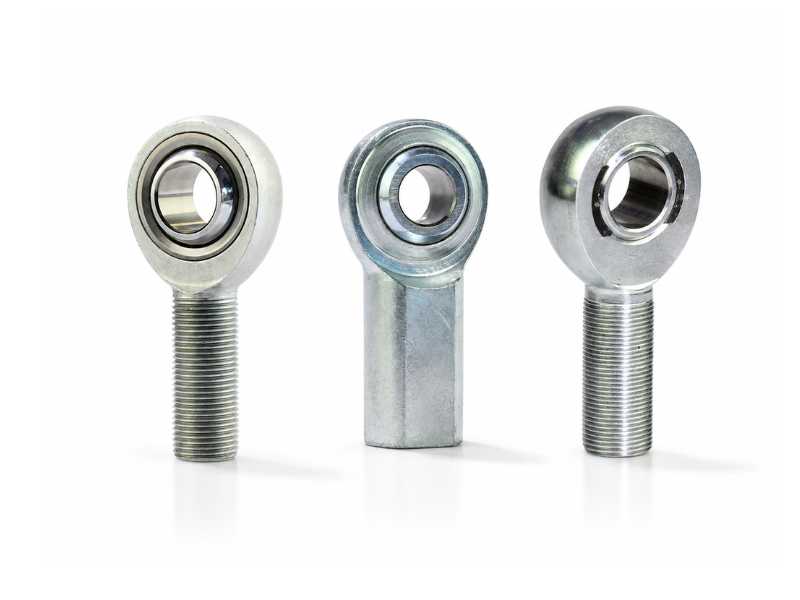
Two rod ends machined from the same 316 bar stock can have meaningfully different pitting resistance depending on their surface finish. The passive film quality, not just the alloy composition, determines how readily chloride ions displace chromium oxide at the surface.
As-machined surfaces from CNC turning or milling carry tool marks, heat-affected zones at cutting edges, and embedded iron particles from tooling contact. Iron contamination on a stainless steel surface creates galvanic micro-cells that initiate pitting at far lower chloride concentrations than the clean alloy would require. Passivation per ASTM A967 removes free iron from the surface, reforms the passive layer uniformly, and is the minimum surface treatment standard for marine stainless components. It costs almost nothing relative to the part value and is omitted from specifications with surprising frequency.
Electropolishing goes further. The electrochemical material removal process selectively attacks surface asperities, leaving a smoother surface with fewer pitting initiation sites and a thicker, more chromium-rich passive film than mechanical polishing or passivation alone can produce. On rod end ball surfaces and housing bores, electropolishing additionally reduces the micro-crevice geometry at surface roughness peaks, directly addressing one of the initiation conditions described above. For marine rod ends in splash zone or continuous exposure service, electropolishing to Ra 0.4 µm or better on ball and housing contact surfaces is a meaningful upgrade with quantifiable effect on pitting initiation threshold.
Shot peening is relevant for high-cycle fatigue rod ends in marine service. The compressive residual stress layer introduced by shot peening opposes the tensile stress required for stress corrosion cracking initiation at pits. It does not prevent pit formation but interrupts the progression from pit to SCC crack that is the dominant catastrophic failure mode in high-strength stainless grades in chloride service.
Maintenance Interval and Inspection Logic
Pitting corrosion in marine rod ends is manageable with a maintenance regime that targets the specific initiation sites described above. Inspection after commissioning, after storm exposure events, and at seasonal service intervals should examine three locations: the ball-housing gap circumference for staining or surface irregularity indicating crevice activity, the thread root on the shank for pitting at the minor diameter, and the bolt bore interior if the bolt is removable.
Pits at early stage, when they appear as dark staining or minor surface roughness rather than visible holes, can be arrested by thorough drying of the assembly, application of corrosion inhibitor, and re-passivation if the part can be removed for chemical treatment. Pits that have progressed to measurable depth require assessment against the load-bearing cross-section. A pit at the shank thread root reduces the effective stress area of the thread and cannot be evaluated by visual inspection alone; dimensional measurement or dye penetrant inspection is required to confirm whether the part remains serviceable.
Replacement criteria for pitted marine rod ends should include any pit at the shank thread root deeper than 10% of the thread depth, any visible cracking originating from a pit (indicating SCC progression), and any ball surface pitting that produces audible or tactile roughness during manual rotation of the ball in the housing, indicating that liner damage has occurred from abrasive contact with the pitted ball surface.
Profab Machine supplies marine-grade rod ends with passivation and electropolishing available to order. Feel free to contact us!