Stainless steel procurement often begins with the wrong question. Buyers ask, “what does this cost per kilogram?” and the answer is usually straightforward: 2205 costs more. From there, 316L gets written into the specification, the order goes out, and the project keeps moving.
That can look sensible on paper. Then a pipe run fails after eighteen months. Maintenance intervals get pulled forward. A plant stops for an unplanned repair, and the cost of that downtime wipes out the original material saving many times over. The problem is not that the price-per-kilogram figure was wrong. It was simply too narrow.
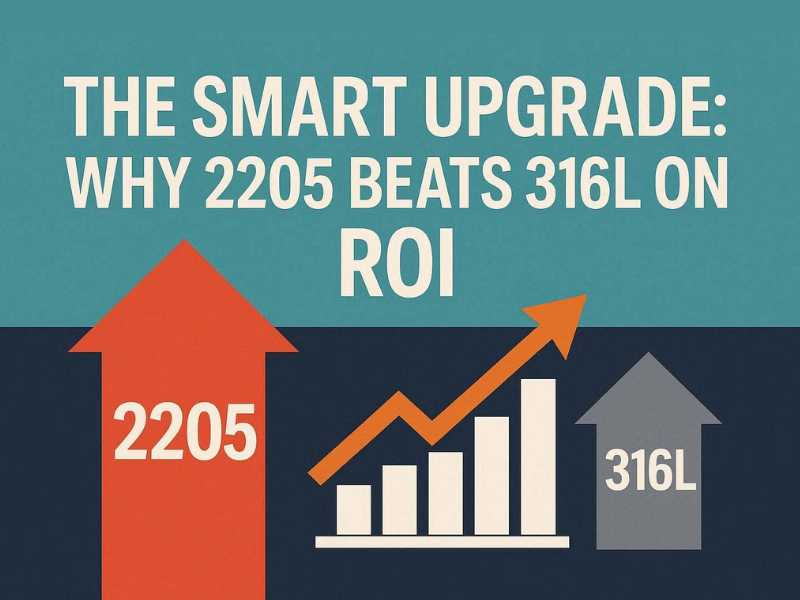
When the full service life is brought into the calculation, 2205 duplex stainless steel often delivers a stronger economic result than 316L in demanding environments. The difference is not a rounding error. Knowing where 2205 earns its premium is what turns a grade selection into a defensible procurement decision.
Two Grades, Two Different Engineering Philosophies
316L (UNS S31603) and 2205 (UNS S32205) both belong to the stainless steel family, but they were not designed around the same priorities.
316L is an austenitic grade. Its face-centered cubic microstructure gives it excellent ductility, good weldability, and predictable performance across a broad temperature range. With 2–3% molybdenum, it resists pitting better than 304. Its non-magnetic behavior also makes it useful where electromagnetic constraints matter. In the right environment, these are practical and well-proven advantages.
Where 316L is weaker is in the combination of high mechanical stress and chloride exposure. Its yield strength is approximately 205 MPa. Under stress, and in the presence of chlorides, it is vulnerable to stress corrosion cracking (SCC). That failure mode is especially difficult because it can develop with little visible warning, then progress suddenly and severely.
2205 takes a different route. It is a duplex grade, with a microstructure made up of roughly equal proportions of austenite and ferrite. That two-phase structure gives it a property set neither phase can provide on its own. Yield strength is approximately 450 MPa, more than double 316L. The PREN (Pitting Resistance Equivalent Number, calculated as %Cr + 3.3×%Mo + 16×%N) for 2205 typically sits at around 35, compared to approximately 25 for 316L. Higher PREN is directly associated with better resistance to pitting and crevice corrosion in chloride-containing environments.
The SCC comparison is even more telling. Laboratory testing shows 316L can fail under chloride conditions at stress levels as low as 30% of its yield strength. Under similar conditions, 2205 can typically sustain stresses approaching its yield strength without cracking. In chloride service under load, these two grades should not be treated as close substitutes.
The Wall Thickness Factor: Strength as a Cost-Reduction Tool
One common misunderstanding about 2205 is that its price premium ends the discussion. On a per-kilogram basis, 2205 typically carries a premium over 316L that runs roughly 15–60%, depending on the mill, product form, and metals-market conditions at the time of purchase. That figure is real, but it does not tell the whole story.
The key difference is strength. At approximately 450 MPa, the yield strength of 2205 is more than double 316L’s 205 MPa. For pressure-bearing parts, vessel shells, pipe schedules, and structural members, wall thickness is closely tied to yield strength. If the same pressure load can be carried with substantially less wall thickness, the project may need less steel overall.
In practical design work, pressure vessels and storage tanks specified in 2205 are often detailed with walls 30–50% thinner than comparable 316L designs. A vessel that needs 20 mm wall thickness in 316L can often be redesigned at 12–14 mm in 2205 while meeting the same pressure rating. At 2205’s density of approximately 7.8 g/cm³, that reduction in thickness translates directly into lower total material weight per vessel.
Those savings rarely stop at the material line. Lower fabricated weight can mean fewer total kg purchased, even with the higher unit price. Thinner sections are generally faster to cut, roll, and weld, which reduces fabrication labor. Lighter assemblies cost less to move. In structural applications, reduced dead load can also simplify supports. Once these follow-on savings are included, the per-kg premium becomes a much smaller part of the installed-cost picture.
For smaller components such as fittings, fasteners, and connectors, down-gauging is usually less important. In those cases, the economic argument shifts to service life, maintenance frequency, and the cost of avoiding failures.
Corrosion Resistance and the Cost of Failure
The financial case for 2205 becomes clearest when failure is part of the risk model. A corrosion failure is rarely just a replacement-material problem. In an industrial setting, it can also mean:
Unplanned shutdown time (often measured in days, not hours)
Labor for removal, inspection, and reinstallation
Secondary damage to adjacent equipment or product contamination
Regulatory or insurance implications in food, pharmaceutical, or marine environments
The critical pitting temperature (CPT, the temperature above which pitting corrosion initiates in a given chloride concentration) is approximately 25°C for 316L in a 1M NaCl solution. For 2205, the CPT in the same solution typically exceeds 55°C, with many measurements in the 50–65°C range. That is a large operating margin, not a small improvement. It means many ambient-temperature seawater, brine, and chlorinated process applications that push 316L into trouble remain well inside 2205’s performance range.
As described in BSSA's technical guide to duplex stainless steels, SCC in austenitic stainless steels in chloride environments is particularly dangerous because crack propagation is fast relative to detection time. By the time surface indicators appear, the structural integrity of the component may already be compromised. Duplex grades like 2205 are substantially more resistant to SCC initiation because the ferritic phase interrupts crack propagation paths through the microstructure.
A pattern reported across chemical processing plants follows the same shape: 316L chemical injection lines specified for corrosion resistance alone fail within a few years under sustained chloride exposure, while the same lines in 2205 commonly run a decade or more with far less maintenance. The avoided failure cycle is usually enough on its own to cover the 2205 premium.
That is where the ROI calculation changes. Even a cautious estimate of one unplanned shutdown of two to three days per year, once labor and production loss are included, usually exceeds the annualized cost difference between a 316L and 2205 specification.
The Nickel Volatility Factor
316L pricing is heavily influenced by nickel content, which typically runs 10–14% by weight. Nickel is among the more volatile metals traded on the London Metal Exchange. Price swings of 30–40% in a single year are not unusual, and procurement teams managing multi-year capital projects have seen how quickly that volatility can move a budget.
2205 contains far less nickel, typically 4.5–6.5%. Its duplex structure gets much of its performance from chromium (around 22%), molybdenum (around 3%), and nitrogen (around 0.17%), rather than from a high nickel addition. Because chromium and molybdenum are generally less exposed to the same price swings as nickel, 2205 can offer a more predictable long-run cost profile.
For procurement teams on multi-year capital builds, that predictability matters. A project specified in 316L across two budget cycles may reach the buying stage with material costs 20–30% above the original estimate because of nickel movement alone. A 2205 specification reduces that particular source of variance.
As noted in the technical overview of duplex stainless steels, the lower nickel content was deliberately engineered into duplex grades to reduce cost sensitivity to nickel price cycles while maintaining or exceeding austenitic performance in demanding service conditions. The grade was designed, in part, as a more economically stable alternative to the high-nickel austenitic grades.
When 316L Is Still the Right Call
A credible ROI comparison also has to say where 316L remains the better choice.
Low-chloride or benign environments: If the operating environment does not involve chlorides, elevated temperatures, or significant mechanical stress, 316L’s corrosion resistance is often sufficient. Pharmaceutical clean rooms, indoor instrumentation enclosures, and food processing lines using mild detergents do not require PREN 35. Specifying 2205 in these contexts adds cost without adding useful performance.
Complex forming and deep drawing: 316L’s austenitic ductility makes it easier to form into tight radii and complex geometries. Applications requiring deep-drawn shells, severely bent tubing, or intricate stamped profiles often prefer 316L for its forming behavior. 2205’s duplex microstructure makes it less ductile and more prone to springback.
High-temperature service (above 300°C): 2205 is not recommended for continuous service above approximately 300°C. Prolonged exposure in this range causes precipitation of intermetallic phases that degrade toughness and corrosion resistance. 316L handles elevated temperatures more gracefully.
Weld-intensive, thin-section fabrication: While 2205 is weldable, it requires tighter control of heat input and interpass temperature to maintain the desired austenite-ferrite balance. For projects involving many small welds in thin sections, the additional process control requirements add fabrication cost that can offset material advantages.
Making the ROI Case to Procurement
For engineers, the challenge is often not understanding why 2205 works. It is translating that advantage into procurement language. The comparison table below is a useful starting point:
| Factor | 316L | 2205 | ROI Impact |
|---|---|---|---|
| Raw material cost per kg | Baseline | Higher | Against 2205 |
| Required wall thickness (pressure) | Baseline | 30–50% less | Partial offset |
| Fabricated weight per unit | Baseline | Up to 30% less | Partial offset |
| Maintenance interval | Shorter | Longer | Favors 2205 |
| SCC failure risk (chloride environments) | Moderate-high | Low | Strongly favors 2205 |
| Nickel price exposure | High | Low | Favors 2205 over project life |
| Service life (chloride service) | 2–5 years typical | 10–15+ years | Strongly favors 2205 |
The strongest ROI argument for 2205 is found where mechanical stress, chloride exposure, and high failure costs intersect. Desalination plants, offshore oil and gas processing equipment, chemical injection systems, coastal marine hardware, and pulp and paper processing are typical examples. In these settings, choosing 316L to reduce the material line can create larger, less predictable downstream costs that are harder to explain than a controlled upfront premium.
The specification question to ask:
- Will this component see chlorides above trace levels? → 2205 warranted
- Is structural load a factor in the design? → 2205’s strength advantage applies
- Does a failure here cause a shutdown? → 2205’s service life pays back
- Is this a multi-year capital project? → 2205’s nickel stability reduces budget risk
If the answer to two or more of these is yes, the lifecycle economics favor 2205 in most documented case data.
For procurement teams and project engineers working on stainless steel-intensive builds, it helps to work with a supplier experienced in specifying and machining both grades. Profab Machine manufactures precision components in both 316L and 2205, with OEM and project supply capabilities. For technical specifications and sourcing requirements, visit Profab Machine.