

Why Do Jam Nuts Gall on Stainless Steel Rod Ends?
Thread Galling / Seized Threads The jam nut is the highest-probability galling location in a stainless rod end assembly. The reasons are structural, not random. Understanding them explains why jam nut galling is so common even when the primary thread engagement went smoothly. Identical material pairing at high contact stress A 316 stainless jam nut […]
How Can I Stop Stainless Steel Threads from Locking Up?
Thread Galling / Seized Threads Four specific measures prevent stainless steel thread lockup on rod ends. Applied together, they eliminate the conditions that produce galling. Applied selectively, they reduce but do not eliminate the risk. Apply nickel-based anti-seize to every stainless thread before engagement Nickel-based anti-seize is the standard for stainless-to-stainless threaded connections in industrial […]
How Are Rod Ends Measured?
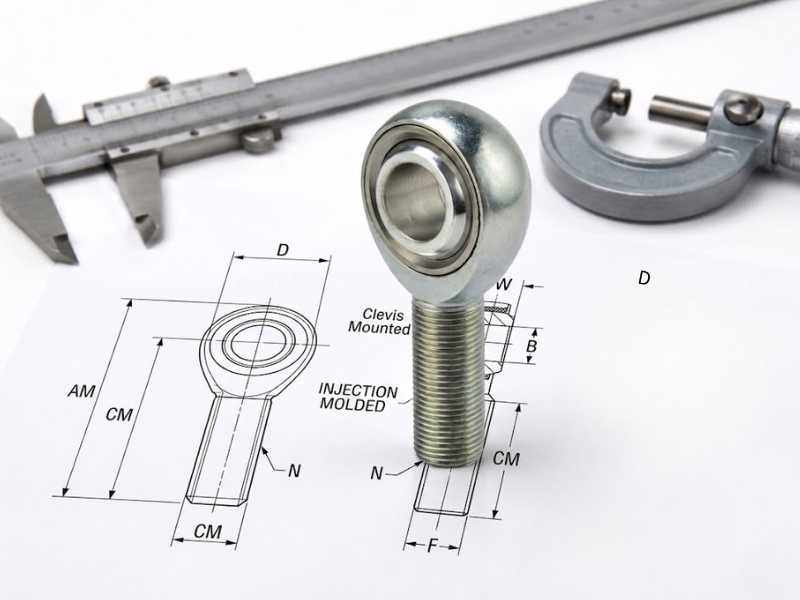
Thread size alone does not define a rod end. Bore diameter, body width, housing OD, shank length, and misalignment angle all matter. Here is how to measure each one and what to do with the numbers.
What Causes a Rod End to Seize During Installation?
Thread Galling / Seized Threads Seizure during installation is almost always galling that progressed to cold-welding before the installer noticed. Three installation conditions create the specific combination of contact stress and friction heat that drives this. Dry threading. No lubricant at the thread interface means no film between the stainless surfaces during engagement. Anti-seize compound on […]
Why Do Stainless Steel Rod End Threads Gall?
Thread Galling / Seized Threads Galling is adhesive wear between two metal surfaces in sliding contact. On stainless steel threads, it progresses from surface roughening to material transfer to cold-welding in seconds. Often during the installation that was supposed to take five minutes. The mechanism is specific to austenitic stainless grades: 304 and 316. The […]
How Do I Protect Rod Ends from Rust and Corrosion?
Corrosion and Harsh Environments Protection from rust and corrosion requires decisions at three stages: material selection before ordering, surface treatment before installation, and maintenance after installation. Skipping any one stage produces protection that fails exactly where it was skipped. Stage 1: Material Selection For any application with moisture, chloride, or chemical exposure, start with 316 […]
How Do Stainless Steel Rod Ends Perform in Wet Conditions?
Corrosion and Harsh Environments “Wet conditions” spans several distinct environments. Fresh water with no chloride, industrial washdown with cleaning chemicals, marine spray, and continuous saltwater contact all affect stainless rod ends differently. Treating all wet environments as equivalent produces misspecification. Fresh Water and Ambient Humidity 304 and 316 perform reliably in fresh water and humid […]
What Causes Corrosion on Rod End Threads?
Corrosion and Harsh Environments Thread corrosion is the most common in-service corrosion complaint on rod ends. It is almost always preventable. The thread root is the highest-risk location on the entire assembly for three independent reasons that act simultaneously. Reason 1: Crevice Geometry Thread roots are tight, enclosed spaces with restricted electrolyte circulation. In any […]
What Rod End Is Best for Chemical Exposure?
Corrosion and Harsh Environments Chemical exposure is the most demanding category in rod end corrosion specification. Unlike marine environments where 316 covers most cases, chemical exposure has no single default. The correct grade depends entirely on which chemical, at what concentration, and at what temperature. Corrosion Data First, Grade Second Every stainless grade has published […]
What Is the Best Rod End for Corrosive Environments?
Corrosion and Harsh Environments The best rod end for a corrosive environment is not a single product. It is a combination of grade, surface treatment, and liner type matched to the specific corrosion mechanism in the application. A rod end that works in food processing washdown is not automatically correct for offshore marine or chemical […]