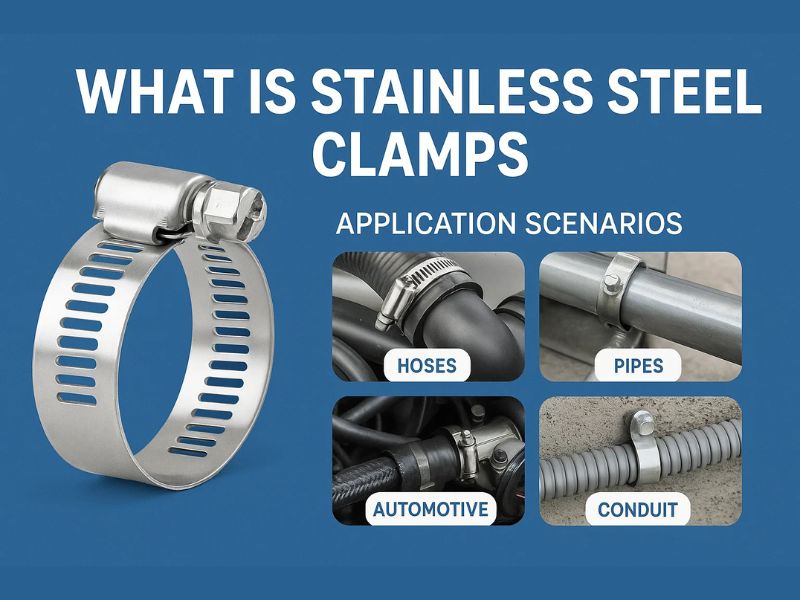
A piping or hose connection is only as reliable as the clamp holding it together. Stainless steel clamps protect against the two failure modes that matter most in a fluid system: leakage and pressure loss. Unlike galvanized steel, which relies on a zinc coating that eventually wears away, stainless steel resists corrosion through the metal itself. This article covers how stainless steel clamps are built, how they work, where they're used, and how to keep them in service.
Structure of Stainless Steel Clamps
Clamp designs vary by type, but most share the same core components.
Band / Strap
The band is the ring-shaped body that wraps around a hose, line, or connector. Thickness, width, and finish depend on the application: automotive exhaust clamps typically use thicker, heat-resistant bands, while household plumbing clamps use thinner, easier-to-tighten bands.
Fastening Mechanism
The fastening mechanism tightens the band against the tubing or fitting. Common types include:
- Bolt/screw: tightens the band by rotating a bolt to generate axial force. Common in T-bolt clamps and worm gear clamps.
- Snap/lock: enables quick mounting and removal through a structural snap mechanism, as in quick-release clamps.
- Spring: uses elastic force to maintain constant clamping pressure. Spring clamps automatically adjust as the pipe expands or contracts with temperature.
Bridge / Trunnion
Heavy-duty clamps such as V-band and T-bolt designs use a bridge or trunnion connector at each end of the band. This distributes clamping force more evenly and makes it easier to apply consistent preload. These connectors are typically heat-treated for added strength and durability.
Liner / Shield
Where the hose or a precision component needs protection, a liner is added to the inside of the clamp. This keeps the metal edge from contacting the hose surface directly, preventing damage or air leakage. Liners are common on hose clamps used in medical and food-processing equipment.
Surface Finish
Clamps are commonly electro-galvanized, chrome-plated, polished, or painted to improve corrosion resistance and durability. Stainless steel clamps, because of their inherent corrosion resistance, generally need only a passivation treatment rather than a protective coating.
How Stainless Steel Clamps Work
A stainless steel clamp's job is to keep a system sealed and stable by mechanically securing a hose, pipe, or tube to a fitting. That function breaks down into five underlying principles.
Circumferential Tightening
As the bolt, screw, or snap mechanism is tightened, the band gradually closes around the pipe. This circumferential pressure acts uniformly on the outer wall of the hose or fitting, producing a consistent clamping force. The resulting force depends on the band's width and thickness and how much preload is applied during tightening.
Friction Fixation
The clamp doesn't lock the pipe directly; the band presses the hose against the fitting surface, and friction keeps the hose from slipping under internal fluid pressure. This friction is what prevents leakage in gas and liquid lines under normal operating pressure.
Sealing
Sealing matters most on lines carrying liquid or gas. The clamp applies uniform radial pressure to close any gap between the hose and the coupling or nozzle it's mounted to. High-pressure applications, such as automotive boost lines or industrial gas lines, often call for double or reinforced clamps to keep the seal intact.
Compensation and Adaptability
Spring clamps use elastic force to automatically adjust to changes in pipe diameter as temperature changes. In an automotive engine cooling system, for example, a spring clamp relaxes slightly as the coolant heats and the hose expands, then tightens again as it cools — keeping the seal stable through the thermal cycle.
Anti-Dislodgement and Safety
Heavy-duty clamps such as V-band designs do more than seal; the locking mechanism also acts as a retaining ring, holding two sections of tubing together and resisting loosening from vibration or shock. This construction is common in automotive exhaust systems and turbocharger lines.
Applications of Stainless Steel Clamps
Marine and Offshore
316 stainless steel is the standard choice in marine and offshore service for its service life and strength in saltwater exposure. 316 T-bolt clamps protect fittings and hoses against corrosive marine environments.
Vehicles
Stainless steel clamps protect the fluid and air lines throughout a vehicle, including cooling, fuel, and exhaust systems. 316 stainless steel in particular holds up in the highly corrosive under-hood and undercarriage environment.
Food and Beverage / Sanitary Processing
Food and beverage systems need clean, robust connections that meet strict health and safety standards, and stainless steel clamps are a core part of that. Selection has to account for the mechanical stress and pressure that high-temperature Clean-in-Place (CIP) sterilization cycles put on a connection.
Fluid and Gas Management Systems
Stainless steel clamps are standard on high-pressure oil and gas pipelines, chemical transfer lines, and HVAC systems. T-bolt clamps and other heavy-duty designs maintain leak-proof connections in these higher-risk environments.
Installation and Maintenance
Installation and Sizing Accuracy
Correct sizing and installation precision are what determine a clamp's service life. Selecting the right size is non-negotiable: a clamp that's too small can damage the hose, while one that's too large won't provide a secure, leak-free seal. The clamp's inner diameter range should be matched carefully to the hose's outer diameter, and installation torque should stay within the manufacturer's specified range. Overtightening can damage the band or the hose, and undertightening leaves the seal unreliable.
Routine Inspection and Readjustment
Inspect clamps regularly for corrosion (pitting), deformation, and loss of tightness. Vibration and thermal cycling compress the hose over time, which can loosen a clamp that was correctly torqued at installation, so periodic readjustment is often necessary to prevent leaks.
Cleaning
Clean accumulated dirt, grease, or moisture with a soft brush or cloth and mild detergent. Avoid abrasive cleaners. They can scratch the surface and damage the passivated chromium oxide layer that gives stainless steel its corrosion resistance.
Component Retirement
Retire and replace any clamp showing corrosion, cracking, or stripped threads immediately. Continuing to use a compromised clamp risks a system failure that costs far more than the clamp itself.
Profab Machine supplies stainless steel clamps in standard sizes as well as custom dimensions and finishes. Contact a Profab technician to work through the right clamp specification for your system.