Clevis Joint Definition and Function
What Is a Clevis Joint
A clevis joint is a connector that links two parts in a machine. It's a U-shaped bracket with two arms, or forks, each with a hole for a pin. The pin holds a mating part, often a rod with a loop, between the forks. That setup lets the connected parts pivot or turn around the pin. In mechanical design, a clevis joint is the standard way to let two parts move at an angle or pivot smoothly relative to each other.
How a Clevis Joint Works
The clevis joint lets the connected parts rotate or pivot around the pin, with the U-shaped bracket providing a stable base and the pin acting as the center of rotation. The mating part fits between the forks and moves as needed.
The design handles force in a straightforward way: tightening the pin clamps the parts together, and that grip creates friction that helps carry the load. The joint typically works in double shear, meaning the load spreads across two planes rather than one, which makes the connection stronger and safer than a single-shear alternative.
A clevis joint also provides two degrees of freedom, letting the connected parts move in two directions depending on orientation. A low-friction design, sometimes with dedicated bearings, keeps that movement smooth, which extends service life and improves performance over time.
Clevis Joint Components
Forks and Pin
A clevis joint has two main parts: the forks and the pin. The forks form the U-shape and hold the pin in place; the pin passes through the holes in the forks and connects the moving part.
The pin does more than just hold the assembly together. It allows quick detachment and rotation when needed, and it carries the forces acting across its length. Engineers size the pin specifically to resist bending and shearing under the expected load, so it stays safe through heavy or repeated use.
- Clevis pins make connecting and disconnecting parts fast and simple
- They transfer sideways (shear) forces directly through the pin
- Clearance between the pin and the holes is what allows smooth movement
Mating Component
The mating component fits between the forks and connects to the pin, commonly a rod end, a linkage piece, or a misalignment compensator. Each type shapes how the joint moves or what loads it handles, and material choice, zinc-plated steel or stainless steel among the common options, should match the application's environment.
How well the mating component fits the forks directly affects joint performance. A good fit gives a secure, flexible, long-lasting connection; some designs allow slight movement specifically to absorb stress from wind or thermal expansion. Corrosion- and wear-resistant materials extend service life meaningfully in outdoor applications.
Shear Load Transmission
The clevis joint carries load by spreading force across the pin and forks together. The pin bears most of the sideways force, and the pin's strength combined with the forks' geometry sets the joint's overall load capacity before failure.
- Material and geometry both shape how load distributes through the joint
- A properly sized pin spreads load evenly across both forks
- An undersized pin concentrates stress near the shear planes, raising failure risk
Regular inspection for wear or bending in the pin and forks keeps the joint safe and reliable over its service life.
Clevis Joint Types
Standard Clevis Joint
The standard clevis joint shows up across a wide range of machinery, valued for fast connection and disconnection:
- Automotive: brakes, clutches, throttle controls, trailer hitches, and tow bars
- Agriculture: connecting implements to tractors and hydraulic arms
- Construction and industrial: linking cables, chains, and hooks on cranes
- Marine: connecting turnbuckles and shackles, typically in stainless steel to resist rust
- Repair and custom builds: forming custom pivots and linkages
This joint delivers strong, flexible connections across all of these settings.
Threaded Clevis Rod Ends
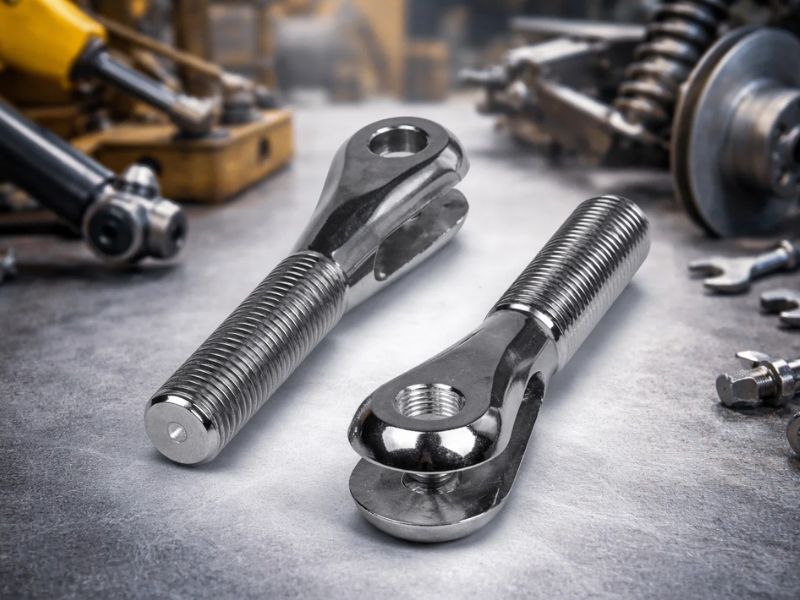
A threaded clevis joint offers a more secure, stable fit. Threads on the pin or body tighten the connection and hold it more firmly, whether the threading runs the full length of the pin or only partway, keeping the assembly together through demanding use.
Quick-Release Clevis
A quick-release clevis joint is built for fast changes, typically openable or closeable with one hand. That speed matters for repairs, service work, or any application where frequent connect/disconnect cycles are the norm.
Applications and Advantages of Clevis Joints
Applications:
- Automotive & Transportation: steering linkages, brake and clutch linkages
- Aerospace & Aviation: flight control systems, landing gear mechanisms
- Heavy Machinery & Construction: hydraulic cylinders, boom and arm articulation
- Industrial & Manufacturing: control and automation linkages, robotics
- Agriculture: tractor hitches and implements
Advantages:
- Controlled articulation
- High shear strength
- Quick assembly and disassembly
- Vibration resistance
- Compensation for misalignment
Conclusion
A clevis joint is a simple but essential mechanical linkage, enabling controlled movement and strong load transfer between connected parts. It's a standard solution across marine, industrial, automotive, and aerospace machinery. Profab specializes in manufacturing precision stainless clevis ends with tight tolerances and corrosion-resistant finishes. Whether you need standard sizes or custom-engineered designs, Profab Machine delivers reliable solutions that enhance your equipment's strength, safety, and efficiency.
FAQ
Which material should you choose for a clevis joint?
Match the material to your environment and load. Stainless steel resists rust and suits wet or corrosive environments. Alloy steel handles heavier loads. Aluminum works well for lighter-duty applications where weight matters.
What maintenance does a clevis joint need?
Inspect regularly for wear or rust, keep the parts clean, lubricate the pin, and replace damaged pins or forks promptly. Regular checks are what keep a clevis joint reliable over the long term.