

- By Profab /
- November 10, 2025
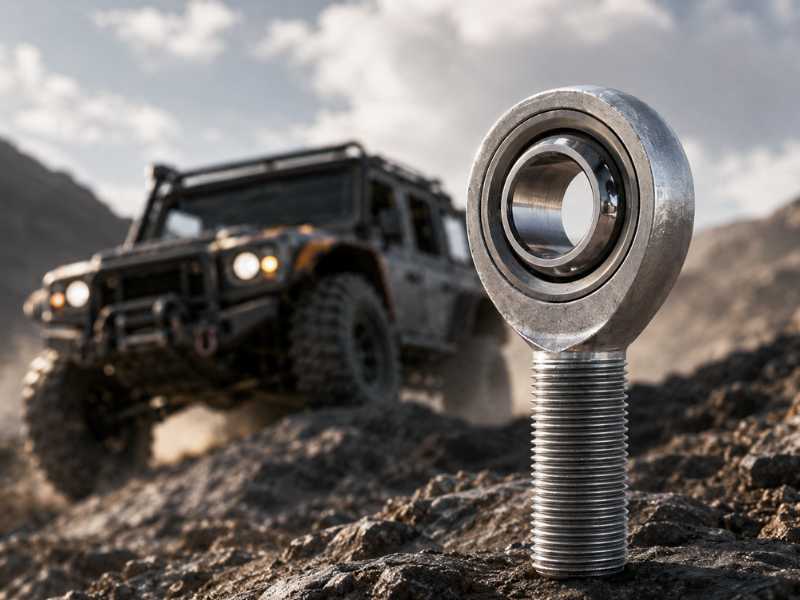
Table of Contents
Choosing the wrong rod end costs more than money. It costs machine downtime, failed safety inspections, and component rebuilds. This guide covers the six decisions every engineer and builder needs to make before ordering — with real numbers, not vague advice.
What Is a Rod End, and Why Does Selection Matter?
A rod end (also called a heim joint or rose joint) is a bearing assembly that connects two components while allowing angular misalignment. The spherical ball inside the housing lets the joint articulate in multiple planes without binding.
What makes selection tricky is that rod ends look simple but fail in very application-specific ways. An undersized bore strips under torque. A carbon steel joint in a marine environment corrodes within months. A 2-piece design in a high-cycle automation system wears out ten times faster than a 3-piece alternative.
The six decisions below eliminate those failures before they happen.
Decision 1: Material — The Most Critical Choice
Material determines corrosion resistance, load capacity, and long-term cost. Most ordering mistakes start here.
Carbon Steel (Zinc-Plated)
The default choice for dry, indoor applications. Carbon steel rod ends offer the best load-per-dollar ratio and are available in the widest size range. However, the zinc plating provides only basic protection — expect accelerated corrosion in salt spray, humidity above 80%, or regular contact with cleaning agents.
Best for: Industrial machinery, agricultural equipment, indoor automation linkages, budget-constrained automotive builds.
Chromoly Steel (4130/4140)
Chromoly rod ends are roughly 20–30% lighter than carbon steel equivalents at the same load rating. The higher yield strength (typically 90,000–120,000 psi versus 60,000–70,000 psi for carbon steel) makes them the standard for performance suspension, four-link systems, and race car steering. They require proper coating — bare chromoly will rust.
Best for: Off-road suspension, custom control arms, racing linkages, applications where weight and strength both matter.
Stainless Steel (304 / 316 / 316L)
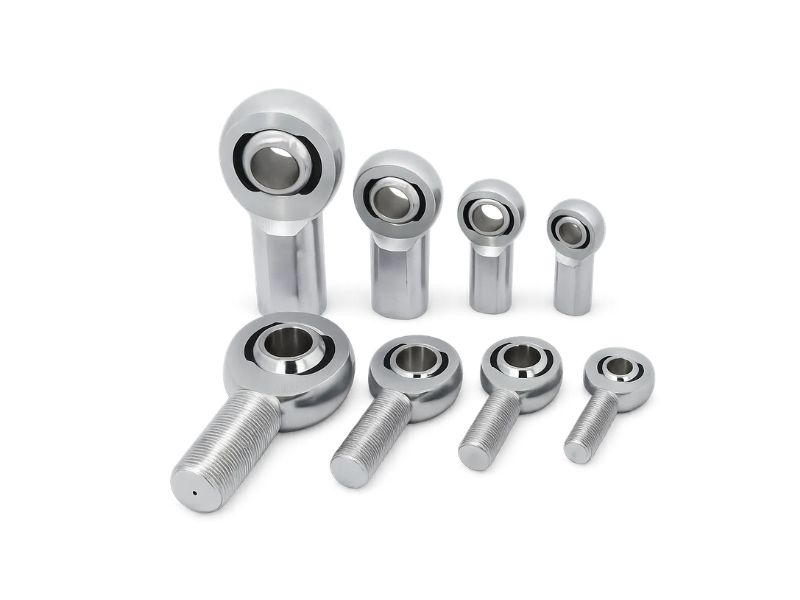
Stainless rod ends are the correct answer whenever corrosion is the primary failure mode. The key is matching the grade to the actual environment:
| Grade | Chloride Resistance | Typical Application |
|---|---|---|
| 304 | Moderate | Food processing, indoor wash-down, general marine |
| 316 | Good | Coastal/marine, chemical exposure, outdoor equipment |
| 316L | Best (low carbon) | Salt water immersion, aggressive chemicals, medical |
The most common mistake is ordering 304 for a saltwater boat application. 316 or 316L contains molybdenum, which gives it roughly 3× better chloride resistance than 304. In a direct salt-spray environment, 304 will show surface pitting within 6–12 months. 316L will not.
Profab Machine supplies 304, 316, and 316L rod ends with material test certificates (MTC) available on request.
Best for: Marine hardware, food and beverage equipment, outdoor automation, hydraulic systems in corrosive environments.
Decision 2: Structural Design — 2-Piece vs 3-Piece vs Injection Molded
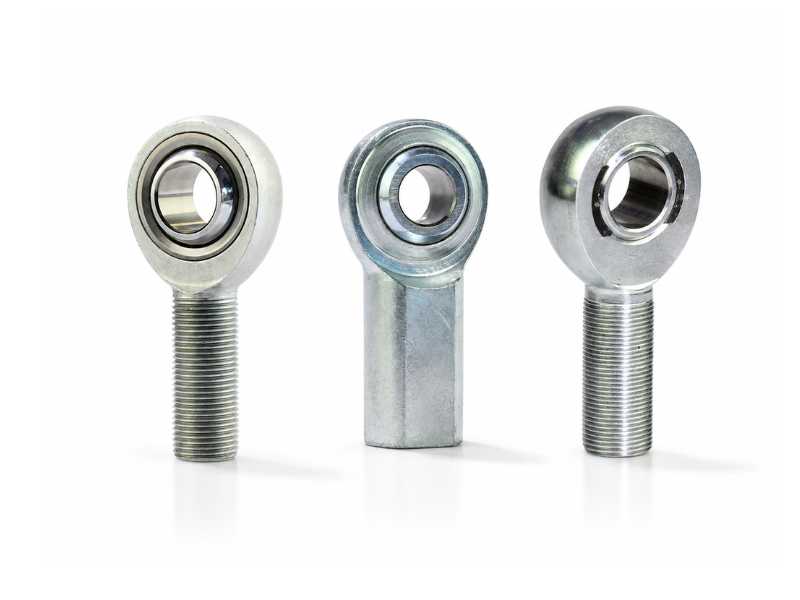
2-Piece Rod Ends
The ball presses directly into the housing. This is the most common design and suits most standard applications. Typical misalignment angle: 15°–25°. Lower cost, widely stocked.
3-Piece Rod Ends
A separate race sits between the ball and housing, distributing load over a larger contact area. This design significantly extends service life under high-cycle or high-vibration conditions. JMX/JFX-series 3-piece rod ends, for example, handle static radial loads from 2,800 lbs up to 100,000+ lbs depending on bore size.
Use 3-piece when: load ratings exceed what 2-piece can sustain, or the application involves continuous oscillation (conveyor systems, packaging machines, robotic arms).
Injection Molded (PTFE-Lined)
The inner race is lined with PTFE, eliminating the need for grease. Operating range: approximately −65°F to 325°F (−54°C to 163°C). These are the correct choice for applications where re-lubrication is impractical — sealed assemblies, remote machinery, food-safe environments.
Decision 3: Thread Configuration
Male vs Female
- Male rod ends have an external threaded shank. They screw directly into a tapped hole or clevis.
- Female rod ends have an internal threaded bore. A bolt or stud passes through the housing.
The application geometry tells you which one you need. If you’re mounting into a welded tab with a threaded hole, use male. If a bolt passes through the mount and threads into the rod end, use female.
Right-Hand vs Left-Hand Thread
Right-hand threads (standard) tighten clockwise. Left-hand threads tighten counter-clockwise. Left-hand threads are required on the opposite end of adjustable linkages — tie rods, panhard bars, and drag links — so both ends can be turned simultaneously to change length without disassembly.
When building a two-ended adjustable linkage, always pair one male right-hand with one male left-hand on the same tube.
Imperial vs Metric
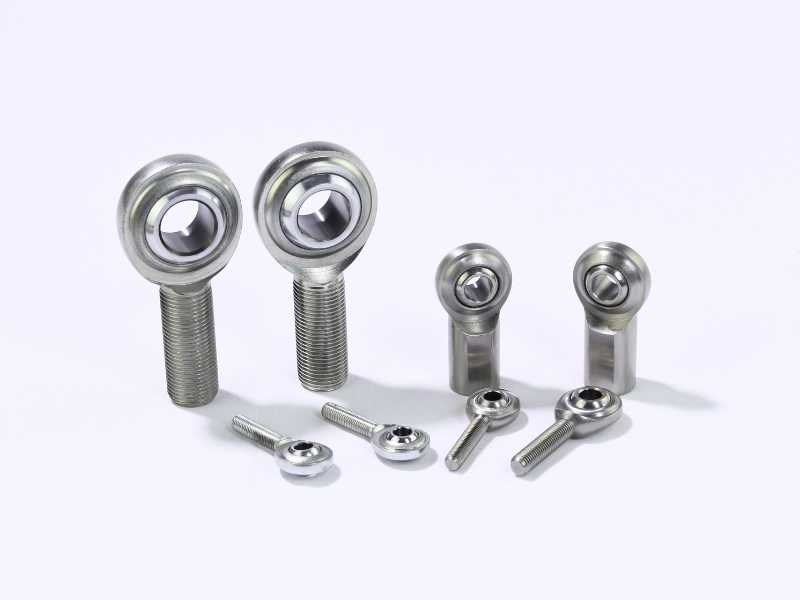
- Imperial threads (UNF/UNC) dominate North American automotive, off-road, and motorsport applications.
- Metric threads (M-series) are standard in European machinery, industrial automation, and most OEM equipment outside the US.
Confirm which thread standard your existing hardware uses before ordering. Mixing a metric rod end with an imperial adjuster tube is one of the most common (and avoidable) specification errors.
Decision 4: Bore Diameter and Key Dimensions
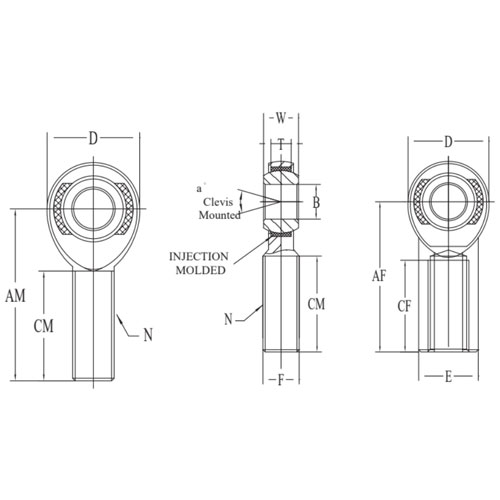
The bore diameter (B) must match the pivot bolt or pin exactly. Undersized bores cannot be installed. Oversized bores create slop that accelerates wear.
Beyond bore diameter, confirm these dimensions against your mounting geometry:
- B (Bore Diameter): Must match the bolt/pin size. Common imperial sizes: 1/4″, 5/16″, 3/8″, 1/2″, 5/8″, 3/4″, 1″
- Thread Size (AM/AF): The shank thread diameter and pitch, e.g., 1/2″-20 UNF or M12×1.25
- T (Body Width): Must clear the mounting bracket on both sides
- W (Ball Width): Determines the effective pivot span
- Misalignment Angle: Typically 15°–25°. Confirm this exceeds the maximum articulation angle in your application, with margin
- Static Radial Load Rating: Must exceed peak loading, including dynamic shock factors (typically 1.5×–3× static load for off-road/vibration applications)
If you’re replacing an existing rod end, measure the worn one or pull the OEM specification. Catalog load ratings assume correct installation — a misaligned or over-torqued rod end fails well below its rated load.
Decision 5: Lubrication Type
| Type | Maintenance | Temperature Range | Best For |
|---|---|---|---|
| PTFE-lined (maintenance-free) | None | −65°F to 325°F | Sealed assemblies, food-safe, remote locations |
| Greaseable (Zerk fitting) | Periodic lubrication | −22°F to 140°F | Heavy-duty, contaminated environments |
| Metal-to-metal | Periodic lubrication | −58°F to 392°F | High-temp, high-load, racing, aerospace |
| Polymer bushing | Minimal | Application-specific | Low-friction automation, light loads |
Greaseable rod ends are the correct choice when abrasive particles (dirt, sand, metal fines) are present — regular greasing flushes contaminants out and significantly extends service life. Do not use sealed PTFE-lined joints in high-contamination environments; the liner will be destroyed by abrasion before it wears out from normal use.
Decision 6: Application Environment Checklist
Run through this checklist before finalizing your order:
- Is moisture or salt present? → 316 stainless minimum; 316L for immersion
- Is the environment above 140°F consistently? → Metal-to-metal design; PTFE-lined if below 325°F
- Are there cyclic loads above 1 Hz? → 3-piece design; verify dynamic load rating, not just static
- Is re-lubrication practical? → Yes: greaseable. No: PTFE-lined or polymer bushing
- Is this a safety-critical suspension or steering component? → Use a rod end with a documented load rating, not a no-name import. Request a material cert
- Is weight critical (racing, aerospace)? → Chromoly or titanium over stainless; verify strength-to-weight ratio
Common Mistakes to Avoid
Using load rating as the only selection criterion. A rod end rated for 10,000 lbs static load in a clean, aligned installation may fail at 3,000 lbs in a misaligned, contaminated environment. Match the joint type and liner material to the actual operating conditions first; confirm load capacity second.
Ordering carbon steel for outdoor or marine use. Zinc plating is not corrosion protection for marine environments — it is a sacrificial coating that delays rust. Stainless steel costs more upfront and saves the cost of replacement labor within a single season.
Ignoring misalignment angle. A rod end installed at an angle beyond its rated misalignment will load the race edge rather than the ball face, causing accelerated wear and early failure. Build in 5°–10° of margin beyond expected maximum articulation.
Mixing thread standards on the same linkage. Imperial and metric threads have different pitch profiles and are not interchangeable even when they appear to fit. Forced cross-threading damages both components.
Quick Selection Reference
| Application | Material | Design | Lubrication |
|---|---|---|---|
| Racing / high-performance suspension | Chromoly | 3-piece | Metal-to-metal or PTFE |
| Off-road 4×4 / rock crawler | Chromoly or 316 SS | 3-piece | Greaseable |
| Marine / boat hardware | 316 or 316L SS | 2 or 3-piece | PTFE-lined or greaseable |
| Industrial automation | 304 SS or carbon | 3-piece | PTFE-lined |
| Agricultural equipment | Carbon steel (zinc) | 2-piece | Greaseable |
| Food processing / wash-down | 316L SS | 2 or 3-piece | PTFE-lined |
| Hydraulic cylinder ends | Carbon or 316 SS | 2-piece | Metal-to-metal |
FAQ
What is the difference between a rod end and a heim joint?
They are the same component. “Heim joint” is a brand name (from Heim Manufacturing) that became a generic term in North America. “Rod end” or “rose joint” is the more common industrial and international terminology.
How do I know if I need left-hand or right-hand threads?
For a single-end mount (one rod end per linkage), right-hand thread is almost always correct. For an adjustable two-ended linkage (such as a tie rod or turnbuckle-style assembly), one end is right-hand and the other is left-hand so length can be adjusted by rotating the tube.
Can I use a standard rod end in saltwater?
No. Carbon steel rod ends with zinc plating will corrode significantly within weeks in direct saltwater contact. Use 316 or 316L stainless steel. The molybdenum content in 316-series stainless provides the chloride resistance needed for marine environments.
What maintenance do stainless steel rod ends require?
PTFE-lined stainless rod ends are maintenance-free under normal operating conditions. Greaseable stainless variants should be lubricated at the same interval as the surrounding equipment’s maintenance schedule, or whenever visible contamination is present.
How do I calculate the correct load rating for my application?
Start with the maximum expected static load on the joint, then apply a safety factor of 2×–3× for dynamic applications (vibration, shock loading, repeated cycles). For safety-critical applications, consult an engineer and request load data from the manufacturer.
Need Help Selecting?
If your application has unusual load conditions, extreme temperatures, or specific certifications required (FDA food-safe, marine-grade documentation, aerospace traceability), Profab Machine’s engineering team can review your specifications and recommend the correct rod end model with supporting data.
Provide your: maximum static and dynamic load, operating temperature range, environment (dry / humid / corrosive), bore diameter, thread size and hand, and cycle frequency. We typically respond within one business day.
Send Inquiry Now
Related Resource
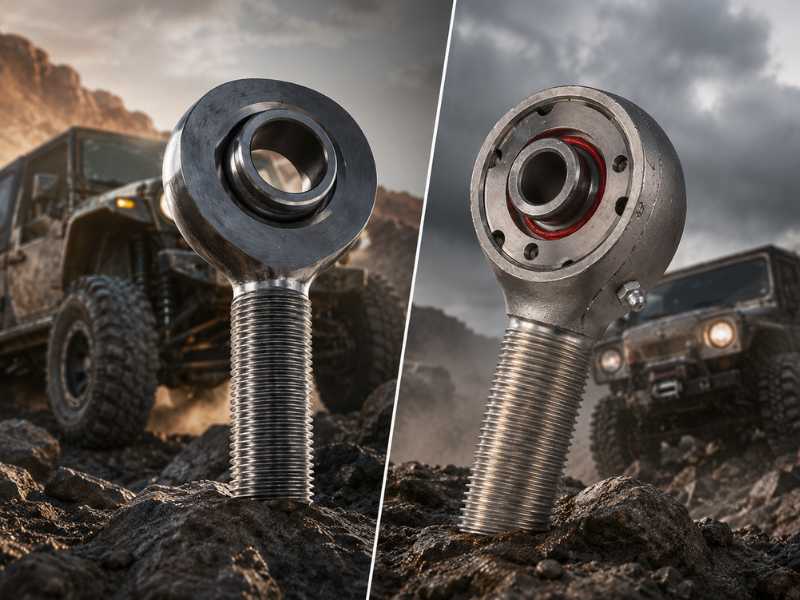
Johnny Joints vs. Heim Joints: The Real Performance Gap
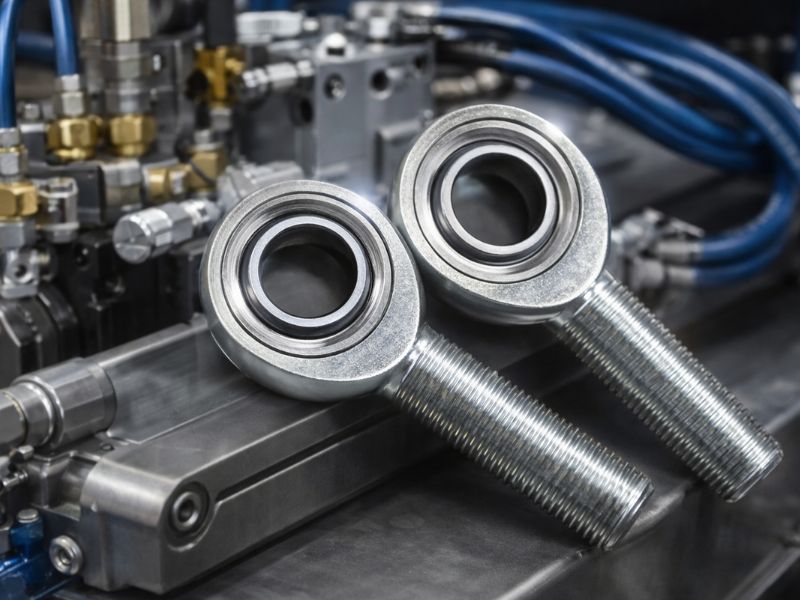
Advantages of Maintenance-Free Rod Ends in Hydraulic Applications
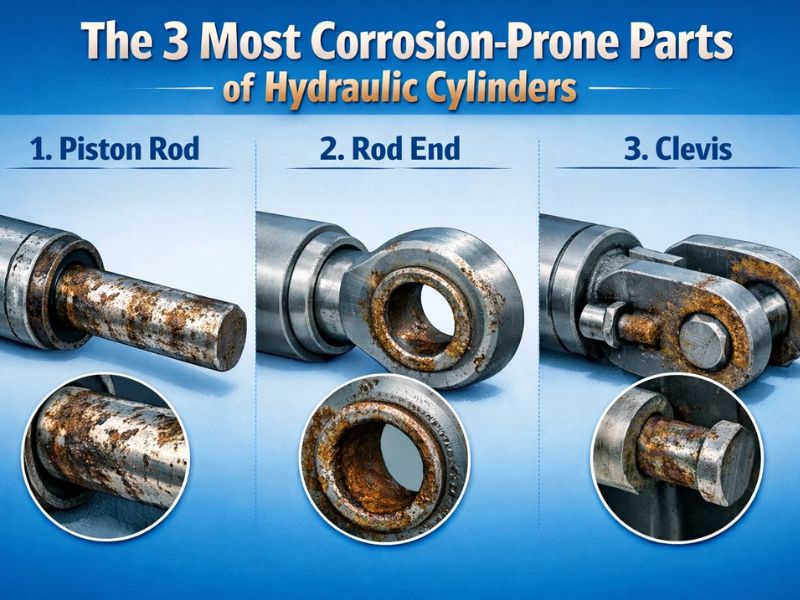
The 3 Most Corrosion-Prone Parts of Hydraulic Cylinder