
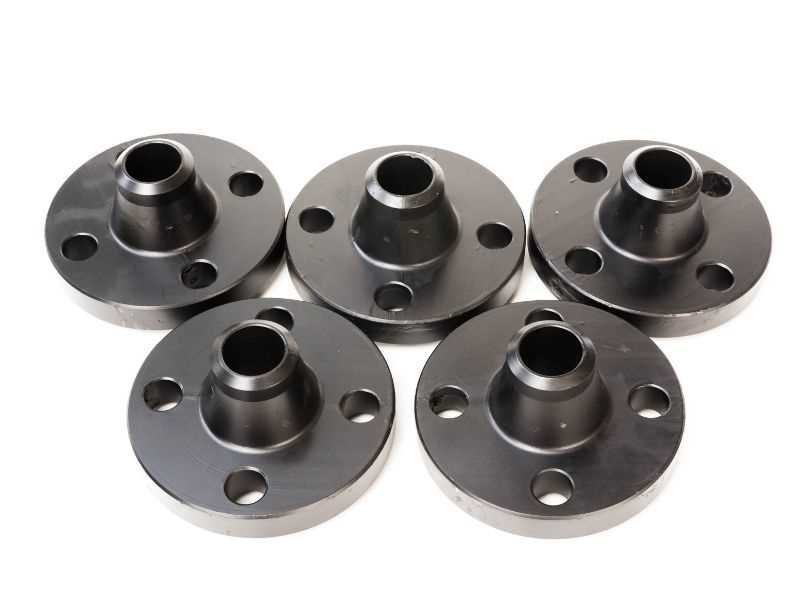
Choose a flange in four steps. Pick the type that joins the pipe, the face that seals the gasket, the pressure class from the governing standard, and the stainless grade for the media. Each choice is separate, and a mistake in one cannot be fixed by the others. The table below shows what each type does and where it needs care.
| Flange type | How it joins the pipe | Where it is used | Watch for |
|---|---|---|---|
| Weld neck | Butt weld to a tapered hub | High pressure, high temperature, cyclic service | Needs a pipe end prepared for butt welding |
| Slip-on | Slides over the pipe, fillet welded | Low-pressure general piping | Easy to align, so check the weld, not only the fit |
| Socket weld | Pipe sits in a stepped bore, one fillet weld | Small-bore lines | The socket leaves a crevice |
| Threaded | Tapped bore screws onto a threaded pipe end | Small sizes where welding is not wanted | Thread standard must match (NPT, BSP) |
| Lap joint | Loose flange on a welded stub end | Lines taken apart often | Two parts to order as a pair |
| Blind | Solid disc, no pipe | Closes a pipe end, nozzle or spare port | Face and bolt pattern still have to match |
The Six Flange Types and What Each Joins
A flange joins two pipes, or a pipe and a piece of equipment, with a bolted joint that can be taken apart. Bolt tension squeezes a gasket between two faces, and the squeezed gasket is what seals. The type of flange decides how the flange is fixed to the pipe, so it decides the welding or threading you need on site.
Weld neck flanges
A weld neck flange has a long tapered hub that is butt welded to the pipe. The taper carries load from the flange face into the pipe wall gradually instead of at a sharp step. This is why a general flange reference places weld neck in high-pressure, high-temperature service. It is also the usual choice where the line cycles between hot and cold.
Slip-on flanges
A slip-on flange slides over the pipe and is fillet welded on the outside and the inside. It aligns easily because the pipe does not have to be cut to an exact length, and it is common in low-pressure systems. Do not read a pressure limit from the flange type alone. The allowable pressure depends on the class, the material and the temperature, so take it from the standard's table for your case.
Socket weld flanges
A socket weld flange has a stepped bore where the pipe sits before one fillet weld closes the joint. It suits small-bore lines. The socket leaves a crevice at the pipe end, and practitioners in corrosive service avoid it for that reason. In services with crevice corrosion or poor cleanability, a butt-welded joint is often chosen instead.
Threaded, lap joint and blind flanges
A threaded flange has a tapped bore and screws onto a threaded pipe end, so no weld is made on the pipe. It is used in small sizes, and the thread standard (NPT or BSP) must match the pipe. A lap joint flange turns freely on a stub end welded to the pipe, which lets you line up the bolt holes without turning the whole pipe spool. A blind flange is a solid disc that closes a pipe end, a nozzle or a spare port.
Face Types: Flat, Raised, Ring Joint
The face is the part of the flange that meets the gasket. Common styles are flat face, raised face, tongue and groove, and ring joint. A raised face has a small ring around the bore that concentrates the gasket load. A flat face has no ring. A ring joint seats a metal ring gasket in a machined groove.
The face has to match the flange it bolts to. Published guidance says not to bolt a raised-face steel flange to a flat-face cast iron flange. The raised ring bears near the bore and the bolts can bend the brittle casting outward until it cracks as the bolts are tightened. The usual remedy is to machine the raised face off and use a full-face gasket. Check the mating equipment before you order, and ask its maker if the bolting or face is in doubt.
Pressure Class Is Not One Number
Flange dimensions and ratings come from standards. ASME B16.5 covers sizes up to NPS 24 and classes 150 to 2500 (Class 2500 stops at NPS 12), ASME B16.47 covers larger sizes, and most of Europe uses EN 1092-1. A class number is not a pressure. The maximum pressure depends on the flange material and the temperature, so one class carries a table of values.
For example, a Class 150 flange in ASTM A105 carbon steel is rated at 285 psig at or below 100 °F, and a Class 300 flange at 740 psig. A stainless flange of the same class has its own table, and the allowable pressure falls as temperature rises. An ASME 150 flange and an ASME 300 flange of the same size differ in bolt circle, bolt count and outside diameter, so they do not mate. ASME and EN flanges also generally differ, so check the drawing before swapping one for the other.
Gaskets and Bolting Decide the Joint
A flange rating covers the flange. The joint also needs the right gasket and the right bolts, and the weakest of the three limits it. Upgrading the flange grade may not raise the capacity of the joint if the bolting stays the same. The standard and its gasket and bolting references guide both, so follow them for the class you chose.
304L or 316L for a Flange
304L is the usual grade for flanges in non-chloride service such as water treatment, dry food areas, HVAC and indoor piping. 316L is the usual choice for chloride washdown, marine piping and lines that carry chlorides, because its 2 to 3 percent molybdenum gives it a higher pitting resistance number than 304L. The L suffix limits carbon to 0.03 percent, which reduces carbide precipitation in the weld heat-affected zone of a welded flange that is not annealed afterwards.
That last point applies to welded joints. A threaded or blind flange is not welded to the pipe, so the choice between L and standard grades follows the media and the rest of the assembly. Duplex grades are available on request for continuous high-chloride service.
Reading a Flange Callout
A flange is ordered with a short callout. Here is one, read field by field.
| Callout | Field | What it fixes |
|---|---|---|
| NPS 2 | Nominal pipe size | Bore and outside diameter that match the pipe |
| Class 150 | Pressure class | Bolt circle, bolt count, flange thickness and rating table |
| Slip-on | Type | How the flange is welded to the pipe |
| RF | Face | The gasket seat and the mating flange face |
| 316L | Grade | Corrosion resistance in the media |
If any field is missing from your drawing, the flange cannot be made to the right standard.
Choosing by Service
Start from what the line does, then check the type against the standard and the design code for your piping.
| Service | Types to consider | Reason |
|---|---|---|
| High pressure or high temperature | Weld neck | Tapered hub spreads load into the pipe wall |
| Thermal or pressure cycling | Weld neck | Gradual stress transition at the weld |
| Low-pressure utility or drain | Slip-on | Easy alignment, common in low-pressure systems |
| Small-bore instrument or sample line | Socket weld, threaded | Both are used in small sizes; check crevice and cleanability |
| Spool that is taken apart often | Lap joint with stub end | Loose flange lines up the bolt holes without turning the pipe |
| End of a run, spare port, test closure | Blind | Solid disc closes the opening |
Four Ordering Mistakes That Waste a Flange
- Quoting a class without a face. Class 150 raised face and Class 150 flat face are different parts.
- Mixing classes or standards at one joint. Change both flanges together and keep to one standard on a drawing.
- Ordering a lap joint flange without its stub end. The two parts work as a matched pair.
- Leaving the thread standard off a threaded flange. NPT, BSP and metric threads do not mate with each other, so name the standard.
What to Send for a Flange Quote
Profab Machine machines stainless steel flanges to your drawing: bore, sealing face and bolt-hole pattern, in 304, 316L and other grades. We do not rate flanges for pressure, so the class, code and test requirement belong on your drawing and in your design review. Send these details:
- The mating standard and size (for example ASME B16.5, NPS 2, Class 150)
- Flange type and face, and the part it bolts to
- Material grade and the media it will see
- Thread standard if the flange is threaded, and the quantity
Conclusion
Pick the type from how the pipe is joined, the face from the part it bolts to, the class from the standard and the grade from the media. Do not infer a pressure limit from the type, and check the gasket and bolting as part of the joint. If you need flanges made to a drawing, send the callout above to Profab Machine and we will confirm the bore, face and bolt pattern before we quote.