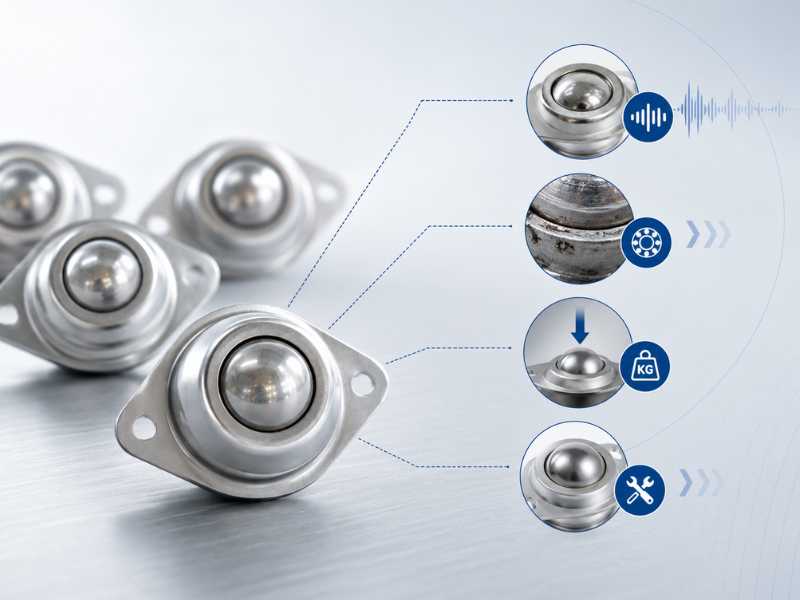
A ball transfer unit that's running well is quiet, moves freely in every direction, and carries its rated load without visible deformation or heat. When something changes, the symptom is usually obvious: a new noise, a rough spot in the rotation, units that feel stiff, or visible wear on the main ball. What's less obvious is which of several possible causes is actually responsible. Fix the wrong thing and the problem returns on the same schedule.
This guide covers the most common failure modes in stainless steel ball transfer units, what causes each one, and what the correct fix actually involves.
Grinding or Grating Noise
A grinding sound during operation almost always means metal-to-metal contact somewhere in the load path. In a ball transfer unit, the main ball is supported by a ring of smaller recirculating balls inside the housing. When that internal ball race loses lubrication or becomes contaminated with abrasive particles, the recirculating balls drag against the housing surface instead of rolling cleanly.
The fix depends on whether the unit is sealed-for-life or serviceable. Most light-duty and medium-duty units are sealed at the factory and not designed for relubrication in the field. If a sealed unit starts grinding, the internal lubrication has either dried out from heat cycles or been displaced by contamination that entered through a degraded wiper seal. Replacement is the practical answer. For heavy-duty units with grease fittings, purge the housing with fresh grease rated for your operating temperature until the old grease exits the housing, then run the unit briefly and check whether the noise clears.
In stainless steel units running in food processing or pharmaceutical environments, the choice of lubricant matters more than in standard industrial applications. Food-grade grease certified to NSF H1 is typically specified where incidental food contact is possible. Standard industrial grease in these environments creates a contamination risk that supersedes the bearing failure question entirely.
One cause of grinding that doesn't get enough attention: installation debris. If a ball transfer unit is pressed into a panel or table cutout without cleaning the hole edges, metal chips and swarf from the machining operation enter the housing immediately. The unit grinds from its first hour of service. Clean the mounting hole before pressing in any unit.
Clicking or Irregular Noise at a Specific Point in Rotation
A click that repeats at a consistent point in the main ball's rotation, rather than continuously, points to a localized surface defect. The most common cause is a flat spot on the main ball.
Flat spots form in two ways. The first is impact damage: a heavy load dropped onto a unit from height, or a unit run over by a forklift wheel while sitting loose on a table, deforms the ball surface at the contact point. The second is static loading during storage or extended downtime. If a loaded pallet sits on a ball transfer table for weeks without moving, the weight of the load creates a sustained contact stress at one point on each main ball. Over time, especially on softer grade units, that stress produces a slight deformation. When the unit starts moving again, the flat passes through the load zone once per revolution and produces a repeating click or thud.
316L stainless in the annealed condition is softer than hardened carbon steel. Where the main ball material is specified as 316L stainless, resistance to flat-spot formation is generally lower than hardened 440C or precipitation-hardened 17-4PH. If your application involves extended periods of stationary loaded storage on a ball transfer table, the ball material specification matters more than it would in a continuous-movement conveyor application.
A flat spot doesn't repair itself. Once formed, the defect grows slightly with each revolution as the edge of the flat creates a stress concentration. The correct fix is unit replacement. The progressive nature of flat-spot damage is rooted in the recirculating ball support geometry used inside most ball transfer units.
Stiff or Binding Rotation
A unit that resists movement in one direction, or requires noticeably more push force than others in the same table, has either a contamination problem or a fit problem.
Contamination is the more common cause in production environments. Fine particulate from machining, powder coating overspray, or food product residue packs into the gap between the main ball and the housing cap. The material acts as a brake. In washdown environments, high-pressure water forces debris into the housing faster than a wiper seal can block it. The fix is to remove the unit, flush the housing with appropriate solvent or water, relubricate if the unit has a grease fitting, and reinstall. In environments where this happens repeatedly, switch to units with drain holes that allow washdown fluid and debris to exit rather than accumulate.
The fit problem is less obvious. Ball transfer units press into or thread into a mounting panel. If the mounting hole is undersized, the housing deforms slightly when pressed in, which distorts the internal ball race geometry and increases rolling resistance. The main ball still rotates, but with more friction than the unit's specification predicts. Check the mounting hole diameter against the manufacturer's specification before pressing. The interference should be enough to retain the unit against pullout loads, but not so tight that it compresses the housing wall into the ball race. For stainless units pressed into stainless panels, apply a thin film of anti-seize to the housing OD before pressing. Stainless-on-stainless press fits gall during installation, and a galled housing surface transfers irregular stress into the housing wall.
Premature Wear on the Main Ball
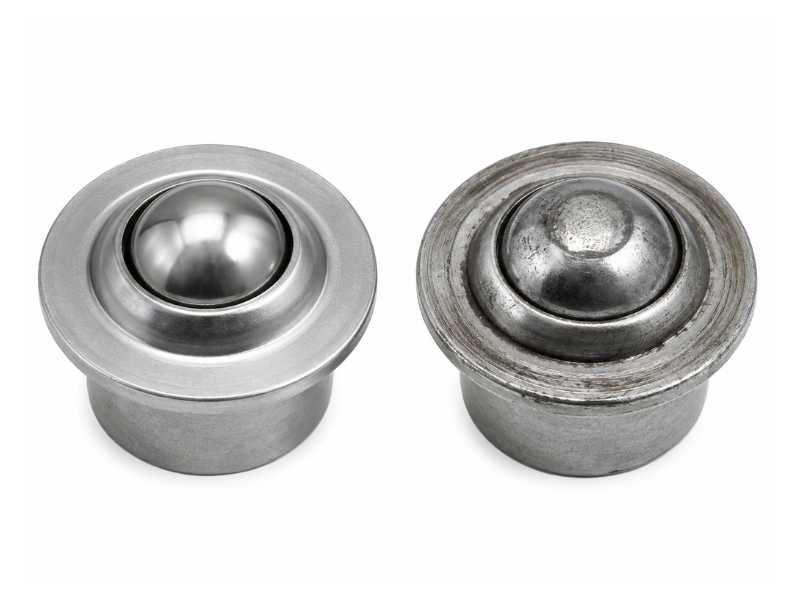
Visible wear on the main ball surface, showing as a matte or scored ring around the equator, means the unit is operating beyond its rated load or the load distribution across the table is wrong.
Each ball transfer unit has a rated static load. That rating assumes the unit is mounted flush with the panel surface, loaded vertically, and part of an array where load is shared across multiple units simultaneously. The load per unit in a table is not the total table load divided by the total number of units. It's the load carried by the minimum number of units that contact a given load at any position. For most rigid, flat-bottom loads on a properly designed table, at least three units typically share the load at any given time. For a flexible load or an uneven table surface, individual units can momentarily carry significantly more than their share.
The rule for spacing ball transfer units is to divide the smallest dimension of the load being conveyed by 2.5. This geometry ensures that any load will always be supported by at least three units simultaneously. Tables with spacing designed around average load rather than worst-case geometry will see accelerated wear on units at the edges of the array, where loads entering or exiting the table are temporarily supported by fewer units.
⚠️ Notes: Overloaded units don't always fail visibly and immediately. A unit running significantly above its rated static load may continue to function for a period while subsurface fatigue damage develops in the main ball. The first visible sign is often a sudden flat spot or ball fracture during normal operation. Check your load distribution calculation before attributing wear to defective units.
In stainless steel units for food or marine applications, 420 or 440C stainless for the main ball gives significantly better wear resistance than 304 or 316L, at the cost of somewhat lower corrosion resistance. For applications where both matters, 17-4PH in precipitation-hardened condition offers a better balance, with yield strength typically ranging from approximately 930 MPa to over 1,170 MPa depending on the heat treatment condition and adequate corrosion resistance for most washdown environments. It's not a substitute for 316L in continuously submerged or high-chloride service, but for food processing lines with CIP cycles, it handles the mechanical demands better than soft austenitic grades.
Units That Won't Stay Flush With the Panel
A ball transfer unit that gradually works itself out of its mounting hole causes two problems: the unit sits proud of the surface and creates a bump in the transfer path, and the retention force decreases further with each vibration cycle until the unit drops out entirely.
This happens when the housing-to-hole fit was specified correctly but the hole has worn over time from repeated unit removal and reinstallation. Each removal cycle removes material from the hole edges. After three or four replacements, the hole is oversized for the unit's OD.
The fix is a retaining ring or a thin-wall stainless bushing pressed into the enlarged hole to restore the correct diameter, then the ball transfer unit pressed into the bushing. Don't attempt to compensate with retaining compound alone in a high-vibration environment. Anaerobic compounds lose effectiveness under continuous vibration at the interface.
Corrosion Inside the Housing
Stainless steel housings resist external corrosion well. The problem appears inside, where the recirculating balls and their race are often made from carbon steel or lower-grade stainless to achieve the hardness needed for wear resistance. In environments with high humidity, salt spray, or frequent water exposure, moisture enters through the wiper seal and attacks the internal components even when the housing exterior looks clean.
The symptom is a unit that develops rough rotation gradually over weeks rather than suddenly. Pulling the unit and inspecting the main ball and housing interior reveals rust staining and pitting on the internal ball race surface.
In marine, coastal, or food processing environments, specify all-stainless units where the internal components, including the recirculating balls and their race, are specified in stainless rather than carbon steel. Profab's stainless steel ball transfer units use 304 or 316L housing with hardened stainless options for the main ball to address this directly. For submerged or constantly wet service, 316L throughout is the correct material specification.
When to Replace vs. When to Service
Units with grease fittings: service first, replace if noise or binding persists after fresh lubrication. Units sealed for life: replace when noise, binding, or visible surface damage appears. Housing fits that have worn: restore the hole with a bushing and replace the unit. Flat spots: always replace, no repair is possible. Internal corrosion: replace, and specify the correct all-stainless internal grade for the environment going forward.
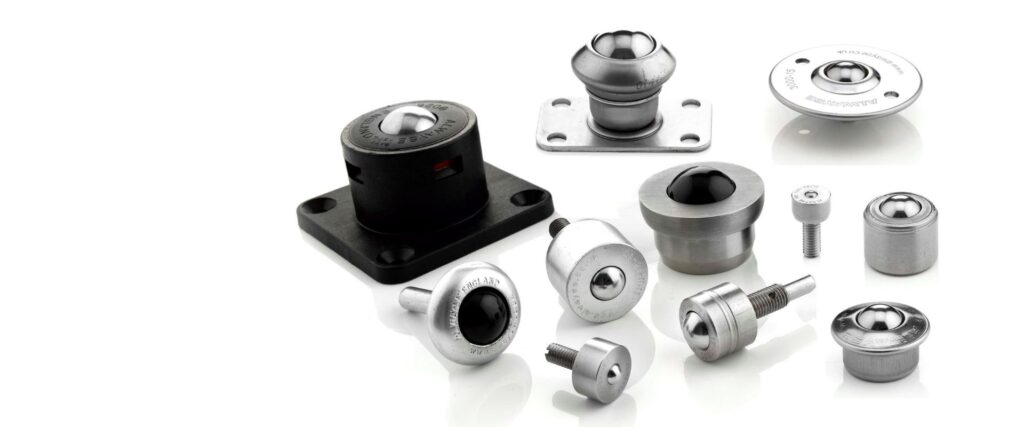
Profab Machine manufactures stainless steel ball transfer units in flange, round-base, and stud-mount configurations for conveyor tables, food processing lines, cargo platforms, and assembly workstations.