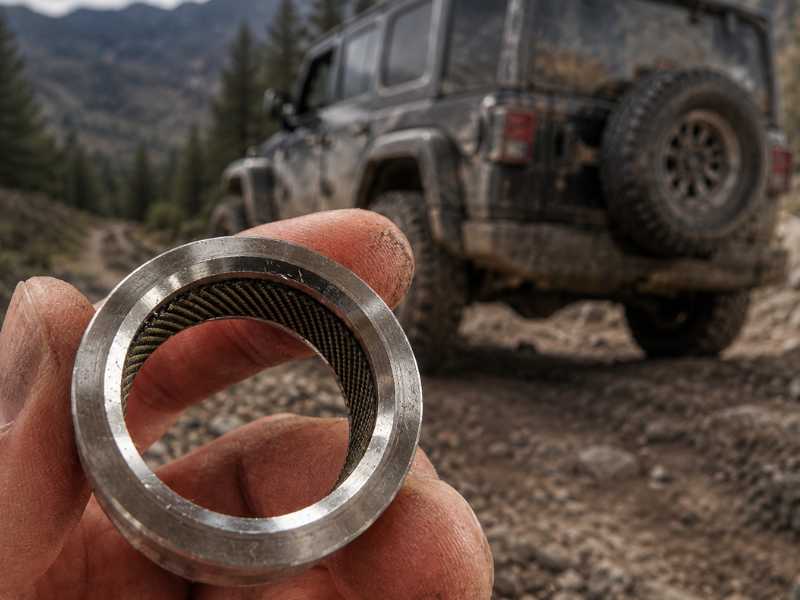
The maintenance record looked clean. The fitting had been relubricated on schedule. The grease nipple was reached, the gun was used, and the service entry was logged. Six months later, the bearing still failed. The wear pattern showed dry running.
This is a known failure mode in greased spherical plain bearings when the installation geometry works against the lubrication path. Grease reaches the nipple, but not the bearing surface. In a tight mounting location, with no direct route from the fitting to the ball-race interface, relubrication can become little more than a checkbox. The bearing may run dry between service intervals while everything at the fitting appears normal.
Self-lubricating spherical plain bearings remove that failure mode. There is no grease path to block, no starvation interval to manage, and no requirement for scheduled service access. That is the practical reason they often outlast greased metal-to-metal designs, especially in assemblies where relubrication is difficult, inconsistent, or impossible.
They are not always the better choice. Self-lubricating bearings have a performance ceiling, and in high-load continuous oscillation service, greased metal-to-metal bearings usually last much longer than PTFE-lined versions. Knowing where that ceiling sits matters just as much as understanding the advantage.
How Self-Lubricating Bearings Actually Work
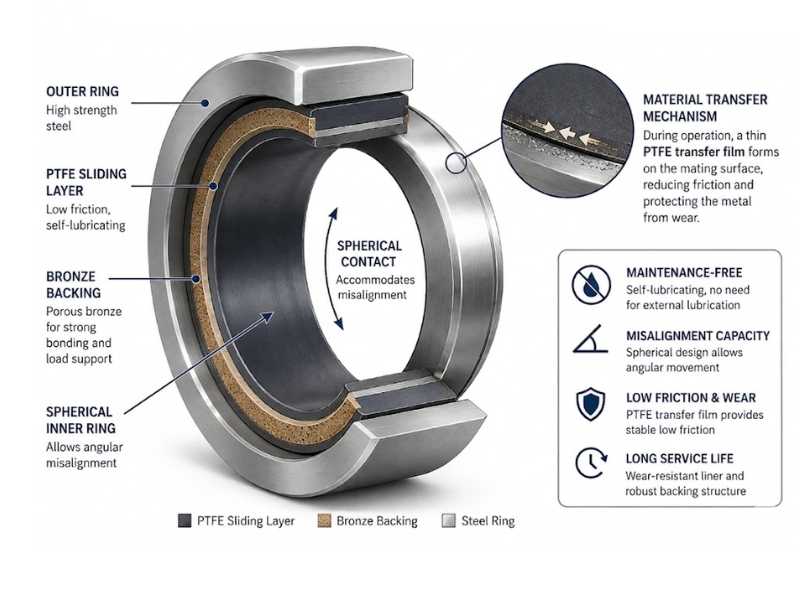
The term "self-lubricating" refers to a bearing that carries its own lubricating medium instead of relying on applied grease or oil. In spherical plain bearings, this usually means a composite liner bonded to the inner face of the outer ring. The liner is typically PTFE (polytetrafluoroethylene), often woven or combined with glass fiber or bronze fiber to improve load capacity and dimensional stability.
During the first operating cycles, the PTFE liner deposits a thin film of material onto the mating ball surface. This transfer film develops gradually over the first few thousand cycles, then renews itself during operation. The low coefficient of friction for PTFE-lined bearings, typically 0.02 to 0.10 depending on load and sliding velocity, comes from this transfer film rather than from an external lubricant.
Once that film is established, the bearing is working as intended. Friction stays low without grease replenishment. The film keeps renewing as long as the bearing remains within its rated load and motion parameters.
This has a direct implication for installation. New PTFE-lined bearings should not be put under peak load during break-in. Running them at moderate loads for the first several hundred to thousand cycles helps the transfer film form evenly across the contact zone. Heavy loading before the film is established can abrade the liner unevenly and shorten service life.
The PV Rating: Where Self-Lubricating Bearings Have a Ceiling
Every self-lubricating plain bearing has a PV rating. P is the bearing pressure, defined as the applied load divided by the projected bearing area. V is the sliding velocity at the ball-race interface. The PV value is the product of those two parameters.
For standard PTFE composite-lined spherical plain bearings, the PV limit is typically in the range of 0.03 to 0.10 MPa·m/s, depending on bearing size and liner composition. High-performance woven PTFE fabric liners, used in aerospace and heavy architectural applications, can sustain significantly higher PV values. In both cases, the limiting factor is heat. When a bearing runs continuously above the liner's rated PV, heat is generated faster than the assembly can dissipate it. The composite resins and bonding agents in self-lubricating liners typically begin to soften above 120°C to 150°C, which can cause liner displacement or accelerated wear even before the PTFE fiber itself is affected. At that point, material transfers to the ball faster than the self-renewing mechanism can replace it. Wear then accelerates quickly.
The important word is "sustained." Short-duration peak loads above the PV limit are often acceptable within design safety factors when motion is intermittent and the bearing has adequate cooling intervals. Continuous oscillation at high load, with no dwell time, is the condition that breaks PTFE-lined bearings.
There is also a minimum motion factor. PTFE-lined bearings need some sliding movement to maintain the transfer film. In applications with very low-frequency oscillation, where the bearing barely moves for long periods, the transfer film can become patchy. In practice, this rarely causes failure under static load because a bearing carrying steady load without movement does not generate the wear that erodes the liner. Still, the liner specification should be checked when angular movement is very infrequent.
Where Self-Lubricating Bearings Outlast Greased Designs
The advantages show up most clearly in specific service conditions.
Inaccessible mounting locations. Any joint that is hard to reach for regular maintenance is a strong candidate for a self-lubricating design. Marine rigging hardware, articulating mounts on cranes, linkage points inside enclosed actuators, and architectural movement joints in buildings are all good examples. Once installed, a properly specified PTFE-lined bearing in one of these locations needs no maintenance intervention for its full service life.
Marine and splash-zone environments. Greased bearings in saltwater face two problems at once: grease washout and corrosion at the grease-to-metal interface. Frequent relubrication helps, but it does not fully solve either issue. PTFE-lined stainless bearings avoid grease washout completely. There is no lubricant to displace. Paired with a 316 or 316L stainless outer ring and inner ring, these bearings are well suited to permanent installation in marine hardware, deck fittings, and offshore structural joints.
Food processing and sanitary equipment. Applied lubricants in food-contact equipment must carry food-grade certification (NSF H1 registration, based on FDA 21 CFR 178.3570). Even with H1 grease, lubricant migration into the product stream remains a regulatory and quality concern, especially in overhead installations where grease can drip. PTFE is approved for incidental food contact under FDA 21 CFR 177.1550. A self-lubricating bearing removes the ongoing lubricant management requirement and eliminates the lubricant migration vector from the process zone.
Architectural and structural movement joints. Expansion joints in bridges, movement connections in structural steel, and articulated facade brackets all experience low-frequency oscillation under significant static load. Metal-to-metal bearings in these locations are hard to maintain because access is limited and maintenance intervals for architectural joints are often measured in years, not months. PTFE-lined bearings with stainless outer rings are the standard design choice in architectural applications globally.
Low-temperature service. Grease consistency changes significantly with temperature. In cold-climate applications or refrigerated processing equipment, a greased bearing may still be within its rated lubrication interval while the grease is too stiff to distribute properly during early operating cycles. PTFE-lined bearings do not meaningfully change their tribological behavior across the typical working temperature range, although extreme cold below approximately -40°C requires checking the specific liner composition for its low-temperature rating.
Where Greased Metal-to-Metal Bearings Win
The picture changes in high-duty oscillating applications.
For hydraulic actuators, heavy construction linkages, and industrial machinery joints with high cycle rates and high loads, metal-to-metal spherical plain bearings with a proper lubrication program consistently outperform standard PTFE composite-lined designs in load life. For standard molded or composite PTFE liners, the radial load capacity in the same bore size is typically lower than the equivalent metal-to-metal bearing. High-density woven fabric PTFE liners, as used in ISO 12240-1 Series E and G designs, can approach comparable dynamic load ratings, but their performance ceiling is then governed by sliding velocity and heat dissipation rather than load alone. In continuous high-cycle oscillation service, the thermal limit of any PTFE liner usually becomes the constraint before the mechanical load rating does.
Temperature is another constraint. Hardened steel-on-steel contact with good grease lubrication tolerates operating temperatures well above PTFE's practical service limit. In high-heat environments such as diesel engine linkages, foundry equipment, and glass manufacturing machinery, metal-to-metal bearings with high-temperature grease are the appropriate choice.
The trade-off is maintenance access. If relubrication can be scheduled reliably and carried out consistently, greased metal-to-metal bearings deliver better load life in heavy-duty oscillation. If access for maintenance is uncertain, self-lubricating designs are more predictable across the full installation lifetime.
Self-lubricating bearings are particularly valued in applications where lubrication maintenance is impractical or where contamination from lubricants must be avoided, which matches the application pattern described above.
The table below summarizes service life factors for both bearing types across common installation scenarios:
| Application | PTFE Self-Lubricating | Metal-to-Metal (Greased) | Deciding Factor |
|---|---|---|---|
| Marine/offshore hardware | Long life, no maintenance needed | Requires periodic relubrication | PTFE eliminates grease washout |
| Food-grade/sanitary equipment | Preferred, FDA 21 CFR compliant | Acceptable with H1 grease | PTFE removes lubricant migration risk |
| Architectural movement joints | Long-term standard choice | Limited by maintenance access | PTFE needs no service interval |
| Heavy hydraulic actuators | Limited by PV ceiling | Better load life with lubrication | Metal-to-metal handles higher load |
| High-temperature linkages | Limited above ~120°C | Wide range with correct grease | PTFE softens at elevated temperature |
| Low-frequency/intermittent use | Well-suited | Acceptable if relubrication is feasible | PTFE has no grease starvation risk |
PTFE Plus Stainless: The Combination for Corrosive Service
In corrosive environments, the base material question and the lubrication question are linked. A PTFE-lined bearing with a carbon steel outer ring will still corrode in saltwater, regardless of the liner. The combination that addresses both issues is a PTFE-lined bearing with 316 or 316L stainless outer and inner rings.
This configuration provides adequate chloride resistance for marine splash zones, coastal installations, and seawater-cooled systems. It also removes the lubricant management requirement. The 316L grade maintains its passive oxide film under moderate chloride exposure and resists crevice corrosion better than 304 in the same enclosed geometry.
For immersed service, expectations need to be adjusted. Even 316L stainless can suffer localized corrosion over long periods in stagnant seawater with tight crevice geometries. In those conditions, duplex alloys or cathodic protection are more appropriate base material choices. The PTFE liner remains functional in immersed service within its PV limits, but the base material must match the actual immersion exposure.
Polytetrafluoroethylene is chemically inert to almost all industrial chemicals, including dilute acids, alkalis, and solvents. For bearings in chemical processing equipment, this inertness adds value beyond the tribological function. The liner material itself will not degrade from chemical exposure in most processing environments, and the combined stainless-plus-PTFE assembly covers metal corrosion resistance and chemical compatibility in one selection.
When to specify PTFE-lined stainless spherical bearings:
- Installation point is inaccessible for periodic relubrication
- Marine, coastal, or splash-zone exposure requiring 316/316L alloy
- Food-contact or sanitary equipment where lubricant migration must be avoided
- Architectural or structural joints designed for multi-year maintenance intervals
- Chemical processing where lubricant contamination of the process stream is unacceptable
Selecting for Service Life, Not Just Catalog Load Rating
Most catalog comparisons between PTFE-lined and metal-to-metal bearings show the metal-to-metal design winning on static and dynamic load ratings for the same bore size. That comparison is accurate, but only within its own limits. Catalog load rating is peak capacity under ideal conditions.
In real installations, peak load capacity is rarely the limiting factor for self-lubricating bearings in the applications where they are commonly specified. Grease starvation, inaccessible maintenance points, and lubricant contamination are more likely to cause greased bearings to fail before their calculated life in those same applications. Comparing peak load ratings without accounting for installation conditions and maintenance reliability gives a distorted view of actual service life.
The selection decision comes down to two questions. First: can relubrication be reliably executed throughout the service period? If not, a properly rated self-lubricating bearing will almost always outlast a greased bearing of comparable load capacity in the same installation. Second: does the applied PV value stay within the liner rating under all operating conditions? If yes, service life will be consistent and predictable. Profab Machine manufactures stainless steel spherical bearings in PTFE-lined and metal-to-metal configurations, built to ISO 12240-1 in 304, 316, and 316L grades.