Some maintenance routines are cargo cult rituals dressed up as engineering. Greasing ball joints every three months is one of them. It looks like proper preventive maintenance. In many applications, it genuinely is. But on stainless steel ball joints, the reflex to add grease at regular intervals misunderstands what’s actually keeping those joints alive, and in some cases, the grease is the problem.
Consider a joint greased faithfully every quarter for two years. Then it seizes, or the surface becomes noticeably rougher, or the articulation stiffens and never recovers. The post-mortem blame goes to insufficient lubrication. More grease is added to the replacement. The cycle repeats.
What actually happened, in most of these cases, is that the joint was failing from a mechanism that grease doesn’t address, or the grease itself was attracting contaminants that accelerated wear. The fix isn’t more maintenance. It’s understanding what stainless ball joints actually fail from.
How Stainless Ball Joints Actually Degrade
Carbon steel ball joints corrode via rust jacking: iron oxide forms, expands inside the socket, and mechanically locks the ball. The solution is lubrication to exclude moisture, or better, switching to stainless.
Stainless ball joints don’t corrode the same way. The chromium oxide passive film handles that. What they fail from instead is a different set of mechanisms, and misidentifying the mechanism is where maintenance programs go wrong.
Fretting is the first mechanism most maintenance teams don’t recognize by name. It occurs when two loaded metal surfaces undergo very small, repetitive oscillatory movement against each other. The motion is too small to be obvious visually, often just tens of microns, but it’s enough to wear away the protective oxide layer at each contact point with each cycle. The debris that forms is fine dark grey or black oxide powder, distinct from red rust, because stainless fretting produces chromium-rich oxide rather than iron oxide. It has nothing to do with moisture exposure. It happens in dry air. Lubrication reduces fretting by creating a film that reduces friction and inhibits the oxidation that produces the abrasive debris. But the wrong lubricant, or insufficient lubricant retention, makes it worse.
Per the engineering literature on fretting, the mechanism is particularly aggressive in joints with very small angular oscillation under high contact stress, which is exactly the operating condition of many structural ball joints in vibrating equipment, actuator linkages, and conveyor systems.
Galling is the second mechanism, and it’s specific to stainless steel in a way that surprises engineers who come from carbon steel backgrounds. When two stainless steel surfaces contact each other under load, the passive oxide film at the contact points can break down locally. The exposed metal surfaces, austenitic grades (316, 304) in particular, tend to cold-weld under pressure. When the joint attempts to move, it tears the weld rather than sliding cleanly. The damage is cumulative: each cycle creates more torn metal and debris, the contact geometry degrades, and articulation becomes progressively stiffer until it locks entirely. Duplex grades like 2205 are meaningfully more galling-resistant: the mixed ferrite-austenite microstructure interrupts the adhesive welding mechanism, which makes 2205 the better material choice over 316 for metal-on-metal joints in high-load articulating service.
Galling is primarily a problem in metal-on-metal stainless assemblies. It does not occur in PTFE-lined joints because the ball never contacts the metal housing directly. This distinction matters a great deal for how the joint should be maintained.
Contamination abrasion is the third mechanism, and it’s frequently caused or worsened by the maintenance routine itself. In environments with airborne particles, process dust, or abrasive media, external grease acts as a trap. The grease film on the outside of the joint collects particles. Those particles get drawn into the socket during articulation. Inside the socket, they become an abrasive paste working against the ball surface with every movement. A joint that would have run clean on minimal lubrication is now being lapped by its own maintenance grease.
PTFE-Lined Ball Joints: What “Maintenance-Free” Actually Means
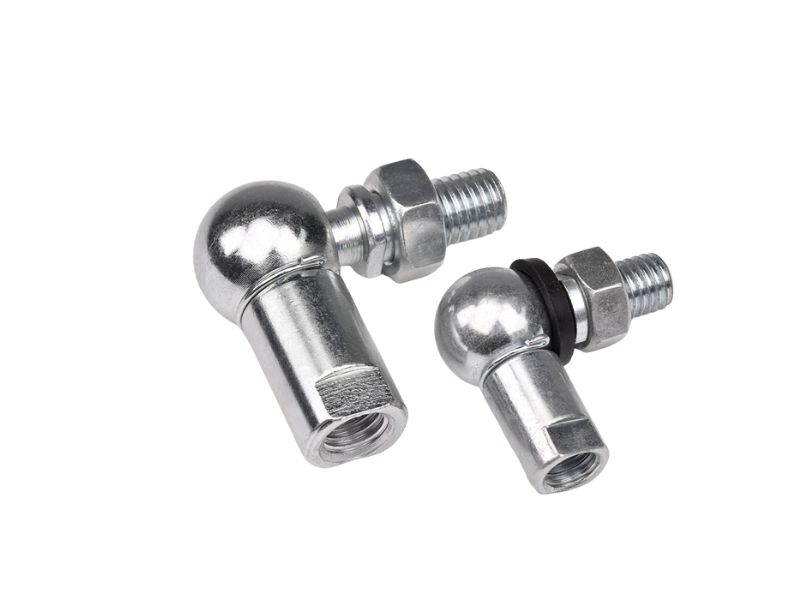
Most stainless ball joints designed for industrial and marine applications use a PTFE liner between the ball and the housing. The liner material is a composite that achieves very low friction at the contact surface while carrying the compressive load from the ball. PTFE-lined joints are rated maintenance-free because the liner itself provides lubrication. The ball doesn’t contact metal. It rides on PTFE.
External grease applied to a PTFE-lined joint does not penetrate the contact interface. The PTFE is already there. The grease pools around the outside of the socket, where it accomplishes nothing protective and collects whatever contamination is present in the environment. In clean environments, this is merely wasteful. In environments with process dust, fine particles, or spray contamination, it is actively counterproductive.
PTFE liners have two real service limits. The first is temperature. Standard PTFE composite liners are rated to approximately 163°C (325°F). Above that, the liner softens, compressive capacity drops, and accelerated wear follows. In high-temperature applications, a metal-on-metal joint with appropriate high-temperature grease is the correct choice over a PTFE-lined joint.
The second limit is compressive load. PTFE fabric liners carry a peak static compressive limit that can reach 275 MPa in specialized grades, but the dynamic limit under cyclic loading is substantially lower, typically in the 70–140 MPa range for standard industrial designs. Operating consistently at the upper end of the dynamic range accelerates liner wear; inspection intervals need to reflect the actual load relative to the liner’s specific dynamic rating, not the peak static figure.
For PTFE-lined stainless ball joints in normal service, the maintenance task is not lubrication. It’s periodic inspection of liner condition and dimensional clearance, particularly in applications with cyclic loading where liner wear rate is meaningful.
PTFE-lined vs metal-on-metal: different maintenance logic entirely
- PTFE-lined joints: maintenance-free by design. External grease doesn’t reach the contact interface. Inspect liner wear and dimensional clearance at scheduled intervals.
- Metal-on-metal stainless joints: require lubrication to prevent galling and manage fretting. Wrong lubricant type or over-greasing in dirty environments introduces abrasive contamination.
- Mismatch: treating a PTFE-lined joint with a metal-on-metal lubrication schedule wastes effort and can introduce contamination.
Metal-on-Metal Stainless: When Grease Helps and When It Doesn’t
Metal-on-metal stainless ball joints do require lubrication. Without it, the galling risk under load is real and the fretting wear rate under oscillatory conditions is substantially higher than in PTFE-lined designs. But lubrication here has a narrower correct specification than most maintenance programs acknowledge.
The lubricant needs to accomplish two things simultaneously: maintain a film between stainless surfaces under contact stress, and not attract and retain abrasive contamination. These requirements sometimes pull against each other.
Heavy, tacky greases retain contamination efficiently. In a clean indoor environment, this isn’t a problem. In a food processing facility with regular washdown, a marine application with seawater splash, or an agricultural setting with fine dust, a high-viscosity grease becomes a contamination sponge over weeks. The result is exactly the abrasive paste problem described earlier.
Over-greasing compounds this. When more grease is applied than the joint can retain at the contact interface, the excess sits on external surfaces where it is exposed to the environment. More grease does not improve the film at the ball-race contact. It increases the contamination trap area.
The grease type matters as much as the quantity. For metal-on-metal stainless, PTFE-based greases work well because they maintain film integrity under high contact stress without the tackiness of petroleum-based compounds. Molybdenum disulfide (MoS2) dry film lubricants are effective in applications where grease would attract contamination but the interface still requires protection against galling. One caveat: MoS2's sulfur content raises corrosion risk when paired with stainless in wet, chloride-rich conditions, particularly at elevated temperature and contact pressure, which is a documented cause of sulfur-induced stress corrosion in stainless and nickel alloys. In those environments, graphite-based or specialized PTFE dry films are the safer choice.
What to avoid: silicone greases have poor load-carrying capacity under the contact stresses typical in metal-on-metal ball joints and are not appropriate for galling prevention. Petroleum-based greases are incompatible with food-grade applications (NSF H1 or H2 lubricants are the appropriate specification there). Mixing lubricant types without cleaning the joint first can produce incompatible combinations that separate under heat and leave uneven coverage.
The Correct Maintenance Protocol
Before setting any interval, identify which type of joint is in service and what failure mode it’s actually susceptible to. The table below frames the decision.
| Joint Type | Primary Failure Mode | Lubrication Needed? | Recommended Lubricant | Inspection Focus |
|---|---|---|---|---|
| PTFE-lined stainless (standard service) | Liner wear, compressive fatigue | No | None required | Liner thickness, articulation clearance |
| PTFE-lined stainless (high cycle) | Accelerated liner wear | No | None required | Dimensional wear rate vs cycle count |
| Metal-on-metal stainless (clean environment) | Galling, fretting under oscillation | Yes | PTFE-based grease | Surface condition, articulation resistance |
| Metal-on-metal stainless (dirty/wet environment) | Abrasion from contaminated grease | Yes (limited) | PTFE dry film or graphite (marine); MoS2 in dry-dirty only | Contamination in socket, surface scoring |
| Metal-on-metal stainless (food-grade) | Galling, regulatory compliance | Yes | NSF H1 food-safe grease | Lubricant condition, re-lube interval |
| Metal-on-metal stainless (high temperature) | Fretting, oxidation above PTFE range | Yes | High-temp MoS2 or graphite-based | Surface discoloration, articulation |
Two practical additions that most maintenance programs skip:
Clean before re-lubricating. Applying fresh grease over contaminated grease in a metal-on-metal joint doesn’t flush the old material. It dilutes it, but the abrasive particles are still there. In applications where contamination is expected, the correct procedure is to flush the socket before re-packing. In practice, this is rarely done, which is why re-greasing on a schedule in dirty environments often extends joint life by less than expected.
Check articulation resistance, not just the presence of lubrication. A joint can be well-greased and still be developing the early stages of galling or fretting damage. A simple hand check of articulation resistance at each inspection, comparing against baseline, catches progressive stiffening before it becomes a seized joint. The grease nipple being full is not a health indicator.
Getting the Design Right Before Maintenance Starts
The most effective maintenance insight for stainless ball joints is upstream of the maintenance schedule entirely: if the application specifies the correct joint type from the start, the maintenance burden drops significantly.
PTFE-lined stainless ball joints eliminate the galling risk, reduce fretting by removing metal-on-metal contact, and require no lubrication schedule. They cost more than equivalent metal-on-metal joints. In any application where contamination is present, access is difficult, or lubrication consistency is hard to guarantee, they reduce total lifecycle cost by removing the failure modes that maintenance schedules exist to manage.
For applications where high temperature, extreme load, or other constraints make PTFE liners unsuitable, metal-on-metal stainless joints with a clearly specified lubricant type, application quantity, and inspection interval outperform the same joints managed with an ad-hoc “grease when you remember to” approach.
Lubrication matters in stainless ball joints. It’s just not the primary variable. For PTFE-lined joints it’s not a variable at all. For metal-on-metal designs, the lubricant type matters more than the quantity, and the maintenance interval matters less than confirming the joint is actually performing the way it should.
Profab Machine manufactures precision stainless steel ball joints in both PTFE-lined and metal-on-metal configurations, in 316, 316L, and 2205 duplex, machined to DIN ISO 12240-4 and custom drawings. For applications where the correct joint specification matters as much as the maintenance plan, our stainless steel ball joint range covers standard and custom configurations with documented design parameters.