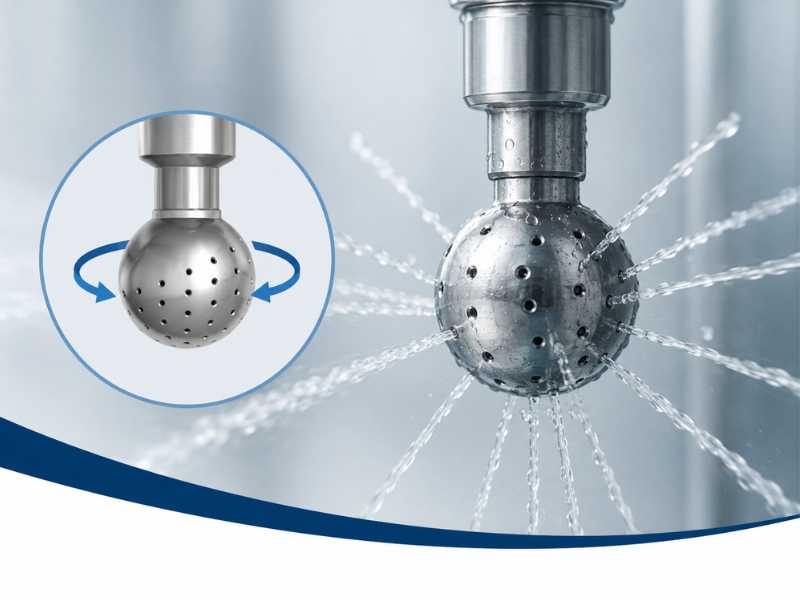
A static spray ball that's clogged at least tells you what's wrong. A rotary spray ball that won't spin is harder to read. Water is flowing, the tank is getting wet, and from outside the vessel everything looks fine. But nothing is rotating, which means your cleaning solution is hitting the same strip of tank wall on every cycle instead of sweeping the interior.
Flow Rate Below the Rotation Threshold
Rotary spray balls are not pressure-driven in the way people assume. They spin because the reactive force of fluid exiting the orifices at an angle generates a torque on the ball body. That torque only exceeds the internal friction and starts rotation when the flow rate through the device reaches a minimum threshold. Below that threshold, the fluid exits the orifices fine, the tank gets wet, and nothing rotates.
This is the most common cause of non-rotation and the one most often misdiagnosed as a pressure problem. Pressure and flow are related but not the same thing. You can run a rotary spray ball at high inlet pressure with a pump that's too small for the line diameter and still not achieve rotation, because the flow rate at the ball inlet is insufficient even if the pressure gauge reads correctly.
As CIP system design guidance notes, rotating spray devices typically need roughly 1.5 to 2 GPM per foot of vessel circumference to achieve reliable rotation, well below the 2.5 to 3 GPM per foot a static spray ball needs for the same coverage. A 1-meter-diameter tank has a circumference of roughly 3.14 meters (about 10.3 feet), which puts the minimum flow requirement in the 15 to 20 GPM range for that vessel. If your CIP pump is undersized for the line or the pump curve drops off at the operating point, this threshold may never be reached.
The check: measure actual flow at the spray ball inlet during a live cleaning cycle, not at the pump outlet. Pipe friction losses, strainers, valves, and elevation all reduce the flow available at the device relative to what the pump is nominally delivering.
Operating Outside the Pressure Window
Every rotary spray ball has an operating pressure range, not just a minimum. Too low, and the orifice exit velocity is insufficient to generate rotation torque. Too high and the fluid dynamics change in a way that can actually reduce the angular force rather than increase it, because the spray stream becomes more turbulent and dispersed rather than a focused reactive jet.
The principle behind this matters. As Spray.com's vessel cleaning engineering guide documents, doubling flow rate increases cleaning impact by up to 100%, while doubling pressure only yields about 40% more impact. While rotary spray balls primarily clean via cascading liquid film rather than high-impact jets, this rule still highlights why cranking up pump pressure is solving the wrong variable. Excessive pressure often atomizes the fluid and disrupts the driving torque, making the rotation issue worse at the orifice level.
Most sanitary rotary spray balls are designed to operate between 1 and 5 bar (15–72 PSI) at the inlet. Below 1 bar, rotation is inconsistent. Above 5 bar on a device not rated for it, joint integrity and orifice wear become issues that compound the rotation problem. Check the manufacturer's datasheet for the specific model in your system. The pressure range on the spec sheet is not a suggestion.
The Orifice Geometry Controls the Drive Force
Most troubleshooting guides skip this entirely, yet it's what separates a device that rotates reliably from one that barely moves under identical system conditions.
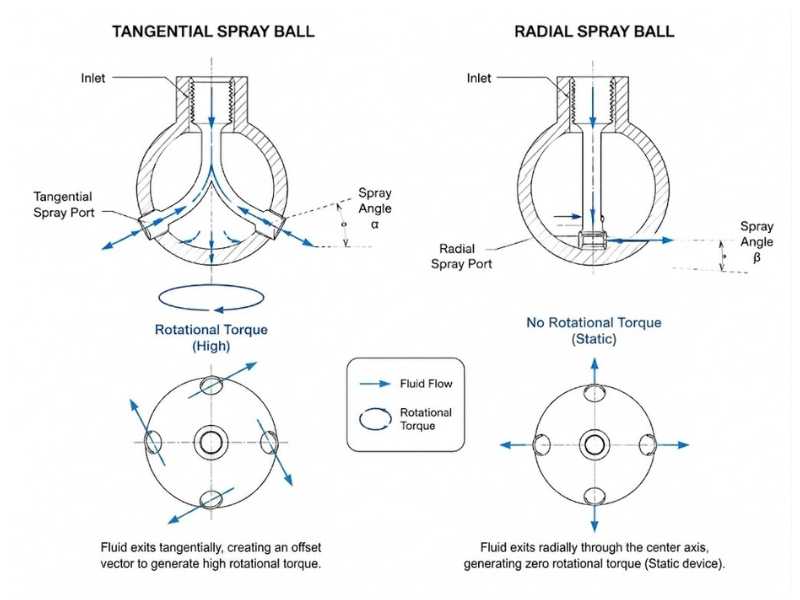
Rotary spray balls spin because their orifices are angled tangentially relative to the ball's axis of rotation, not radially. Fluid exiting at a tangential angle imparts a reactive torque. Fluid exiting radially produces nothing. The angle of the orifice, the number of orifices, and the diameter of each one together determine how much torque the ball generates at a given flow rate.
A ball with small, closely spaced orifices angled at a shallow tangential offset generates less drive torque than one with fewer, larger orifices angled more aggressively, even at identical total flow. This is why you can't substitute one rotary ball model for another in an existing system without rechecking flow requirements. Same pump, same line, same pressure, same tank can produce reliable rotation with one model and near-zero rotation with another, purely because the orifice geometry differs.
If you've verified flow and pressure and the ball still won't rotate, check whether the installed device actually matches the system's flow specification. A ball designed for a larger tank will stall in a lower-flow system.
Why Cheap Rotary Spray Balls Stop Rotating
There's a practical reason why rotary spray balls show a wide price range for what looks like the same component.
The dynamic joint is the critical moving interface. In a sanitary CIP environment, it is regularly exposed to caustic cleaning agents at 60–80°C, followed by acid rinses and thermal shock from cold water. To maintain 3-A sanitary compliance, high-quality devices avoid standard roller bearings that can trap bacteria and process residue. Instead, they rely on precision-machined sliding sleeves made of high-grade PTFE, PEEK, or silicon carbide, using the CIP fluid itself for hydrodynamic lubrication.
Economy rotary balls frequently use poorly toleranced stainless steel dynamic joints or low-grade polymers. Under hot, highly alkaline conditions, these materials degrade, score, or gall. Once surface roughness increases, the friction coefficient rises, the rotation threshold climbs, and a ball that spun reliably at 30 GPM now needs 50 GPM to turn. Eventually, it stalls completely while looking undamaged from the outside.
This is the failure mode users report as "the ball just stopped spinning one day", except it didn't happen overnight. It degraded over months. If your ball spun when new and stopped rotating gradually, pull the device and spin it by hand with no flow. A healthy device turns with zero resistance, while a degraded one will feel rough, sticky, or dragged.
Blocked Orifices: Check This First
Before working through the above, check the orifices for blockage. A partially blocked orifice reduces the flow through that nozzle, shifts the thrust balance across the ball, and can stop rotation even when flow and pressure are within range. CIP systems that process high-sugar products, dairy with protein residue, or mineral-heavy process water all deposit material in orifices over time. The orifice diameters on a rotary spray ball are typically 1–3 mm. It doesn't take much to partially block one.
Remove the ball and inspect each orifice under light. Flush with clean water in reverse flow direction if blockage is present. Check whether the CIP supply line has an upstream strainer sized to prevent particles larger than the smallest orifice from reaching the device. A missing or bypassed strainer is the most common reason orifices block repeatedly after cleaning.
Rotation Confirmed, Coverage Still Poor
If the ball is rotating but cleaning validation still fails, the issue shifts from mechanical to hydraulic. The flow rate may be above the rotation threshold but below the coverage threshold, or shadow zones inside the tank are blocking spray from reaching specific surfaces. That's a spray ball coverage test problem rather than a rotation problem, and it needs to be diagnosed separately.
Conclusion
A rotary spray ball that won't turn is a flow problem, a pressure problem, a geometry mismatch, or a worn dynamic joint. Rotating but still failing coverage validation is a different, separate problem. Diagnose in that order, starting with actual measured flow at the device inlet, not the number on the pump spec sheet.
Profab Machine manufactures stainless steel spray balls in static and rotary configurations for food, beverage, and pharmaceutical tank cleaning, in 316L with seal options matched to your CIP chemistry. If your rotary spray ball is failing to rotate and the cause isn't clear from standard troubleshooting, the device specification can be reviewed against your actual system flow and pressure.