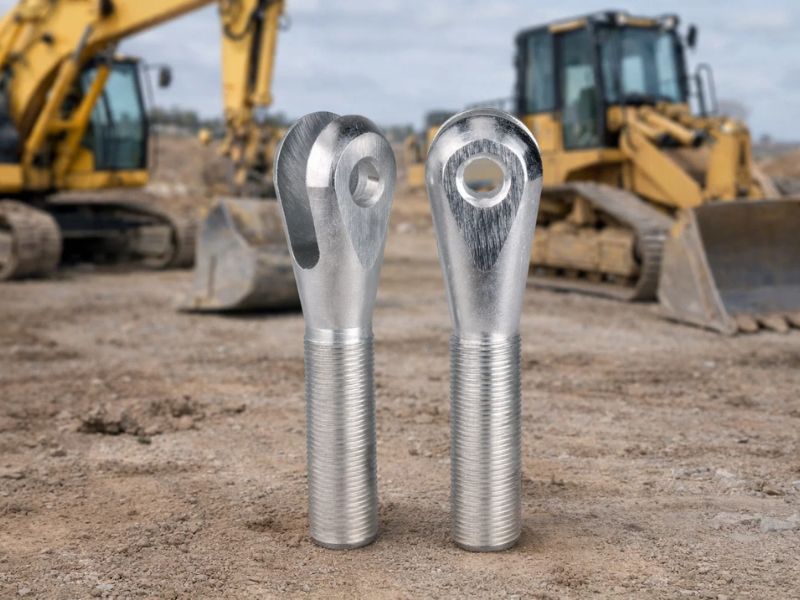
Specifying a clevis rod end for an excavator boom link or a loader arm usually starts and ends with one number: the working load. That's not wrong, but it's incomplete. A rod end carries two different ratings, gets its real-world capacity reduced by how it's mounted, and depends on a pin material choice that most spec sheets gloss over. Get any of those three wrong and the joint can fail well under its printed rating.
Static Load Rating and Dynamic Load Rating Are Not the Same Number
Every rod end has two published capacities, and construction machinery specs frequently only quote one of them.
The static load rating (often written C0r) is the load the joint can carry at rest, or under very slow, occasional movement, without permanent deformation at its weakest point — usually the housing bore or the ball. It's a one-time-load number, not a fatigue number.
The dynamic load rating (Cr) is different. It's tied to a fatigue life convention: the load at which a large population of identical rod ends reaches roughly one million cycles of oscillation before a defined percentage start failing from surface fatigue. Construction equipment linkages — boom pivots, bucket links, stabilizer arms — see constant oscillating load, which means the dynamic rating, not the static one, is almost always the number that actually governs the part's service life.
Specifying against the static rating alone, because it's the bigger, more reassuring number on the datasheet, is a common and avoidable mistake.
Safety Factor Isn't a Fixed Number — It Depends on How Rough the Duty Cycle Is
Bearing and rod-end manufacturers don't publish one safety factor. They publish a range, and the right value depends on how smooth or shock-loaded the application actually is.
For smooth, low-vibration service, a safety factor in the 1.5 to 2 range against the static rating is standard practice. For applications with real shock loading — and a bucket hitting a rock pile, or an attachment slamming into a load stop, both qualify — manufacturers commonly recommend pushing that factor up toward 5 or 6. The joint isn't just carrying the working load anymore; it's carrying working load plus an impact spike that a lighter safety factor doesn't have margin for.
This is where a lot of construction-machinery rod-end failures actually originate: not from underrating the working load, but from applying a smooth-duty safety factor to a shock-duty application.
Installation Misalignment Doesn't Just Look Wrong — It Loads the Joint Differently
A clevis rod end is rated assuming the load runs straight through its centerline. Mount the clevis even slightly out of alignment, and the joint stops seeing pure axial or radial load. It starts seeing a side-load component that the rating never accounted for.
That side load concentrates stress unevenly across the pin and bore instead of spreading it the way the rated capacity assumes. On a pin-and-clevis joint under cyclic load, that uneven stress is exactly the kind of condition that accelerates fatigue crack initiation at the bore edge — the same failure mechanism that governs the dynamic rating in the first place, just showing up sooner than the rating predicts. This is also why the bracket and mounting geometry, not just the rod end itself, belong in the load-capacity conversation: an out-of-true bracket can quietly erase the safety margin a correctly-rated rod end was supposed to provide.
Single Shear vs Double Shear Changes What the Pin Can Carry
How the clevis captures the load matters as much as the rod end's own rating. A double-shear mount — where the eye sits between two bracket faces and the pin is supported at both ends — puts the pin in shear at two planes instead of one, and carries roughly twice the lateral load of the same pin in single shear before reaching its shear limit. Single shear also loads the pin with a bending moment that double shear mostly eliminates, since neither end is free to rotate under load.
For a given pin diameter and working load, double shear buys real margin. It's a mounting decision, not a rod-end spec, but it changes what capacity the same part can actually deliver in service.
Pin Material Sets a Ceiling the Rod End Can't Exceed
The rod end's rating only means something if the pin running through it can carry that load. 42CrMo (the chromoly grade more commonly specified in North America as 4140) is the standard choice for heavy-duty clevis pins because of its combination of hardenability and fatigue resistance: in the quenched-and-tempered condition, its tensile strength typically runs in the 930 to 1080 MPa range, well above lower-alloy grades like 40Cr, which is why it holds up better under the cyclic bending and shear a construction-machinery linkage puts on a pin.
Surface hardening matters too. Induction-hardened pins typically land in the HRC 50 to 55 range at the wear surface, which resists the gouging and galling that an unhardened pin develops against a bronze or steel bushing under repeated articulation — while keeping a tougher core than a through-hardened pin would have, so the pin doesn't turn brittle under shock load.
Putting the Selection Together
None of these factors work in isolation. A rod end sized against the correct dynamic rating, with a safety factor that matches the actual duty cycle, mounted in double shear where geometry allows, installed in true alignment, and running on a properly hardened 42CrMo pin will carry meaningfully more real-world load than the same part spec'd against the static rating alone with a smooth-duty safety factor and a pin that was an afterthought.
Profab Machine machines stainless steel clevis rod ends and rod end assemblies to the tolerances and pin fits that heavy-equipment linkages need, with material certification available for the pin and housing alloys specified. If you're sizing a joint for a shock-loaded application and aren't sure which safety factor actually applies, send the load case and duty cycle for a direct review before the part gets cut.